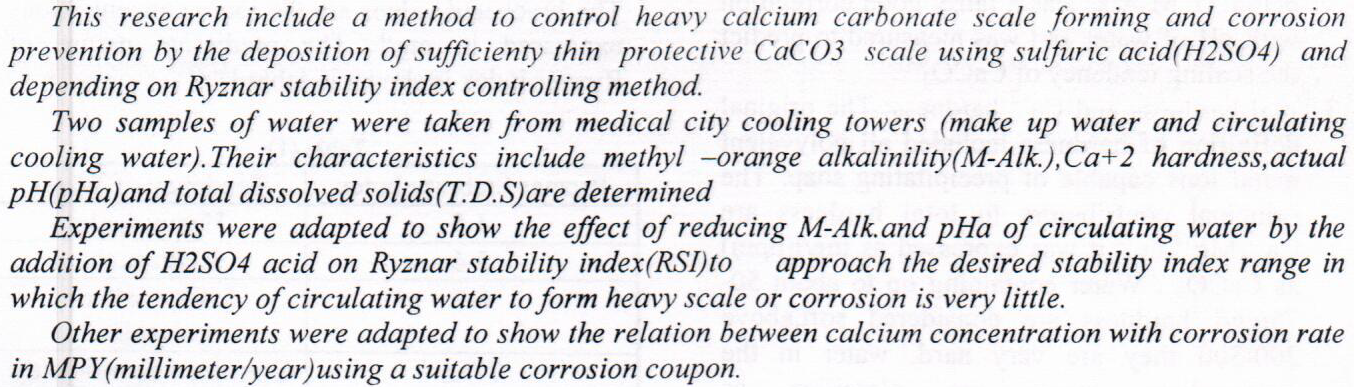
Control of Calcium Scale and Corrosion of Medical City Cooling Water System using Sulfuric Acid

<span lang="EN-US">Increase the in population and kindergarten number, especially in urban areas made it difficult to properly manage waste. Thus, this paper proposed a system dedicated to kindergartens to manage to dispose of waste, the system can be called smart garbage based on internet of things (SGI). To ensure a healthy environment and an intelligent waste in the kindergarten management system in an integrated manner and supported by the internet of things (IoT), we presented it in detail identification, the SGI system includes details like a display system, an automatic lid system, and a communication system. This system supplied capabilities to monitor the status of waste continuously and on IoT website can show the pe
... Show More (5)
(5)
 (1)
(1)


An assembled pulsed Nd:YAG laser-robot system for spot welding similar and dissimilar metals is presented in this paper. The study evaluates the performance of this system through investigating the possibility and accuracy of executing laser spot welding of 0.2 mm in thickness stainless steel grade AISI302 to 0.5 mm in thickness low carbon steel grade AISI1008. The influence of laser beam parameters (peak power, pulse energy, pulse duration, repetition rate, and focal plane position on the final gained best results are evaluated. Enhancement of the experimental results was carried by a computational simulation using ANSYS FLUENT 6.3 package code.
(5)
(7)

Solar energy is one of the immeasurable renewable energy in power generation for a green, clean and healthier environment. The silicon-layer solar panels absorb sun energy and converts it into electricity by off-grid inverter. Electricity is transferred either from this inverter or from transformer, consumed by consumption unit(s) available for residential or economic purposes. The artificial neural network is the foundation of artificial intelligence and solves many complex problems which are difficult by statistical methods or by humans. In view of this, the purpose of this work is to assess the performance of the Solar - Transformer - Consumption (STC) system. The system may be in complete breakdown situation due to failure of both so
... Show More
(10)
(5)
A load-shedding controller suitable for small to medium size loads is designed and implemented based on preprogrammed priorities and power consumption for individual loads. The main controller decides if a particular load can be switched ON or not according to the amount of available power generation, load consumption and loads priorities. When themaximum allowed power consumption is reached and the user want to deliver power to additional load, the controller will decide if this particular load should be denied receiving power if its priority is low. Otherwise, it can be granted to receive power if its priority is high and in this case lower priority loads are automatically switched OFF in order not to overload the power generation. The
... Show MoreAbstract
Electric arc furnace applications in industry are related to position system of its pole, up and down of pole. The pole should be set the certain gap. These setting are needed to calibrate. It is done manually. In this research will proposed smart hydraulic to make this pole works as intelligent using proportional directional control valve. The output of this research will develop and improve the working of the electric arc furnace. This research requires study and design of the system to achieve the purpose and representation using Automation Studio software (AS), in addition to mathematically analyzed and where they were building a laboratory device similar to the design and conduct experiments to stud
... Show MoreIn this paper, a fixed point theorem of nonexpansive mapping is established to study the existence and sufficient conditions for the controllability of nonlinear fractional control systems in reflexive Banach spaces. The result so obtained have been modified and developed in arbitrary space having Opial’s condition by using fixed point theorem deals with nonexpansive mapping defined on a set has normal structure. An application is provided to show the effectiveness of the obtained result.
(2)
(7)