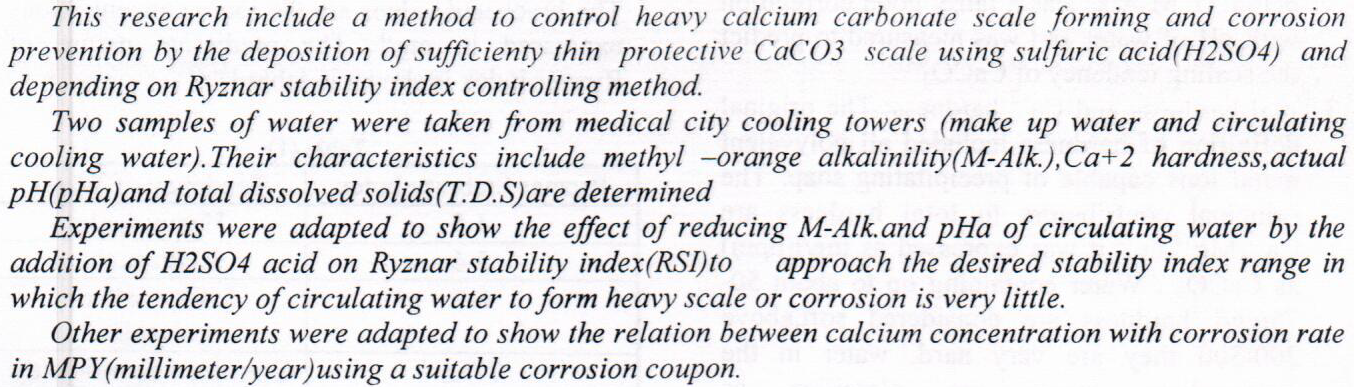
Control of Calcium Scale and Corrosion of Medical City Cooling Water System using Sulfuric Acid

Bipedal robotic mechanisms are unstable due to the unilateral contact passive joint between the sole and the ground. Hierarchical control layers are crucial for creating walking patterns, stabilizing locomotion, and ensuring correct angular trajectories for bipedal joints due to the system’s various degrees of freedom. This work provides a hierarchical control scheme for a bipedal robot that focuses on balance (stabilization) and low-level tracking control while considering flexible joints. The stabilization control method uses the Newton–Euler formulation to establish a mathematical relationship between the zero-moment point (ZMP) and the center of mass (COM), resulting in highly nonlinear and coupled dynamic equations. Adaptiv
... Show More (5)
(5)
 (3)
(3)



This study was aimed to isolate and identify Saccharomyces boulardii from Mangosteen fruits (Garcinia mangostana L.) by traditional and molecular identification methods To get safe and healthy foods probiotics for use, The isolates and two commercial strains were subjected to cultural, morphological and biochemical tests, The colonies of the isolates were spherical, smooth, mucoidal, dull and white to cream colour on SD agar media .The shape of cells was globose to ovoid and sometimes with budding, in a single form or clustered like a beehive. The isolates and two commercial strains were unable to metabolized galactose and lactose , Results shows that all isolates were unable to utilize potassium nitrate and not grow in the presence of (
... Show MoreThe normalized difference vegetation index (NDVI) is an effective graphical indicator that can be used to analyze remote sensing measurements using a space platform, in order to investigate the trend of the live green vegetation in the observed target. In this research, the change detection of vegetation in Babylon city was done by tracing the NDVI factor for temporal Landsat satellite images. These images were used and utilized in two different terms: in March 19th in 2015 and March 5th in 2020. The Arc-GIS program ver. 10.7 was adopted to analyze the collected data. The final results indicate a spatial variation in the (NDVI), where it increases from (1666.91 𝑘𝑚2) in 2015 to (1697.01 𝑘𝑚2)) in 2020 between the t
... Show More
Interface evaluation has been the subject of extensive study and research in human-computer interaction (HCI). It is a crucial tool for promoting the idea that user engagement with computers should resemble casual conversations and interactions between individuals, according to specialists in the field. Researchers in the HCI field initially focused on making various computer interfaces more usable, thus improving the user experience. This study's objectives were to evaluate and enhance the user interface of the University of Baghdad's implementation of an online academic management system using the effectiveness, time-based efficiency, and satisfaction rates that comply with the task questionnaire process. We made a variety of interfaces f
... Show More
Laser is a powerful device that has a wide range of applications in fields ranging from materials science and manufacturing to medicine and fibre optic communications. One remarkable
One of the most important problems of IRAQI HEALTH MINISTRY and all healthy instruments in IRAQ is Chronic Diseases because it have a negative effects on IRAQI population, this is the aim of our study ,to specify the important Chronic diseases which make the population fell weakly, they are six diseases as the IRAQ ministry of health specified ( Diabetes, blood pressure diseases ,Brain diseases , Cardiology, Asthma, epilepsy) we got these data from IRAQI HEALTH MINISTRY ,bureau of planning and studies ,for the period 2009-2012,as monthly observations , represent sum of peoples have chronic diseases in Baghdad .
Our research obj
... Show More
(4)
(3)
In this paper Heun method has been used to find numerical solution for first order nonlinear functional differential equation. Moreover, this method has been modified in order to treat system of nonlinear functional differential equations .two numerical examples are given for conciliated the results of this method.