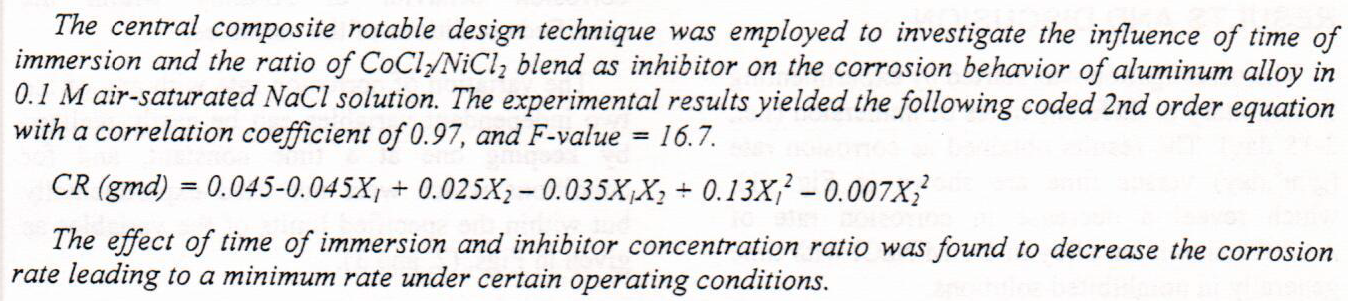
The Optimal Corrosion Inhibition of Aluminum in 0.1M NaCl Solution

In this work, the finite element analysis of moving coordinates has been used to study the thermal behavior of the tissue subjected to both continuous wave and pulsed CO2 laser. The results are compared with previously published data, and a good agreement has been found, which verifies the implemented theory. Some conclusions are obtained; As pulse width decreases, or repetition rate increases, or fluence increases then the char depth is decreased which can be explained by an increase in induced energy or its rate, which increases the ablation rate, leading to a decrease in char depth. Thus: An increase in the fluence or decreasing pulse width or increasing repetition rate will increase ablation rate, which will increase the depth of cut
... Show MoreThe inhibition of mild steel corrosion in 1.0M HCl by 1-propanol and the synergistic effect of potassium iodide (KI) was investigated using weight loss and polarization techniques in the temperature range (30 ‒ 50) ̊ C. A matrix of Doelhert to three factors was used as the experimental design, adopting weight loss results as it permits the use of the response surface methodology which exploited in determination of the synergistic effect as inhibition on the mild steel. The results were confirmed using electrochemical polarization measurements. Experimental results showed that the inhibition efficiency (IE%) increases with increase in concentration of inhibitor and with increasing of temperature. The addition iodide ions t
... Show MoreThis paper introduces a non-conventional approach with multi-dimensional random sampling to solve a cocaine abuse model with statistical probability. The mean Latin hypercube finite difference (MLHFD) method is proposed for the first time via hybrid integration of the classical numerical finite difference (FD) formula with Latin hypercube sampling (LHS) technique to create a random distribution for the model parameters which are dependent on time t . The LHS technique gives advantage to MLHFD method to produce fast variation of the parameters’ values via number of multidimensional simulations (100, 1000 and 5000). The generated Latin hypercube sample which is random or non-deterministic in nature is further integrated with the FD method t
... Show More (4)
(4)
 (1)
(1)



The main objective of this research is to use the methods of calculus ???????? solving integral equations Altbataah When McCann slowdown is a function of time as the integral equation used in this research is a kind of Volterra
KE Sharquie, AA Khorsheed, AA Al-Nuaimy, Saudi Medical Journal, 2007 - Cited by 91
The Multiple Signal Classification (MUSIC) algorithm is the most popular algorithm to estimate the Angle of Arrival (AOA) of the received signals. The analysis of this algorithm (MUSIC) with typical array antenna element ( ) shows that there are two false direction indication in the plan
aligned with the axis of the array. In this paper a suggested modification on array system is proposed by using two perpendiculars crossed dipole array antenna in spite of one array antenna. The suggested modification does not affect the AOA estimation algorithm. The simulation and results shows that the proposed solution overcomes the MUSIC problem without any effect on the performance of the system.
The exploitation of obsolete recyclable resources including paper waste has the advantages of saving resources and environment protection. This study has been conducted to study utilizing paper waste to adsorb phenol which is one of the harmful organic compound byproducts deposited in the environment. The influence of different agitation methods, pH of the solution (3-11), initial phenol concentration (30-120ppm), adsorbent dose (0.5-2.5 g) and contact time (30-150 min) were studied. The highest phenol removal efficiency obtained was 86% with an adsorption capacity of 5.1 mg /g at optimization conditions (pH of 9, initial phenol concentration of 30 mg/L, an adsorbent dose of 2 g and contact time of 120min and at room temperature).
... Show More
(6)
AG Al-Ghazzi, 2009
In this paper, Min-Max composition fuzzy relation equation are studied. This study is a generalization of the works of Ohsato and Sekigushi. The conditions for the existence of solutions are studied, then the resolution of equations is discussed.
In this paper, author’s study sub diffusion bio heat transfer model and developed explicit finite difference scheme for time fractional sub diffusion bio heat transfer equation by using caputo fabrizio fractional derivative. Also discussed conditional stability and convergence of developed scheme. Furthermore numerical solution of time fractional sub diffusion bio heat transfer equation is obtained and it is represented graphically by Python.
(3)
(1)