The Optimal Corrosion Inhibition of Aluminum in 0.1M NaCl Solution
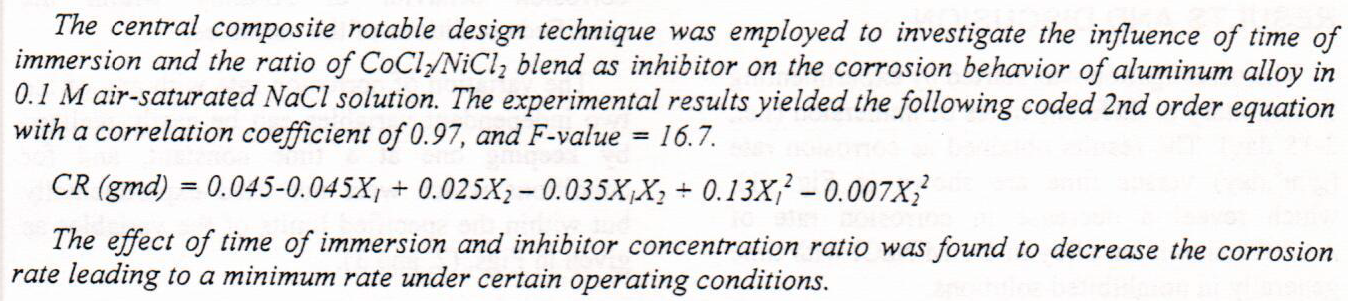

 (1)
(1)


The ability to inhibit corrosion of low carbon steel in a salt solution (3.5%NaCl) has been checked with three real expired drugs (Cloxacillin, Amoxicillin, Ceflaxin) with variable concentrations (0, 250, 500, 750) mg/L were examined in the weight loss. The inhibition efficiency of the Cloxacillin 750 mg/L showed the highest value (82.8125 %) and the best inhibitor of the rest of the antibiotics. The different concentrations of Cloxacillin drug (0, 250, 500, 750) mg/L and temperature (25, 35, 45, 55) oC were studied as variables with potentiodynamic polarization, Scanning Electron Microscopy (SEM) for surface morphology and electrochemical impedance spectroscopy (EIS) depending on current values and the resistance of charge to
... Show More (3)
(2)
(3)
(2)
<p>Daftardar Gejji and Hossein Jafari have proposed a new iterative method for solving many of the linear and nonlinear equations namely (DJM). This method proved already the effectiveness in solved many of the ordinary differential equations, partial differential equations and integral equations. The main aim from this paper is to propose the Daftardar-Jafari method (DJM) to solve the Duffing equations and to find the exact solution and numerical solutions. The proposed (DJM) is very effective and reliable, and the solution is obtained in the series form with easily computed components. The software used for the calculations in this study was MATHEMATICA<sup>®</sup> 9.0.</p>
(17)
The turning process has various factors, which affecting machinability and should be investigated. These are surface roughness, tool life, power consumption, cutting temperature, machining force components, tool wear, and chip thickness ratio. These factors made the process nonlinear and complicated. This work aims to build neural network models to correlate the cutting parameters, namely cutting speed, depth of cut and feed rate, to the machining force and chip thickness ratio. The turning process was performed on high strength aluminum alloy 7075-T6. Three radial basis neural networks are constructed for cutting force, passive force, and feed force. In addition, a radial basis network is constructed to model the chip thickness ratio. T
... Show More
(3)
In this work, the effect of aluminum (Al) dust particles on the DC discharge plasma properties in argon was investigated. A magnetron is placed behind the cathode at different pressures and with varying amounts of Al. The plasma temperature (Te) and density (ne) were calculated using the Boltzmann equation and Stark broadening phenomena, which are considered the most important plasma variables through which the other plasma parameters were calculated. The measurements showed that the emission intensity decreases with increasing pressure from 0.06 to 0.4 Torr, and it slightly decreases with the addition of the NPs. The calculations showed that the ne increased and Te decreased with pressure. Both Te and ne were reduced by increasing
... Show More
(25)
The nanostructured MnO2 /carbon fiber (CF) composite electrode was prepared using the anodic electrodeposition process. The crystal structure and morphology of MnO2 particles were determined with X-ray diffraction and field-emission scanning electron microscopy. The electrosorptive properties of the prepared electrode were investigated in the removal of cadmium ions from aqueous solution, and the effect of pH, cell voltage, and ionic strength was optimized and modeled using the response surface methodology combined with Box–Behnken design. The results confirm that the optimum conditions to remove Cd(II) ions were: pH of 6.03, a voltage of 2.77 V, and NaCl concentration of 3 g/L. The experimental results showed a good fit for the Freundli
... Show More
(4)
(2)

The effective insulation design of the stress grading (SG) system in form-wound stator coils is essential for preventing partial discharges and excessive heat generation under pulse-width modulation excitation. This paper proposes a method to find the optimal insulation design of the SG system aimed at reducing the dielectric and thermal stresses in the machine coil. The non-uniform transmission line model is used to predict the voltage propagation along the overhang, SG, and slot regions considering the variation in the physical properties of the insulation layers. The machine coil parameters for different insulation materials are calculated by using the finite element method. Two optimization algorithms, fmincon and particle swarm optimiz
... Show More
(1)
An effort is made to study the effect of composite nanocoating using aluminum-9%wt silicon alloys reinforced with different percentage (0.5,1,2,4)wt.% of carbon nanotubes (CNTs) using plasma spraying. The effect of this composite on corrosion behavior for AA6061-T6 by extrapolation Tafel test in sea water 3.5wt% NaCl was invested. Many specimens where prepared from AA6061-T6 by the dimension (15x15x3)mm as this first set up and other steps include coating process, X-ray diffraction and SEM examination .The results show the CNTs increase the corrosion rate of the nanocomposite coatings with increasing the weight percentage of CNTs within the Al-Si matrix. Al-9wt%Si coating layer itself has less corrosion rate if compared with both n
... Show More
(2)