The Optimal Corrosion Inhibition of Aluminum in 0.1M NaCl Solution
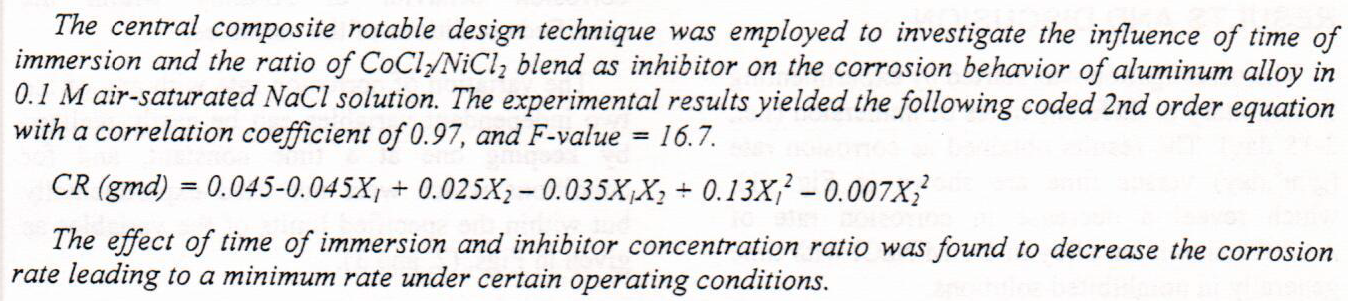

In this article, we design an optimal neural network based on new LM training algorithm. The traditional algorithm of LM required high memory, storage and computational overhead because of it required the updated of Hessian approximations in each iteration. The suggested design implemented to converts the original problem into a minimization problem using feed forward type to solve non-linear 3D - PDEs. Also, optimal design is obtained by computing the parameters of learning with highly precise. Examples are provided to portray the efficiency and applicability of this technique. Comparisons with other designs are also conducted to demonstrate the accuracy of the proposed design.
 (4)
(4)
 (2)
(2)



The research aims to achieve proof of convergence between optimal costs and standard costs in calculating costs for the economic unit, support efforts aimed at adopting optimal costs in cost accounts and accounting thought in general, and achieve benefit from the theory of convergence between optimal costs and standard costs in the field of achieving actual costs in The economic unit in order to reduce and converge, and this came to address the possibility of adopting the concept of optimal costs in the production costs calculations for the purposes of rationalizing administrative decisions, and rationalizing the preparation of financial statements within management accounting.
The research concluded that
... Show MoreComputer models are used in the study of electrocardiography to provide insight into physiological phenomena that are difficult to measure in the lab or in a clinical environment.
The electrocardiogram is an important tool for the clinician in that it changes characteristically in a number of pathological conditions. Many illnesses can be detected by this measurement. By simulating the electrical activity of the heart one obtains a quantitative relationship between the electrocardiogram and different anomalies.
Because of the inhomogeneous fibrous structure of the heart and the irregular geometries of the body, finite element method is used for studying the electrical properties of the heart.
This work describes t
... Show MoreThe change in the optical band gap and optical activation energy have been investigated for pure Poly (vinyl alcohol)and Poly (vinyl alcohol) doped with Aluminum sulphate to proper films from their optical absorption spectra. The absorption spectra were measured in the wave range from (200-700) nm at temperature range (25-140) 0C. The optical band gap (Eg) for allowed direct transition decrease with increase the concentration of Aluminum sulphate. The optical activation energy for allowed direct transition band gap was evaluated using Urbach- edges method. It was found that ?E increases with increasing the concentration of Al2 (SO4)3 and decreases when temperature increases.
Abstract
The traffic jams taking place in the cities of the Republic of Iraq in general and the province of Diwaniyah especially, causes return to the large numbers of the modern vehicles that have been imported in the last ten years and the lack of omission for old vehicles in the province, resulting in the accumulation of a large number of vehicles that exceed the capacity of the city's streets, all these reasons combined led to traffic congestion clear at the time of the beginning of work in the morning, So researchers chose local area network of the main roads of the province of Diwaniyah, which is considered the most important in terms of traffic congestion, it was identified fuzzy numbers for
... Show More
The study is concern on determine the effect of different temperatures (25, 28, 30 and 370C), and different pH values (4.5, 5.5, 6 and 8) on the radial growth (mm) of 15 dermatophyte isolates (Microsporum canis 7, Trichophyton rubrum 5, Trichophyton mentagropyhtes 3). The specimens for the current study were collected from nail infections in patients with different type of leukemia whom admitted at Baghdad Educational Hospital, 7th floor. The result revels that the optimum temperature for radial growth was 300C then 280C for all isolates, while the optimum pH for all isolates was 6.
In this study, a Hydroxyapatite (HA) coating was prepared on a titanium implant by an electrochemical deposition process. The titanium pre-treatment by anodizing in 1.65 mol/L sulfuric acid with (10V) at room temperature. The deposition was all conducted at a constant voltage of 6.0 V, for 1 h at room temperature. The coatings thus prepared were characterized with Fourier transform infrared spectroscopy (FTIR) and thickness of the coated layer.The electrochemical deposition of HA occurred on the titanium as a cathode. Coated titanium by HA after anodizing revealed a good corrosion protection efficiency even at a temperature ranged (293-323) K in artificial saliva. Activation energy and pre-exponential factor (kinetic parameters) were calcul
... Show More
(14)
In this research is to study the influence of the aging heat treatment on the pitting corrosion resistance of martensitic stainless steel (MSS), where a number of specimens from martensitic stainless steel were subjected to solution treatment at 1100 oC for one hour followed by water quenching then aging in the temperatures range (500-750) oC for different holding times (1,5,10,15&20) hr. Accelerated chemical corrosion test and immersion chemical corrosion test were performed on samples after heat treatment. The results of the research showed that the pitting corrosion resistance is significantly affected by the aging temperature. Where found that the aging samples at a temperature of 500 °C have the highest ra
... Show More
(4)
(2)
(3)