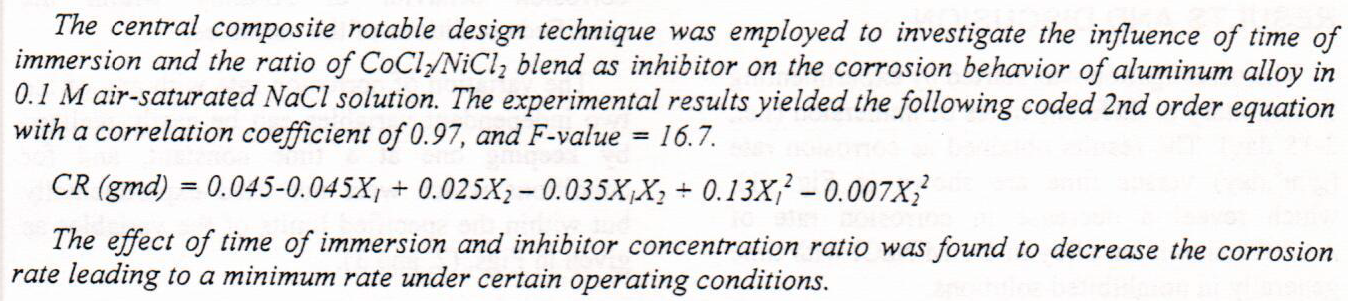
The Optimal Corrosion Inhibition of Aluminum in 0.1M NaCl Solution

In this study many specimen s were prepared from 2024-T3 Aluminum alloy for corrosion test by the dimensions of (15*15*3) mm according to ASTM G71-31 and then subjected to shot peening process at different time (15, 30, 45) minutes using steel ball having a diameter of 2.75 mm and Rockwell Hardness of 55RC to induce compressive residual stress which were measured using X-Ray diffraction method, surface roughness and hardness were tested before and after peening. Electrochemical corrosion test by Tafel extrapolation method was carried out in an environment of 3 .5% NaCl solutions (sea water) where Corrosion rate calculated using Tafle equation.
The obtained results show a favorable influence of SP treatment
... Show MoreAllah legislated marriage and made it dwelling, fellowship and mercy between
the two couples, Prophet Moh'd (peace of Allah and blessing be upon him) ordered a
husband to look after his wife, treat her with full charity and make love with here
every kindly. On the other hand, he ordered a wife to obey her husband and respect
him deeply, nevertheless, some obstacles may sometimes be appeared within the life
of their marriage, this may be caused by either a husband or a wife. This problem is
called lifely disobedience (AL-Noshooz).
In the other words, this means that a wife begins to hate her husband, refuse his orders
and not obey him.
In brief, they hate each other which leads to some marks appear in their
m
 (2)
(2)

This study includes design and synthesis of new non-steroidal anti-inflammatory agents (NSAIDs) with expected cyclooxygenase-2 (COX-2) selective inhibition to achieve better activity and low gastric side effects. Two series of compounds have been designed and synthesized as potential NSAIDs,these are: Salicylamide derivatives (compounds 3,4,5 ) and Diflunisal derivatives (compounds 10&11). In vivo acute anti-inflammatory effect of one of the synthesized agents (compound 3) was evaluated in the rat using egg-white induced paw edema model of inflammation. Preliminary pharmacological study revealed that compound 3 exhibited less anti-inflammatory effect compared to that of aspirin after
... Show More
In this paper, a new third kind Chebyshev wavelets operational matrix of derivative is presented, then the operational matrix of derivative is applied for solving optimal control problems using, third kind Chebyshev wavelets expansions. The proposed method consists of reducing the linear system of optimal control problem into a system of algebraic equations, by expanding the state variables, as a series in terms of third kind Chebyshev wavelets with unknown coefficients. Example to illustrate the effectiveness of the method has been presented.
 (145)
(145)
(145)
(145)


The objective of the current research is to find an optimum design of hybrid laminated moderate thick composite plates with static constraint. The stacking sequence and ply angle is required for optimization to achieve minimum deflection for hybrid laminated composite plates consist of glass and carbon long fibers reinforcements that impeded in epoxy matrix with known plates dimension and loading. The analysis of plate is by adopting the first-order shear deformation theory and using Navier's solution with Genetic Algorithm to approach the current objective. A program written with MATLAB to find best stacking sequence and ply angles that give minimum deflection, and the results comparing with ANSYS.
Heuristic approaches are traditionally applied to find the optimal size and optimal location of Flexible AC Transmission Systems (FACTS) devices in power systems. Genetic Algorithm (GA) technique has been applied to solve power engineering optimization problems giving better results than classical methods. This paper shows the application of GA for optimal sizing and allocation of a Static Compensator (STATCOM) in a power system. STATCOM devices used to increase transmission systems capacity and enhance voltage stability by regulate the voltages at its terminal by controlling the amount of reactive power injected into or absorbed from the power system. IEEE 5-bus standard system is used as an example to illustrate the te
... Show More
(4)
(6)
The survival analysis is one of the modern methods of analysis that is based on the fact that the dependent variable represents time until the event concerned in the study. There are many survival models that deal with the impact of explanatory factors on the likelihood of survival, including the models proposed by the world, David Cox, one of the most important and common models of survival, where it consists of two functions, one of which is a parametric function that does not depend on the survival time and the other a nonparametric function that depends on times of survival, which the Cox model is defined as a semi parametric model, The set of parametric models that depend on the time-to-event distribution parameters such as
... Show More