Gas Holdup in a Bubble Column
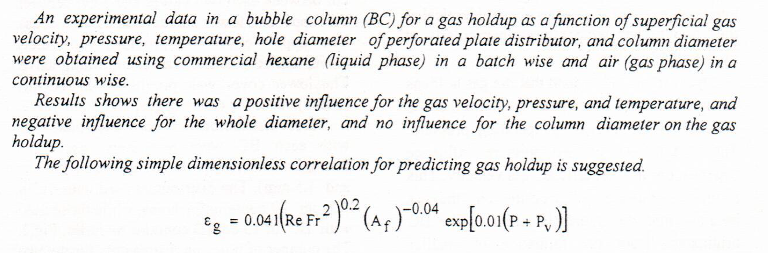

 (2)
(2)

In the present work, a set of indoor Radon concentration measurements was carried out in a number of rooms and buildings of Science College in the University of Mustansiriyah for the first time in Iraq using RAD-7 detector which is an active method for short time measuring compared with the passive method in solid state nuclear track detectors (SSNTD's). The results show that, the Radon concentrations values vary from 9.85±1.7 Bq.m-3 to 94.21±34.7 Bq.m-3 with an average value 53.64±26 Bq.m-3 which is lower than the recommended action level 200-300 Bq/m3 [ICRP, 2009].
The values of the annual effective dose (A.E.D) vary from 0.25 mSv/y to 2.38 mSv/y, with an average value 1.46±0.67 mSv/y which is lower than the recommended the rang
(1)
A method was developed that offers a rapid, simple and accurate technique for the determination of chlorophenols at trace levels in aqueous samples with very limited volumes of organic solvents. These compounds were acetylated, then preliminarily extracted with n-hexane. The enriched chlorophenols were directly analyzed using gas chromatography with an electron-capture detector. The detection limits were in the range of 0.001–0.005 mg/L, except for 2-chlorophenol, which was always above 0.013 mg/L. Relative standard deviation for the spiked water samples ranged from 2.2 to 6.1%, while relative recoveries were in the range of 67.1 to 101.3%.
 (15)
(11)
(15)
(11)

 (13)
(8)
(13)
(8)
In this research the activity of radon gas in air in Baghad governorate,Iraq, using “alpha-emitters track registration (CR-39) track detector were measured. This measurement was done for selected areas from Baghdad Governorate, The results obtained shows that the highest average concentrations for Rn-222 is (179.077 Bq/m^3) which was recorded within Al-Shaaib city and less average concentrations was (15.79 Bq/m^3) in the nearby residential area of Baghdad International Airport and the overall average concentrations is (86.508 Bq/m^3) for these regions. Then the radon concentration was measured annual effective dose calculated from radon concentration and found in range from 0.4031 mSv/y to 4.5179 mSv /y with an average value of 2.1824 m
... Show More
(4)
(1)
Functionalized-multi wall carbon nanotubes (F-MWCNTs) and functionalized-single wall carbon nanotubes (F-SWCNTs) were well enhanced using CoO Nanoparticles. The sensor device consisted of a film of sensitive material (F-MWCNTs/CoONPs) and (F-SWCNTs/CoO NPs) deposited by drop- casting on an n-type porous silicon substrate. The two sensors perform high sensitivity to NO2 gas at room temperatures. The analysis indicated that the (F-MWCNTs/CoONPs) have a better performance than (F-SWCNTs/CoONPs). The F-SWCNTs/CoONPs gas sensor shows high sensitivity (19.1 %) at RT with response time 17 sec, while F-MWCNTs/CoONPs gas sensor show better sensitivity (39 %) at RT with response time 13 sec. The device shows a very reproducible sensor p
... Show More
(6)
In this study, tin oxide (SnO2) and mixed with cadmium oxide (CdO) with concentration ratio of (5, 10, 15, 20)% films were deposited by spray pyrolysis technique onto glass substrates at 300ºC temperature. The structure of the SnO2:CdO mixed films have polycrystalline structure with (110) and (101) preferential orientations. Atomic force microscopy (AFM) show the films are displayed granular structure. It was found that the grain size increases with increasing of mixed concentration ratio. The transmittance in visible and NIR region was estimated for SnO2:CdO mixed films. Direct optical band gap was estimated for SnO2 and SnO2 mixed CdO and show a decrease in the energy gap with increasing mixing ratio. From Hall measurement, it was fou
... Show More
(1)
We prepared polythiophene (PTH) with single wall carbon nanotube (SWCNT) nanocomposite thin films for Nitrogen dioxide (NO2) gas sensing applications. Thin films were synthesized via electrochemical polymerization method onto (Indium tin oxide) ITO coated glass substrate of thiophene monomer with magnesium perchlorate and different concentration from SWCNT (0.012 and 0.016) % in the presence130mL of Acetonitrile used. X-ray diffraction (XRD), Field Emission Scanning Electron microscopy (FE-SEM), Atomic Force Microscope (AFM) and Fourier Transform Infrared Spectroscopy (FT-IR) were used to characterized these nanocomposite thin films. The response of these nanocomposite for NO2 gas was evaluated via monitoring the change
... Show More
(9)
(4)
In this work, fluid catalytic cracking of vacuum gas oil to produce gasoline over prepared faujasite type Y zeolite was investigated using experimental laboratory plant scale of fluidized bed reactor.
The catalytic activity of prepared faujasite type NaY, NaNH4Y and NaHY zeolites was investigated. The cracking process was carried out in the temperature range 440 to 500 oC, weight hourly space velocity (WHSV) range 10 to 25 h-1 ,and atmospheric pressure . The catalytic activities of the prepared faujasite type NaY , NaNH4Y and NaHY zeolites were determined in terms of vacuum gas oil (VGO) conversion, and gasoline yield . The conversion at 500oC and WHSV10 hr-1 by using faujasite type NaY, NaNH4Y and NaHY zeolite were 50.2%, 64.1% and 6