Gas Holdup in a Bubble Column
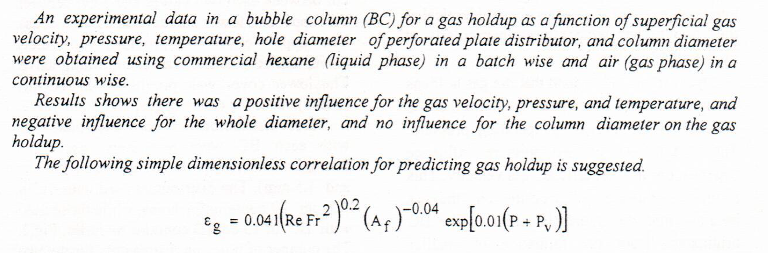

 (7)
(7)

Compounds were prepared from In2O3 doped SnO2 with different doping ratio by mixing and sintering at 1000oC. Pulsed Laser Deposition PLD was used to deposit thin films of different doping ratio In2O3: SnO2 (0, 1, 3, 5, 7 and 9 % wt.) on glass and p-type wafer Si(111) substrates at ambient temperature under vacuum of 10-3 bar thickness of ~100nm. X-ray diffraction and atomic force microscopy were used to examine the structural type, grain size and morphology of the prepared thin films. The results show the structures of thin films was also polycrystalline, and the predominate peaks are identical with standard cards ITO. On the other side the prepared thin films declared a reduction of degree of crystallinity with the increase of doping ra
... Show More
The important parameter used for determining the probable application of miscible displacement is the MMP (minimum miscibility pressure). In enhanced oil recovery, the injection of hydrocarbon gases can be a highly efficient method to improve the productivity of the well especially if miscibility developed through the displacement process. There are a lot of experiments for measuring the value of the miscibility pressure, but they are expensive and take a lot of time, so it's better to use the mathematical equations because of it inexpensive and fast. This study focused on calculating MMP required to inject hydrocarbon gases into two reservoirs namely Sadi and Tanomaa/ East Baghdad field. Modified Peng Robenson Equation of State was
... Show More
(1)
The radon gas concentration in environmental samples soil and water of selected regions in Al-Najaf governorate was measured by using alpha-emitters registrations which are emitted form radon gas in (CR-39) nuclear track detector. The first part is concerned with the determination of radon gas concentration in soil samples, results of measurements indicate that the highest average radon concentration in soil samples was found in (Al-Moalmen) region which was (100.0±7.0 Bq/m3), while the lowest average radon concentration was found in (Al-Askary) region which was (38.5±4.7 Bq/m3), with an average value of (64.23±14.9 Bq/m3) ,the results show that the radon gas concentrations in soil is below the allowed limit from (ICRP) agency which is (
... Show More
(3)
 (14)
(8)
(14)
(8)

Tungsten inert gas arc welding–based shaped metal deposition is a novel additive manufacturing technology which can be used for fabricating solid dense parts by melting a cold wire on a substrate in a layer-by-layer manner via continuous DC arc heat. The shaped metal deposition method would be an alternative way to traditional manufacturing methods, especially for complex featured and large-scale solid parts manufacturing, and it is particularly used for aerospace structural components, manufacturing, and repairing of die/molds and middle-sized dense parts. This article presents the designing, constructing, and controlling of an additive manufacturing system using tungsten inert gas plus wire–based shaped metal deposition metho
... Show More
(13)
(9)
 (9)
(7)
(9)
(7)
The paper discusses the structural and optical properties of In2O3 and In2O3-SnO2 gas sensor thin films were deposited on glass and silicon substrates and grown by irradiation of assistant microwave on seeded layer nucleated using spin coating technique. The X-ray diffraction revealed a polycrystalline nature of the cubic structure. Atomic Force Microscopy (AFM) used for morphology analysis that shown the grain size of the prepared thin film is less than 100 nm, surface roughness and root mean square for In2O3 where increased after loading SnO2, this addition is a challenge in gas sensing application. Sensitivity of In2O3 thin film against NO2 toxic gas is 35% at 300oC. Sensing properties were improved after adding Tin Oxide (SnO2) to be mo
... Show MoreThe work includes fabrication of undoped and silver-doped nanostructured nickel oxide in form thin films, which use for applications such as gas sensors. Pulsed-laser deposition (PLD) technique was used to fabricate the films on a glass substrate. The structure of films is studied by using techniques of x-ray diffraction, SEM, and EDX. Thermal annealing was performed on these films at 450°C to introduce its effect on the characteristics of these films. The films were doped with a silver element at different doping levels and both electrical and gas sensing characteristics were studied and compared to those of the undoped films. Reasonable enhancements in these characteristics were observed and attributed to the effects of thermal annealing
... Show MoreIn this manuscript has investigated the synthesis of plasma-polymerized pyrrole (C4H5N) nano-particles prepared by the proposed atmospheric pressure nonequilibrium plasma jet through the parametric studies, particularly gas flow rate (0.5, 1 and 1.5 L/min). The plasma jet which used operates with alternating voltage 7.5kv and frequency 28kHz. The plasma-flow characteristics were investigated based on optical emission spectroscopy (OES). UV-Vis spectroscopy was used to characterize the oxidization state for polypyrrole. The major absorption appears around 464.1, 449.7 and 435.3 nm at the three flow rate of argon gas. The chemical composition and structural properties of the
... Show More