Gas Holdup in a Bubble Column
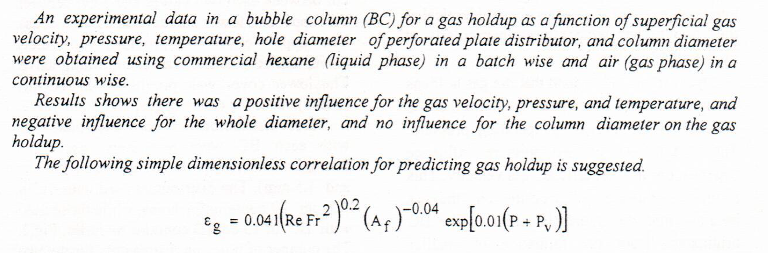

 (1)
(1)
 (2)
(2)


This work represents the set of measurements of radon and thoron concentrations levels of soil-gas in Al-Kufa city in Iraq using electric Radon meter (RAD-7). Radon and thoron concentration were measured in soil-gas in 20 location for three depth of (50, 100 and 150) cm.
The results show that the emanation rate of radon and thoron gas varied from location to anther, depending on the geological formation. The Radon concentration in soil has been found to vary from (12775±400) Bq/m3 at 150 cm depth in location (sample K2) to (41.45±17) Bq/m3, for depth 150 cm in location (sample K20). The thoron concentration in soil has been found to vary from (198±8.5) Bq/m3 at 150 cm depth in location samples (K1 & K2) to undetected in the mos
In subterranean coal seam gas (CSG) reservoirs, massive amounts of small-sized coal fines are released during the production and development stages, especially during hydraulic fracturing stimulation. These coal fines inevitably cause mechanical pump failure and permeability damage due to aggregation and subsequent pore-throat blockage. This aggregation behavior is thus of key importance in CSG production and needs to be minimized. Consequently, such coal fines dispersions need to be stabilized, which can be achieved by the formulation of improved fracturing fluids. Here, we thus systematically investigated the effectiveness of two additives (ethanol, 0.5 wt % and SDBS, 0.001 and 0.01 wt %) on dispersion stability for a wide range of condit
... Show More
(95)
(92)
 (6)
(3)
(6)
(3)
The study showed that all extracts (aqueous, ethanolic and acetonic) of the leaves of Eucalyptus and Myrtus plants had a inhibitory effect on the growth of all types of yeasts studied, acetone extract recorded the highest inhibition of yeastat 100ppm concentration,The inhibition was 35mm, 34mm, 24mm and 20mm for Candida parapsilosis, Candida glabrata, Candida tropicalis and Candida albicans respectively, The experiments above showed the least significant differences at 0.05 level.The results ofE. Cammldulensis ethanolic tincture analysis has shown the presence of 44 biologically active substances. The main Eucalyptus leaves component was: 2-Bicyclo (2-2.1) heptanol (12.37%), Ledol (8.23%),1,2,4- Benzenetriol (8.45%) and that contain spathul
... Show More
(6)
(3)
Tin oxide: titanium oxide: bismuth oxide (SnO2 )1–x(TiO 2 :Bi 2O3 ) x composites with different loading ratios (0, 0.1, 0.15, 0.2, 0.25 and 0.3) have numerous new application in microelectronics, sensors, and capacitors. This work concerned with the synthesis of (SnO 2 )1–x(TiO 2 :Bi 2O3 ) xcomposites as well as, thin films which were deposited on glass substrates as well as, silicon wafers by using pulsed laser deposition. The diffraction pattern confirms the anatase teteragonal phase of undoped tin oxide. It was observed some peaks related with titanium and bismuth oxides appeared at high loading ratios. Upon the transmission-spectra analysis, the undoped samples declared transmittance 60–67% in a visible spectrum, and the energy ga
... Show More
Industrial machining workshops generate substantial quantities of aluminum wire offcuts and filings that cannot be re-entered into bulk metal recycling circuits, posing both a resource management challenge and a potential environmental burden. This study demonstrates a closed-loop valorization route in which this low-grade aluminum waste is converted into nanostructured aluminum oxide (Al2O3) nanoparticles (NPs) by two scalable synthesis pathways (i) chemo-thermal calcination of precipitated Al(OH)₃ at 1000 °C and 1200 °C for 1 and 4 h, and (ii) direct chemical precipitation via AlCl3/Na2CO3 reaction, and then deployed as a functional additive in water-based drilling fluids (WBDFs) used by the oil and gas industry. Comprehensive chara
... Show More
(1)
(3)