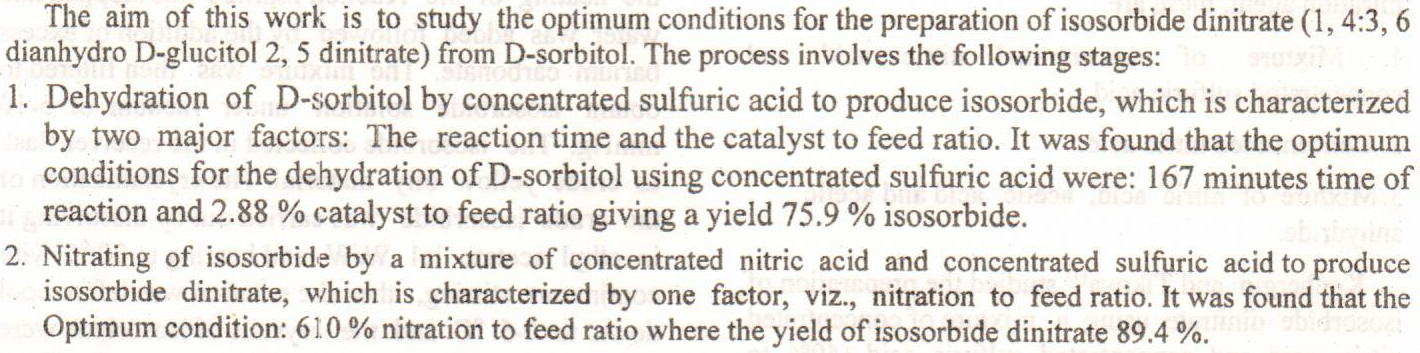
The Preparation of Isosorbide Dinitrate

This study aims to develop a thermosensitive mucoadhesive periodontal in situ gel of secnidazole for local release of drug for treatment of periodontitis, in order to increase the drug residence time and to increase patient compliance while lowering the side effects of the drug.
Cold method was used to prepare 30 formulas of secnidazole periodontal in situ gel, using different concentrations of thermosensitive polymers (poloxamer407 alone or in combination with poloxamer 188) and methyl cellulose (MC ) or hydroxypropyl methylcellulose (HPMC K4M )in different concentrations used as mucoadhesive polymer and the resultant formulations were subjected to several tests such as gelation temperature GT, appearance and pH value. The fo
... Show More (14)
(14)
 (9)
(9)


The purpose of this research was to prepare, characterize, and evaluate the new antimicrobial peptide KSL peptide encapsulated in poly(D,L-lactide-co-glycolide) (PLGA)composite microspheres. KSL was loaded in poly(acryloyl hydroxyethyl) starch (acHES) micropar-ticles, and then the peptide-containing microparticles were encapsulated in the PLGA matrix by a solvent extraction /evaporation method.
KSL-loaded PLGA microspheres were also prepared without the starch hydrogel microparticle microspheres for comparison study. KSL peptide microspheres were characterized for drug content, surface morphology, microspheres size determination, polymers stability , in vitro microspheres degradation and in vitro release. KSL peptide
... Show More
(6)
(5)

The new bidentate Schiff base ligand namely [(E)-N1-(4-methoxy benzylidene) benzene-1, 2-diamine] was prepared from condensation of 4-Methoxy benzaldehyde with O-Phenylene diamine at 1:1 molar ratio in ethanol as a solvent in presence of drops of 48% HBr. The structure of ligand (L) was characterized by, FT-IR, U.V-Vis., 1H-, 13C- NMR spectrophotometer, melting point and elemental microanalysis C.H.N. Metal complexes of the ligand (L) in general molecular formula [M(L)3], where M= Mn(II), Co(II), Ni(II),Cu(II) and Hg(II); L=(C14H14N2O) in ratio (1:3)(Metal:Ligand) were synthesized and characterized by Atomic absorption, FT- IR, U.V-Vis. spectra, molar conductivity, chloride content, melting point and magnetic susceptibility from the above d
... Show MorePurpose: To synthesize and characterize novel Schiff base-chitosan composites and determine their antimicrobial activity. Methods: Novel Schiff-base chitosan composites were synthesized by grafting polyvinylpyrrolidone and then replacing it with different aldehydes. The resulting composites were characterized using advanced analytical techniques, including thermogravimetric analysis (TGA), x-ray diffraction (XRD) studies and Fourier transform infrared spectroscopy (FT-IR). Results: The FT-IR results revealed that the Schiff-base chitosan was successfully produced during mixing and the crystallinity change of the samples was explained by the XRD patterns. Thermogravimetric analysis (TGA) of compounds A1, A3 and A4 showed weight loss
... Show More
(4)
This work investigates the properties of polyvinyl alcohol (PVA) nanocomposite films with varying multi-walled carbon nanotube (MWCNT) content, ranging from 2 to 8 wt.%. The films were prepared using a solution casting method and characterized using UV-visible spectroscopy, optical microscopy, X-ray diffraction, and tensile tests. The prepared PVA/MWCNT nanocomposite films exhibited optical band gap values ranging from 3.5 eV to 5.3 eV. XRD analysis confirmed the semi-crystalline nature of these nanocomposites. Mechanical properties, including hardness, yield strength, ultimate tensile strength, and Young's modulus, were enhanced by increasing MWCNT content by up to 8%. Contact angle measurements showed an increase in hydrophobicity with in
... Show More
(6)
(5)
A variety of single-engine driven files and inematics have been introduced to improve the clinical performance of NiTi rotary files. The purpose of this in vitro study was to measure and compare the incidence of dentinal defects after root canal preparation with different single file systems.
This paper describes the development of a simple spectrophotometric determination of bismuth III with 4-(2-pyridylazo) resorcinol (PAR) in aqueous solution in the presence of cetypyridinium chloride surfactant at pH 5 which exhibits maximum absorption at 532 nm. Beer's law is obeyed over the range 5-200 µg/25 mL. i.e. 0.2-8 ppm with a molar absorptivity of 3×10⁴ l.mol-1.cm-1 and Sandell's sensitivity index of 0.0069 µg.cm-2. The method has been applied successfully in the determination of Bi (III) in waters and veterinary preparation.
(10)
(10)