The Preparation of Isosorbide Dinitrate
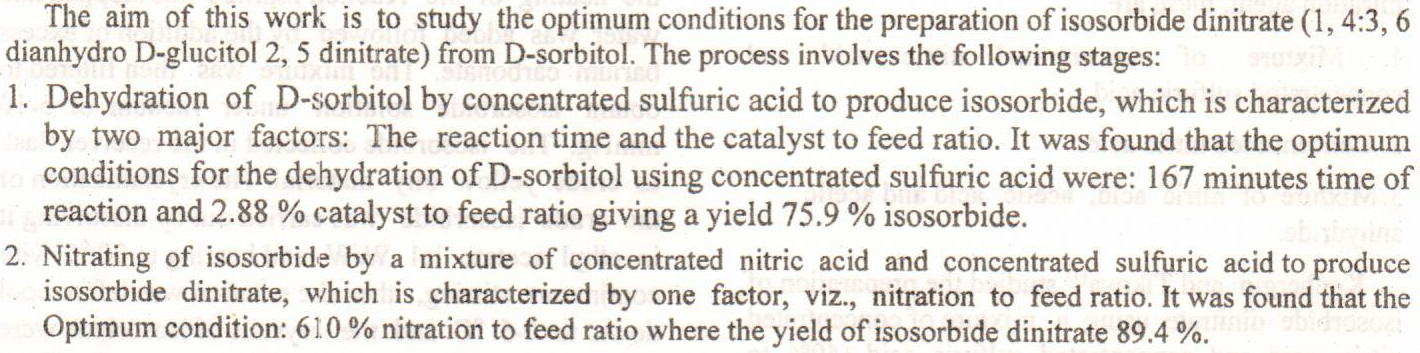

Quite anumber of parents and educators of this behavior,which is characterized by exaggerating locomotor activity and impulsivity and recklessness and the difficulty of continuing the status of certain bodily more than one minute ,and the difficulty of waiting to meet aparticular need or desire,it also characterized by thos meddling children the affairs of others and increased their chatter does not seem the case when you listen to talk to them and they characterized by weak self-confidence and are more solid and seem un able to keep ther responses because of the severity of anxiety .The research aims to know impulsive behavior among kindergartens children and its relation ship with some variables, and the sa
... Show MoreGreen nanotechnology is a thrilling and rising place of technology and generation that bracesthe ideas of inexperienced chemistry with ability advantages for sustainability, protection, andthe general protection from the race human. The inexperienced chemistry method introduces aproper technique for the production, processing, and alertness of much less dangerous chemicalsubstances to lessen threats to human fitness and the environment. The technique calls for inintensity expertise of the uncooked materials, particularly in phrases in their creation intonanomaterials and the resultant bioactivities that pose very few dangerous outcomes for peopleand the environment. In the twenty-first century, nanotechnology has become a systematic
... Show More (13)
(13)

Urea formaldehyde resin was prepared by using basic media by yield 95%. The Remaining of ureaplasts resin were prepared in acetic acid media by high yield. Alkyde resins were prepared by condensation polymerization by react Succinic, Maleic, Phthalic anhydrides with Ethylene glycol or Glycerol. Select samples of the prepared alkyde resins were mixed with Azo dyes in special ratio. The mixtures were used as coatings for wood, and compaised with pure dyes. The Coating that some alkyde resins showed better adhesion from using dyes alone. Preparation of wood coating by mixing ureaplast resins and alkyde resins with Azo dyes in special ratios. The coating showed better adhesion, brighter colors and better resistance to heat from Preceding coat
Objective: The present study was aimed to develop a pH-triggered in situ gel for local release of lidocaine hydrochloride (lidocaine HCL) in the buccal cavity to improve the anesthetic effect of this amino amide drug which has very high water solubility. The formulations were introduced to the oral cavity as a spray to improve compliance and for easier administration.Methods: In this work, two grades of carbopol (934 and 940)-based in situ gel spray were designed. The formulations containing lidocaine HCl 5% were prepared by mixing different concentrations of carbopol with xanthan gum. Eight formulations were investigated and evaluated for gelation capacity, spray angle, volume of solution delivered per each actuation, rheological p
... Show More (21)
(13)
(21)
(13)

In this study a new ligand ,(potassium 2-carbomethoxy amino-5-trithiocarbonate 1,3,4-thiadiazole) (L) has been prepared from 2-carbomethoxy amino-5-mercapto 1,3,4-thiadiazole with CS2 in alkali media . The product has been isolated and characterized by appropriate physical measurements, vibrational and electronic spectroscopy. The ligand was used to prepare a number of complexes with some metal ions Co(II), Ni(II) and Cu(II). These complexes have been characterized by FT-IR, UV-Vis spectra, molar conductivity, magnetic susceptibility, melting points and atomic absorption measurements. The nickel and copper complexes have an octahedral geometry while cobalt complex has a tetrahedral geometry. The nature of bonding between the metal ion
... Show More
(1)
In this work, the effect of preparing a composite of copper oxide nanoparticles with carbon on some of its optical properties was studied. The composite preparing process was carried out by exploding graphite electrodes in an aqueous suspension of copper oxide. The properties of the plasma which is formed during the explosion were studied using emission spectroscopy in order to determine the most important elements that are present in the media. The electron’s density and their energy, which is the main factor in the composite process, were determined. The particle properties were studied before and after the exploding process. The XRD showed an additional peak in the copper oxides pattern corresponding to the hexagonal graphite struct
... Show More
In this study, derivatives of polyvinyl alcohol (PVA) grafted with phthalic anhydride (PhA) and dyes were prepared to produce polymeric materials of PVA-g-PhA, PVA-g-PhA-anthocyanin, PVA-g-PhA-bromophenol blue, and PVA-g-PhAthymol blue. The materials were characterised by FTIR and 1 H NMR spectroscopies. The crystallinity of the polymers was evaluated with powder X-ray difraction, and the thermal stability by thermogravimetric analysis (TGA). The synthetic procedure for the polymeric materials entailed the formation of esters. The FTIR spectra of the polymers confrmed their formation since the ester carbonyl group stretch was observed at approximately 1691–1716 cm−1 in each material. NMR spectroscopy confrmed the addition of t
... Show More
(1)
(1)
 (29)
(11)
(29)
(11)
Objective: The objective of the present study was to design and optimize oral fast dissolving film (OFDF) of practically insoluble drug lafutidine in order to enhance bioavailability and patient compliance especially for a geriatric and unconscious patient who are suffering from difficulty in swallowing.Methods: The films were prepared by a solvent casting method using low-grade hydroxyl propyl methyl cellulose (HPMC E5), polyvinyl alcohol (PVA), and sodium carboxymethyl cellulose (SCMC) as film forming polymers. Polyethylene glycol 400 (PEG400), propylene glycol (PG) and glycerin were used as a plasticizer to enhance the film forming properties of the polymer. Tween 80 (1% solution) and poloxamer407 were used as a surfactant, citri
... Show More
(15)
(7)