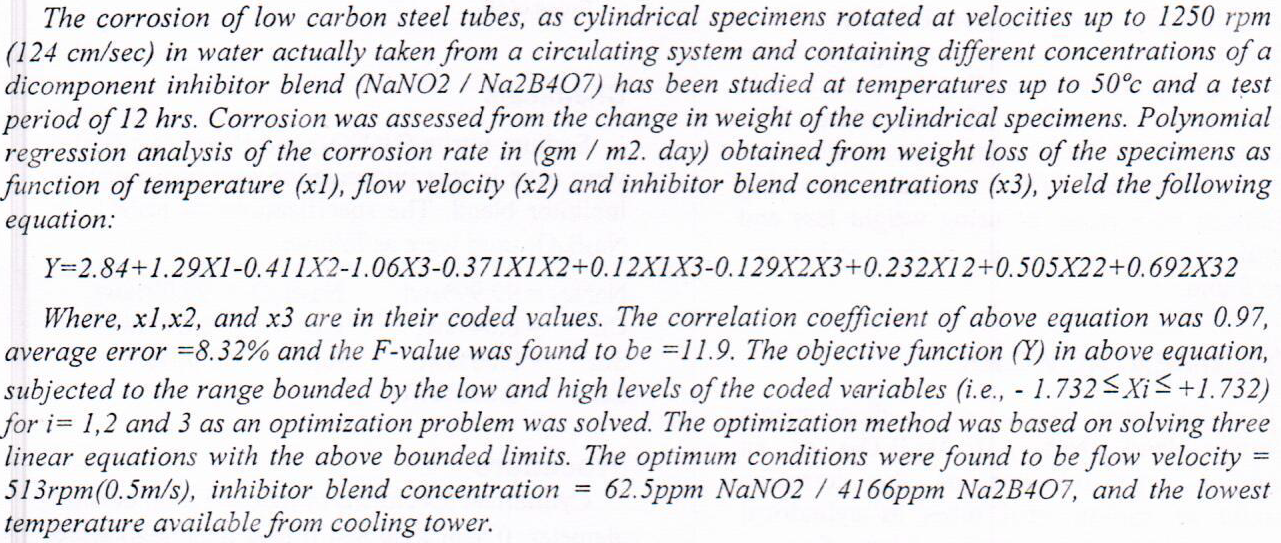
The Influence of Temperature and Flow Velocity on the Corrosion Inhibition of Low Carbon Tubes in Recirculating Water System by a Dicomponent Inhibitor Blend

 (12)
 (12)



The effects of incorporating lithium carbonate (Li2CO3) into a polyvinyl alcohol/polyvinyl pyrrolidone/polyethylene glycol (PVA/PVP/PEG) blend polymer electrolyte were investigated. Electrolytes were prepared via solution casting method, with Li2CO3 added at 10, 20, and 30 wt.% to the PVA/PVP/PEG blend (50/30/20 ratio). Fourier transform infrared spectroscopy analysis revealed interactions between the added salt and the polymer blend. The addition of both PEG and Li2CO3 resulted in increased ionic conductivity, reaching a maximum of 4.51 x 10- 5 S/cm at 30 degrees C with 20 wt.% Li2CO3. Ionic conductivity also exhibited a positive temperature dependence. Optical analysis showed a decrease in the optical energy gap with the addition of PEG a
... Show More
(18)
In this study, iron was coupled with copper to form a bimetallic compound through a biosynthetic method, which was then used as a catalyst in the Fenton-like processes for removing direct Blue 15 dye (DB15) from aqueous solution. Characterization techniques were applied on the resultant nanoparticles such as SEM, BET, EDAX, FT-IR, XRD, and zeta potential. Specifically, the rounded and shaped as spherical nanoparticles were found for green synthesized iron/copper nanoparticles (G-Fe/Cu NPs) with the size ranging from 32-59 nm, and the surface area was 4.452 m2/g. The effect of different experimental factors was studied in both batch and continuous experiments. These factors were H2O2 concentration, G-Fe/CuNPs amount, pH, initial DB15
... Show More
(13)
(8)
This study aimed to investigate the effect of water treated with a magnetic field with different induction on the histological structure of the kidney and testicular tissue of albino rats. For this purpose, fifty albino rats were divided into five equal groups, the first of which was used as a control group, drank clean tap water for four weeks, the other groups were given daily water treated with a magnetic field with an induction of 500, 1000, 1500 and 2000 gauss. Then the animals were sacrificed and histological changes in the kidneys and testicles were examined. Histopathological examination of the kidneys of animals that were given water treated with a magnetic field with an induction of 500, 1000 and 1500 gauss revealed n
... Show More
This research deals with the effects of welding variables using MIG/MAG spot by using Argon (Ar) gas and CO2 to show their effect on the mechanical characteristics and microstructure of low alloy steel type DIN15Mo3 and determine the optimum condition for the process of welding ; current & time. The results show the possibility of using CO2 and also Ar in low alloy steel welding with a little decrease in the shear force of not more than 13% for 4mm thickness and time 2sec. The shear force increased when using Ar instead of CO2 to be , The shear force reach 36KN when using Ar at 2mm thickness time of 8 sec and current of 220 Amp. , when used CO2 instead of Ar d
... Show MoreDissolution of gypsum rock in water is significant, which may result in hydrocarbon reservoir formation and evaporate deposits. However, the complexity of the gypsum dissolution process is still of interest because of its uncleanness that requires more critical analysis. The objectives of this experimental study are emphasis on the dissolution characteristics of gypsum rock under room temperature and by various types of water; namely: deionized, tap, fresh, acidic, well, and normal rainwatre. In addition, the influences of dissolution on gypsum rock's mechanical and physical characteristics. Gypsum rock was obtained from Agjalar area, in the southwest of Sulaymaniyah city, Northern Iraq. Experimental results show that we
... Show More
Background: Cerium oxide and chitosan (Ce/CS) nanoparticles have garnered significant interest due to their remarkable properties, including antioxidant activity, biocompatibility, antibacterial effectiveness and antiinflammatory activities. This study evaluates the impact of incorporating a Ce/CS nanocomposite into polymethylmethacrylate (PMMA) resin on its mechanical properties. The composite consisted of 30% cerium oxide and 70% chitosan by weight (wt), with varying percentages incorporated into the PMMA resin selected according to a pilot study. Material and Methods: Ninety PMMA specimens were fabricated and categorized into three groups according to the Ce/CS nanocomposite percentage in the PMMA resin: control (0 wt%), group A
... Show More
A field experiment was carried out in the College of Agricultural Engineering Sciences - University of Baghdad, during the fall season of 2021 to find out which cultivated cultivars of maize are efficient under nitrogen fertilization. The experiment was applied according to an RCBD (split-plot design with three replications). The cultivars of the experiment (Baghdad, 5018, Sarah) supply three levels of nitrogen fertilizer, which are N1 (100 kg.N/ha), N2 (200 kg.N/ha) and N3 (300 kg.N/ha). The statistical analysis results showed the superiority of the Sarah genotype, which gave the highest value of SOD and CAT enzymes, reaching 11.59 units mg-1 and 10.76 units mg-1 . Protein sequentially, while cultivar5018 outperformed as it gave th
... Show More
(15)
(11)
In this work, some mechanical properties of the polymer coating were improved by preparing a hybrid system containing Graphene (GR) of different weight percentages (0.25, 0.5, 1, and 2wt%) with 5wt% carbon fibres (CF) and added to a polymer coating by using casting method. The properties were improved as GR was added with further improvement on adding 5wt% of CF. The impact strength of acrylic polymer with GR increases with increasing weight ratio of GR; maximum value was obtained when the polymer coating was incorporated with 1wt% GR and 5wt% CF. The impact strength of acrylic polymer with GR and GR/CF composites incorporated with GR at 1wt% and CF at 5wt%. Hardness increase with increasing weight ratio of Gr and a significant imp
... Show More
(3)