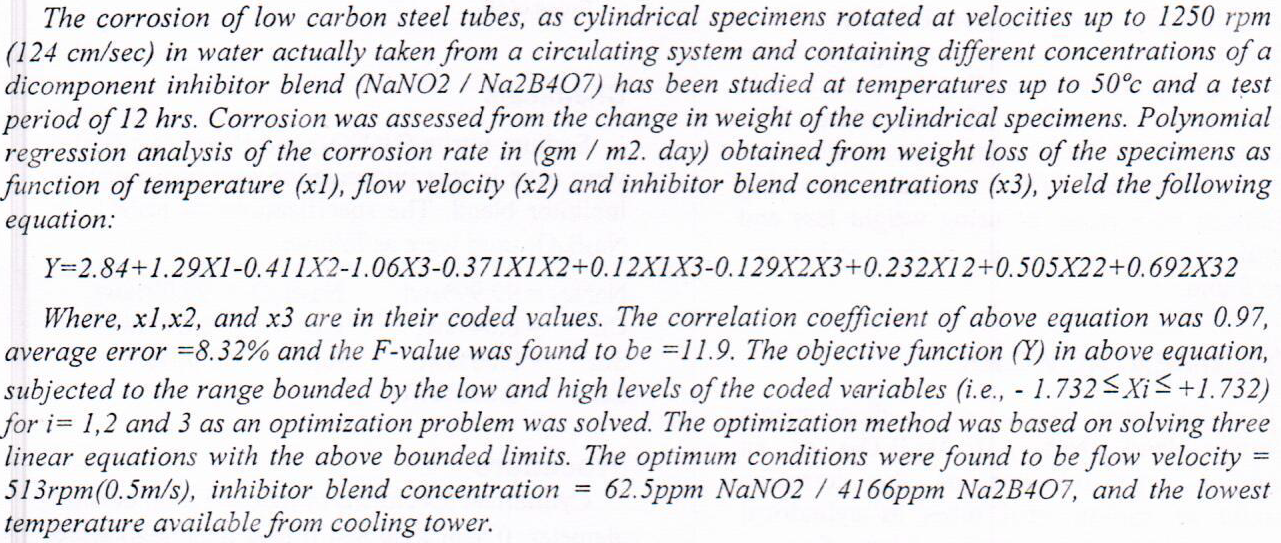
The Influence of Temperature and Flow Velocity on the Corrosion Inhibition of Low Carbon Tubes in Recirculating Water System by a Dicomponent Inhibitor Blend

 (1)
 (1)


The dynamic development of computer and software technology in recent years was accompanied by the expansion and widespread implementation of artificial intelligence (AI) based methods in many aspects of human life. A prominent field where rapid progress was observed are high‐throughput methods in biology that generate big amounts of data that need to be processed and analyzed. Therefore, AI methods are more and more applied in the biomedical field, among others for RNA‐protein binding sites prediction, DNA sequence function prediction, protein‐protein interaction prediction, or biomedical image classification. Stem cells are widely used in biomedical research, e.g., leukemia or other disease studies. Our proposed approach of
... Show More
(5)
(3)
The simulation of passively Q-switching is four non – linear first order differential equations. The optimization of passively Q-switching simulation was carried out using the constrained Rosenbrock technique. The maximization option in this technique was utilized to the fourth equation as an objective function; the parameters, γa, γc and β as were dealt with as decision variables. A FORTRAN program was written to determine the optimum values of the decision variables through the simulation of the four coupled equations, for ruby laser Q–switched by Dy +2: CaF2.For different Dy +2:CaF2 molecules number, the values of decision variables was predicted using our written program. The relaxation time of Dy +2: CaF2, used with ruby was
... Show More
(9)
(9)
(33)
(32)
(5)
(6)
(148)
(149)
 (9)
(3)
(217)
(195)
The conservation for biodiversity in Iraqi freshwater environments is important to protecting native species from the environmental impacts of alien species. Clarias gariepinus (Burchell, 1822) (Siluriformes, Clariidae) has been recognized as an alien species in Iraqi water bodies. This study aims to use molecular DNA to identify this catfish and trace its origins using. The DNA sequences of C. gariepinus were done using the mitochondrial DNA cytochrome c oxidase subunit 1 (COI) gene, and a specific primer set. The polymerase chain reaction (PCR) amplification was used to align the COI gene as a barcoding marker. After analysis, the sequences were compared with sequences in the National Center for Biology Information (NCBI) database
... Show More