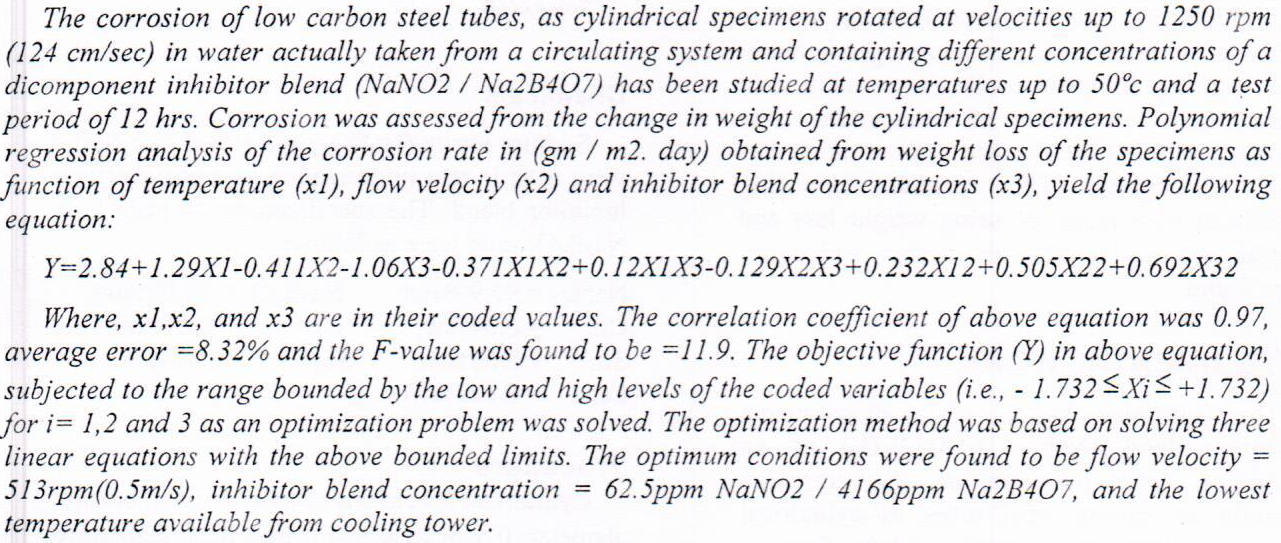
The Influence of Temperature and Flow Velocity on the Corrosion Inhibition of Low Carbon Tubes in Recirculating Water System by a Dicomponent Inhibitor Blend

In the present study, an attempt has been made to experimentally investigate the flexural performance of ten simply supported reinforced concrete gable roof beams, including solid control specimen (i.e., without openings) and nine beams with web openings of different dimensions and configurations. The nine beams with openings have identical reinforcement details. All beams were monotonically loaded to failure under mid-span loading. The main variables were the number of the created openings, the total area of the created openings, and the inclination angle of the posts between openings. Of interest is the load-carrying capacity, cracking resistance and propagation, deformability, failure mode, and strain development that represent the behav
... Show More (2)
(2)
 (2)
(2)


 (216)
(193)
(3)
(5)
(216)
(193)
(3)
(5)
A novel demountable shear connector for precast steel-concrete composite bridges is presented. The connector uses high-strength steel bolts, which are fastened to the top flange of the steel beam with the aid of a special locking nut configuration that prevents bolts from slipping within their holes. Moreover, the connector promotes accelerated construction and overcomes the typical construction tolerance issues of precast structures. Most importantly, the connector allows bridge disassembly. Therefore, it can address different bridge deterioration scenarios with minimum disturbance to traffic flow including the following: (1) precast deck panels can be rapidly uplifted and replaced; (2) connectors can be rapidly removed and replaced; and (
... Show More
(99)
(83)
A new Ni(II) nanostructured chelating system (DHN) was introduced for selective optical heavy-metal ion sensing in an aqueous medium. The cooperative chelating system comprising 8-hydroxyquinoline (8-HQ) and dimethylglyoxime (DMG) has been developed for the first time in association with fibre optic sensing for selective optical heavy-metal ion sensing in an aqueous medium. The Ni(II) nanocompound fluoresces upon 578 nm excitation, showing a highly sensitive optical response with a linear calibration curve in the range 0–100 ng/mL. The regression equation of the calibration curve is y = 0.0035x + 0.9990, which indicates very good linearity, implying R2 = 0.999 with high sensitivity (calibration slope of 0.0035) and low baseline noise (bla
... Show More
The temperature control process of electric heating furnace (EHF) systems is a quite difficult and changeable task owing to non-linearity, time delay, time-varying parameters, and the harsh environment of the furnace. In this paper, a robust temperature control scheme for an EHF system is developed using an adaptive active disturbance rejection control (AADRC) technique with a continuous sliding-mode based component. First, a comprehensive dynamic model is established by using convection laws, in which the EHF systems can be characterized as an uncertain second order system. Second, an adaptive extended state observer (AESO) is utilized to estimate the states of the EHF system and total disturbances, in which the observer gains are updated
... Show More
(48)
(41)
A new azo (LH) ligand was prepared by coupling reaction between, diazonium salt of Sulfamethoxazole, and 8-hydroxyquinoline in a process called diazotization process resulting in azo-ligand [4-((8-hydroxyquinolin-7-yl)- N(4-methylisoxazol-3-yl) benzene sulfonamide]. The azo ligand was identified by using spectroscopic techniques to detect and characterize the formation of ligand and complexes of Ni2+, Pt4+, Pd2+, and Rh3+ metal ions, and to determine the chelating behavior of ligand and also its bind position. All complexes have a [1:1] [M-ligand] ratio and all complexes are nonelectrolytes and most of the complexes have octahedral geometry, while Pd2+complex gave square planer geometry and Ni2+ complex indicate tetrahedral geometry. Therma
... Show More
(10)
(11)
The present study is to investigate the possibility of using wastes in the form of scrap iron (ZVI) and/ or aluminum ZVAI for the detention and immobilization of the chromium ions in simulated wastewater. Different batch equilibrium parameters such as contact time (0-250) min, sorbent dose (2-8 g ZVI/100 mL and 0.2-1 g ZVAI/100 mL), initial pH (3-6), initial pollutant concentration of 50 mg/L, and speed of agitation (0-250) rpm were investigated. Maximum contaminant removal efficiency corresponding to (96 %) at 250 min contact time, 1g ZVAI/ 6g ZVI sorbent mass ratio, pH 5.5, pollutant concentration of 50 mg/L initially, and 250 rpm agitation speed were obtained.
The best isotherm model for the batch single Cr(III) uptake by ZVI
... Show More
(12)
The manganese doped zinc sulfide nanoparticles were synthesized by simple aqueous chemical reaction of manganese chloride, zinc acetate and thioacitamide in aqueous solution. Thioglycolic acid is used as capping agent for controlling the nanoparticle size. The main advantage of the ZnS:Mn nanoparticles of diameter ~ 2.73 nm is that the sample is prepared by using non-toxic precursors in a cost effective and eco-friendly way. The structural, morphological and chemical composition of the nanoparticles have been investigated by X-ray diffraction (XRD), Scanning Electron Microscopy (SEM) with energy dispersion spectroscopy (EDS) and Fourier transform infrared (FTIR) spectroscopy. The nanosize of the prepared nanoparticles was elucidated by Scan
... Show More