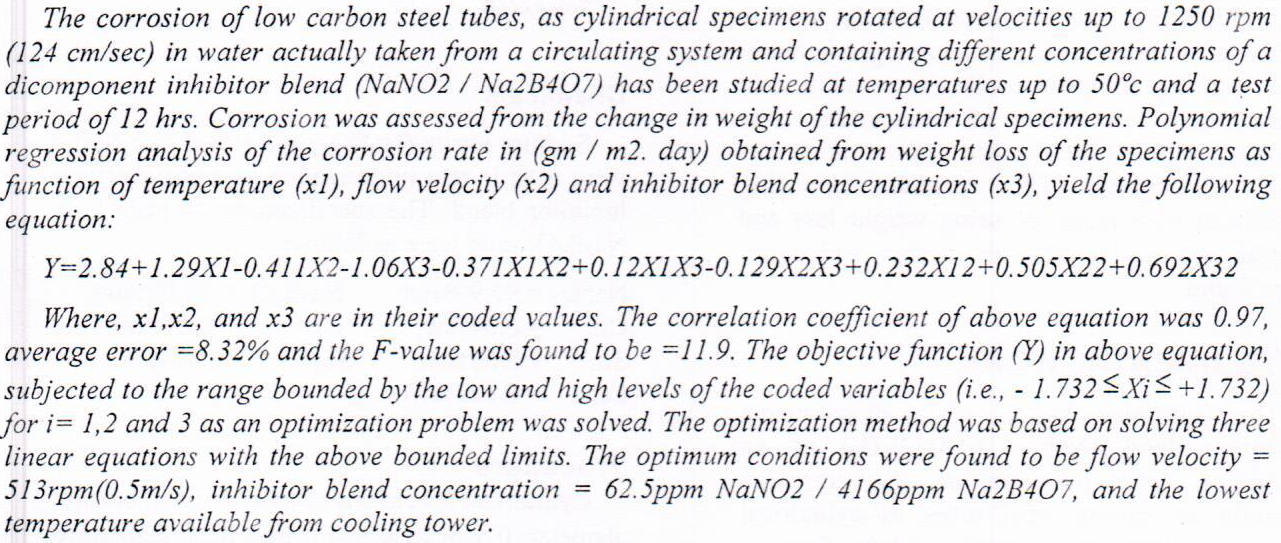
The Influence of Temperature and Flow Velocity on the Corrosion Inhibition of Low Carbon Tubes in Recirculating Water System by a Dicomponent Inhibitor Blend

A novel demountable shear connector for precast steel-concrete composite bridges is presented. The connector uses high-strength steel bolts, which are fastened to the top flange of the steel beam with the aid of a special locking nut configuration that prevents bolts from slipping within their holes. Moreover, the connector promotes accelerated construction and overcomes the typical construction tolerance issues of precast structures. Most importantly, the connector allows bridge disassembly. Therefore, it can address different bridge deterioration scenarios with minimum disturbance to traffic flow including the following: (1) precast deck panels can be rapidly uplifted and replaced; (2) connectors can be rapidly removed and replaced; and (
... Show More (92)
(92)
 (80)
(80)



The temperature control process of electric heating furnace (EHF) systems is a quite difficult and changeable task owing to non-linearity, time delay, time-varying parameters, and the harsh environment of the furnace. In this paper, a robust temperature control scheme for an EHF system is developed using an adaptive active disturbance rejection control (AADRC) technique with a continuous sliding-mode based component. First, a comprehensive dynamic model is established by using convection laws, in which the EHF systems can be characterized as an uncertain second order system. Second, an adaptive extended state observer (AESO) is utilized to estimate the states of the EHF system and total disturbances, in which the observer gains are updated
... Show More
(23)
(24)
(143)
(144)
This study evaluates the flexural behavior of ultra-thin (50 mm) one‑way reinforced‑concrete (RC) slabs retrofitted with near‑surface mounted (NSM) carbon‑fiber‑reinforced polymer (CFRP) rods under quasi‑static loading. T300‑grade CFRP rods (≈4 mm diameter) were bonded in pre‑cut 7 mm × 7 mm grooves using a two‑part epoxy. As a proof-of-concept experimental baseline, three simply‑supported specimens (1000 mm × 500 mm × 50 mm) were tested in a six‑point bending configuration (four applied loads + two reactions): two conventional controls and one strengthened slab. A load‑control rate of ~15 kN/min was applied; the controls were cycled twice and the strengthened slab four times. Relative to the average of
... Show More
(15)
(13)
(213)
(191)
Background: Dorsal plication on each side of the penis at the 2 and 10-o’clock positions had been a mainstay for correction of ventral penile curvature. However, because only the 12-o’clock position proved to be a nerve-free zone, dorsal plication at the 12-o’clock position can be advocated.
Objectives: To evaluate tunica albuginea plication with and without neurovascular bundle mobilization in patients with ventral penile curvature. Type of the study: A prospective study.
Methods: A 34 patients with a mean age of (4.8 ± 0.54) years, Who still
Los nombres propios nombran a un ser o a un objeto, distinguiéndolo de los demás seres de su misma clase, se escriben siempre con letra mayúscula a principio de palabra. Los lingüistas hacen mayor hincapié en las divergencias de referencia, entre nombres propios y nombres comunes. Así, suele decirse que el sustantivo propio no tiene como referente ningún concepto. El asunto de la traducción de los nombres propios parecería una cuestión de gusto personal del traductor pero vemos también que en algunas épocas es más frecuente traducirlos, y en otras, por el contrario, se prefiere dejar esos nombres en su forma original, tal vez con algunas adaptaciones ortográficas. Parecería entonces cuestión de modas. Pero, eviden
... Show MoreVisible-light photodetectors constructed Fe2O3 were manufactured effectively concluded chemical precipitation technique, films deposited on glass substrate and Si wafer below diverse dopant (0,2,4,6)% of Cl, enhancement in intensity with X-ray diffraction analysis was showed through favored orientation along the (110) plane, the optical measurement presented direct allowed with reduced band gap energies thru variation doping ratio , current–voltage characteristics Fe2O3 /p-Si heterojunction revealed respectable correcting performance in dark, amplified by way of intensity of incident light, moreover good photodetector properties with enhancement in responsivity occurred at wavelength between 400 nm and 470 nm.
(2)
(2)
This study examines the removal of ciprofloxacin in an aqueous solution using green tea silver nanoparticles (Ag-NPs). The synthesized Ag-NPs have been classified by the different techniques of SEM, AFM, BET, FTIR, and Zeta potential. Spherical nanoparticles with average sizes of 32 nm and a surface area of 1.2387m2/g are found to be silver nanoparticles. The results showed that the ciprofloxacin removal efficiency depends on the initial pH (2.5-10), CIP (2-15 mg/L), temperature (20-50°C), time (0-180 min), and Ag-NPs dosage (0.1-1g/L). Batch experiments revealed that the removal rate with ratio (1:1) (w/w) were 52%, and 79.8% of the 10 mg/L of CIP at 60, and 180 minutes, respectively with optimal pH=4. Kinetic models for adsorpti
... Show More
(1)