Performance of Mixing Granules Solid Materials by Fluidization
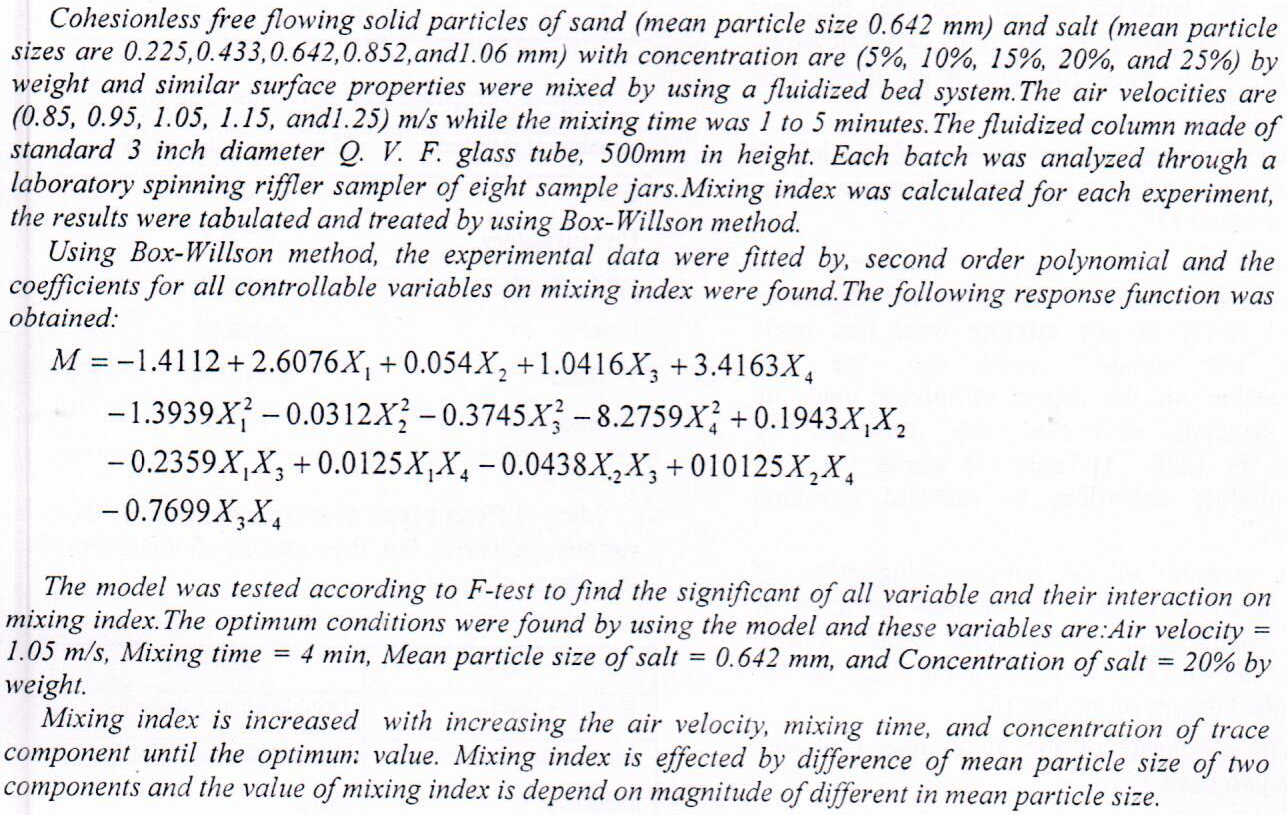

The research aims to; identify the management of conflict as perceived by secondary school managers toward the directors of directorates of education in wassat province, identify functional performance as perceived by secondary school managers toward the directors of directorates of education in wassat province. Besides, explore the relationship between Conflict management and functional performance among the directors of directorates of education in wassat province. A descriptive approach deemed more appropriate with study design. As a tool to collect the data of current research, the author used a questionnaire. Spss tools were used for data analysis
Background: Poly (methylmethacrylate) is the most widely used material in denture fabrication. The characteristics of acrylic resin which support microorganism development can threaten the oral health of denture users. This study was assigned to prepareand incorporate Ag-Zn zeolite powder into heat cured denture base material as antimicrobial material and to investigate its effect on some properties of heat cured acrylic denture base materials. Materials and methods: Sliver –zinc zeolite was prepared by ion exchange method and characterized then incorporated into poly (methylmethacrylate) powder in0.5% by weight. Specimens were constructed and divided into 6 groups according to the using tests; each group was subdivided into 2 groups
... Show MoreBackground: The geriatric patients wearing removable partial dentures are increasing in proportion. At the same time, the root caries prevalence accompanied by gingival recession is increasing. A variety of vehicles can deliver fluoride into the oral cavity, including fluoride mouth-rinse, fluoride dentifrice, topical fluoride, and fluoride-releasing restorative materials, all of which effectively prevent root caries and suppress recurrent caries. This study aimed to evaluate the effect of sodium fluoride addition on some mechanical properties of heat cure acrylic denture base material. Material and method: A total of 90 samples were prepared in this study, then divided into three main groups according to the type of test used (hardness, te
... Show MoreObjective: Evaluate the effects of different storage periods on flexural strength (FS) and degree of conversion (DC) of Bis-Acryl composite and Urethane dimethacrylate provisional restorative materials. Material and Methods: A total of 60 specimens were prepared from four temporary crown materials commercially available and assigned to four tested groups (n = 15 for each group): Prevision Temp, B&E CROWN, Primma Art, and Charm Temp groups. The specimens were stored in artificial saliva, and the FS was tested after 24 h, 7 d, and 14 d. A standard three-point bending test was conducted using a universal testing machine. Additionally, the DC was determined using a Fourier transform infrared spectroscopy (FTIR) device. The data were analyzed st
... Show More (1)
(1)
 (2)
(2)


Water has been acknowledged as one of the key issues of humanity in modern society and worldwide economic advancements, especially with the continuing reductions in fresh-water supply. Solar energy, which is abundant as well as widely available in various fields, has the potential to solve the global challenges of long-term freshwater and energy reduction. Researchers are attempting to address the problem in a variety of methods. Due to the fact that solar energy is the foundation for freshwater, several researches have applied it for improving the effectiveness of solar desalination, evaporation, and wastewater treatment. One of the novel methods used for achieving this is known as “hydrogel,” which comes in a variety of forms. As a un
... Show More
(14)
(9)
Three series of monomers, polymers and thioester cyclic compounds containing 4H-1,2,4-triazol-3-thiol moiety were synthesized and examined for their liquid crystalline properties. All monomers, polymers and thioester compounds were characterized by elemental analysis and FTIR, 1 H-NMR and mass spectroscopy. The phase transition and mesomorphic properties were investigated by polarized optical microscope (POM) and differential scanning calorimetry (DSC). The monomer with terminal phenyl substituent display dimorphism nematic and smectic A (SmA) mesophases. The corresponding polymers derived from acrylic and phenyl acrylic acid monomers show nematic mesophase. The only thioester cyclic compound derived from terephtaloyl chloride show nemati
... Show More
(15)
The photodynamic inactivation against Methicillin-resistant Staphylococcus aureus using two different lasers, 532 nm diode pumped solid state laser (DPSS) in combination with safranin O and 650 nm diode laser in combination with methylene blue was investigated in the present work. A hundred swab samples were collected from patients with burn and wound infections admitted to two hospitals in Baghdad (Specialized Burns Hospital in Medical City and Al Imamein Al Jwadein Medical City Hospital) from December 2015 to February 2016 Antimicrobial susceptibility was performed by using Kirby- Bauer method. The irradiation experiments included four groups; a control group, a photosensitizer only group, a laser irradiation only group and a laser irr
... Show MoreThe purpose of this paper is to identify the statistical indicators of the searched variables and identify the relationship between the cognitive learning outcome and the performance of the two mastering skills by parallel spherical standing and equilibrium on the balance beam. And the identification of the percentage of the cognitive learning outcome contribution to the performance of the two mastering skills by parallel spherical standing and the equilibrium on the balance beam. The two researchers used the descriptive approach in the survey method and the correlational relations, being the most appropriate to the nature of the research problem. The research community for the second stage students in the College of Physical Education and
... Show MoreThe importance of this research is due to its importance goals, Which are about the attempt of researchers to investigate the probability of depending on businesses, environments to transform organizations, performance in away that enhance the leading role of organizations in their environments , and through views of a number of the staff working in the foundation of technical institutes in Mosul. .
After deciding the methodology of the study that ,in one hand ,performs the goals of the study , and achieving a suitable theoretical framework to present the concepts of businesses, environments and the leadin
... Show More
(1)
In this paper it is required to enhance the performance of a mechanical system (here: a Hoisting System) where it is preferred to lift a different payloads with approximately the same speed of lifting and keeping at the same time the good performance, and this of course needs some intelligence of the system which will be responsible on measuring the present load and taking into account the speed and performance desired in order to achieve the requirements or the criteria. The process therefore is a Mechatronics System design which includes a measuring system, a control or automation technique, and an actuating system. The criteria built here in this research using a given Hoist system's characteristics and parameters and changing one of
... Show More