Performance of Mixing Granules Solid Materials by Fluidization
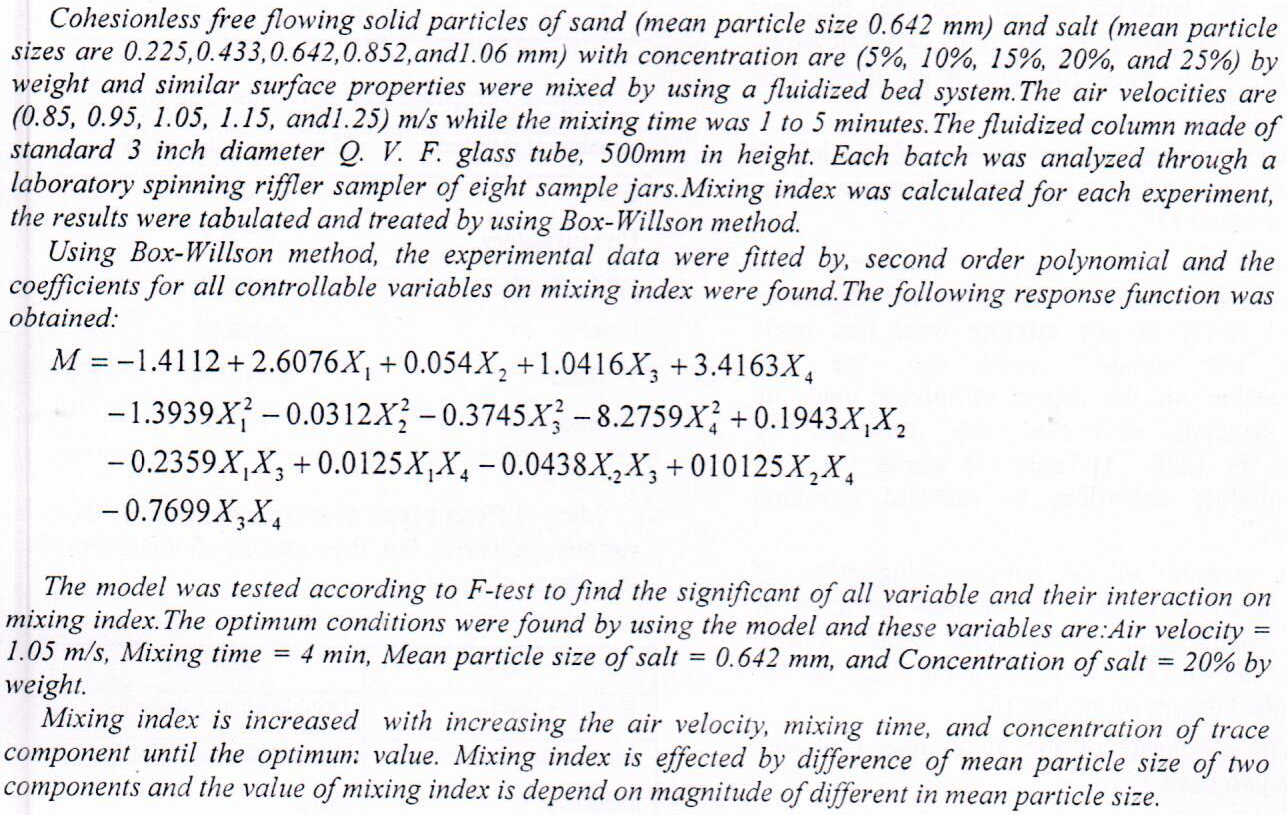

The reclamation of makeup water is studied in terms of breakthrough time (i.e., the leakage of the cations). Makeup water was subjected to lab-scale ion exchangers of two types: strong acid cation and weak base anion exchanger. The experimental investigation was directed to study the ion exchanger performance in terms of four different parameters (i.e., copper concentration, total dissolved solids (TDS), feed rate and bed depth). Box-Wilson composite rotatable design was adopted in designing the experiments. Breakthrough times of the effluent stream are measured in terms of copper concentration of 2 to 25 ppm, TDS concentration of 250 to 1250 ppm, feed rate of 0.38 to 5.34 l/h and bed depth of 5 to 70 cm. Simulation the effect of the stu
... Show MoreThe research deals with a new type of high-performance concrete with improved physical properties, which was prepared by using metal additives minutes (Metakaolin) and by studing their impact on the properties of mortar and concrete high-performance through destructive and non destructive tests. This type of concrete is used broadly in public buildings and in other structures . The research involved a number of experiments such as finding the activity index of burned at a temperature of 750 º C according to the standard ( ASTM C-311/03), as well as casting models for the cubic mortar mixtures and concrete containers at different rates of metakaolin ranging between (5% - 20%) as an added part to the cement mix to get a high- compressive
... Show MoreThe aim of this work is to study the influence of the type of fiber glass –mat on fatigue behavior of composite material which is manufactured from polyester and E-glass (woven roving, chopped strand mat (CSM)) as a laminate with a constant fiber volume fraction (VF) of 33%. The results showed that the laminates reinforced with E-glass (woven roving) [0/90, ±45.0/90] and [0/90, CSM, 0/90] have lower fatigue strength than the laminates reinforced with E-glass [0/90]3,[CSM]3 and [CSM, 0/90, CSM] although they had different tensile strength; the best laminate was [0/90]3 .
Background: Separation and deboning of artificial teeth from denture bases present a major clinical and labortory problem which affect both the patient and the dentist. The optimal bond strength of artificial teeth with denture base reinforced with nanofillers and flexible denture bases and the effect of thermo cycling should be evaluated. This study was conducted to evaluate and compare the shear bond strength of artificial teeth (acrylic and porcelain) with denture bases reinforced by 5% Zirconium oxide nanofillers and flexible bases under the effect of different surface treatments and thermo cycling and comparing the results with conventional water bath cured denture bases. Material and methods: Two types of artificial teeth; acrylic and
... Show MoreBackground: The main drawback of soft lining materials was that they debonded from the denture base after a certain period of usage. Therefore, the purpose of this research was to determine the impact of oxygen and argon plasma treatment on the shear bonding strength of soft liners to two different kinds of denture base materials: conventional acrylic resin and high impact acrylic resin. Materials and Methods: Heat cure conventional and high impact acrylic blocks (40 for each group) were prepared. A soft liner connected the final test specimen of two blocks of each acrylic material. Shear bond strength (SBS) was assessed using universal testing machine. Additional blocks were also prepared for analyzing Vickers microhardness, contact ang
... Show More (15)
(15)
 (4)
(4)


Abstract
In the present study, composites were prepared by Hand lay-up molding. The composites constituents were epoxy resin as a matrix, 6% volume fractions of glass fibers (G.F) as reinforcement and 3%, 6% volume fractions of preparation natural material (Rice Husk Ash, Carrot Powder, and Sawdust) as filler. Studied the erosion wear behavior and coating by natural wastes (Rice Husk Ash) with epoxy resin after erosion. The results showed the non – reinforced epoxy have lower resistance erosion than natural based material composites and the specimen (Epoxy+6%glass fiber+6%RHA) has higher resistance erosion than composites reinforced with carrot powder and sawdust at 30cm , angle 60
... Show MoreObjective: The aim of this study was to evaluate the effect of pumice, burning investment material
and black sand on the surface roughness of heat cure acrylic resin.
Methodology: Sixty specimens were prepared from pink heat cure acrylic resin, the specimens
where grouped into; 20 specimens which polished with pumice and water (control group); 20
specimens which polished with investment material (after burning it) and water; and 20 specimens
which polished with black sand and water. The average surface roughness of specimens after
polishing procedure had been determined by profilometer (surface roughness tester).
Results: Through the application of ANOVA and LSD tests, the result of this study showed that there
wa
Background: Restoration of the gingival margin of Class II cavities with composite resin continues to be problematic, especially where no enamel exists for bonding to the gingival margin. The aim of study is to evaluate the marginal leakage at enamel and cementum margin of class II MOD cavities using amalgam restoration and modern composite restorations Filtek™ P90, Filtek™ Z250 XT (Nano Hybrid Universal Restorative) and SDR bulk fill with different restoratives techniques. Materials and method: Eighty sound maxillary first premolar teeth were collected and divided into two main groups, enamel group and cementum group (40 teeth) for each group. The enamel group was prepared with standardized Class II MOD cavity with gingival margin (1 m
... Show MoreThis in vitro study evaluated the influence of chemomechanical caries removal solution on the surface topography of metal-ceramic feldspar porcelain (MAJOR ceramic) and All-ceramic feldspar porcelain (Vita Alpha) using light polarizing microscope. Forty specimens of MAJOR ceramic and forty specimens of Vita Alpha ceramic of (12mm diameter & 3mm height) were prepared .All specimens were polished with silicon polishing burs, cleaned, autoglazed and stored in 37°C before exposure to Carisolv. Thirty specimens of each material randomly exposed to Carisolv gel for 5, 10 and 20 minutes respectively, other ten specimens were not, to act as control group. All specimens were subjected to surface roughness test by profilometer and evalua
... Show More
Search Results at the International Journal of Science and Research (IJSR)