Performance of Mixing Granules Solid Materials by Fluidization
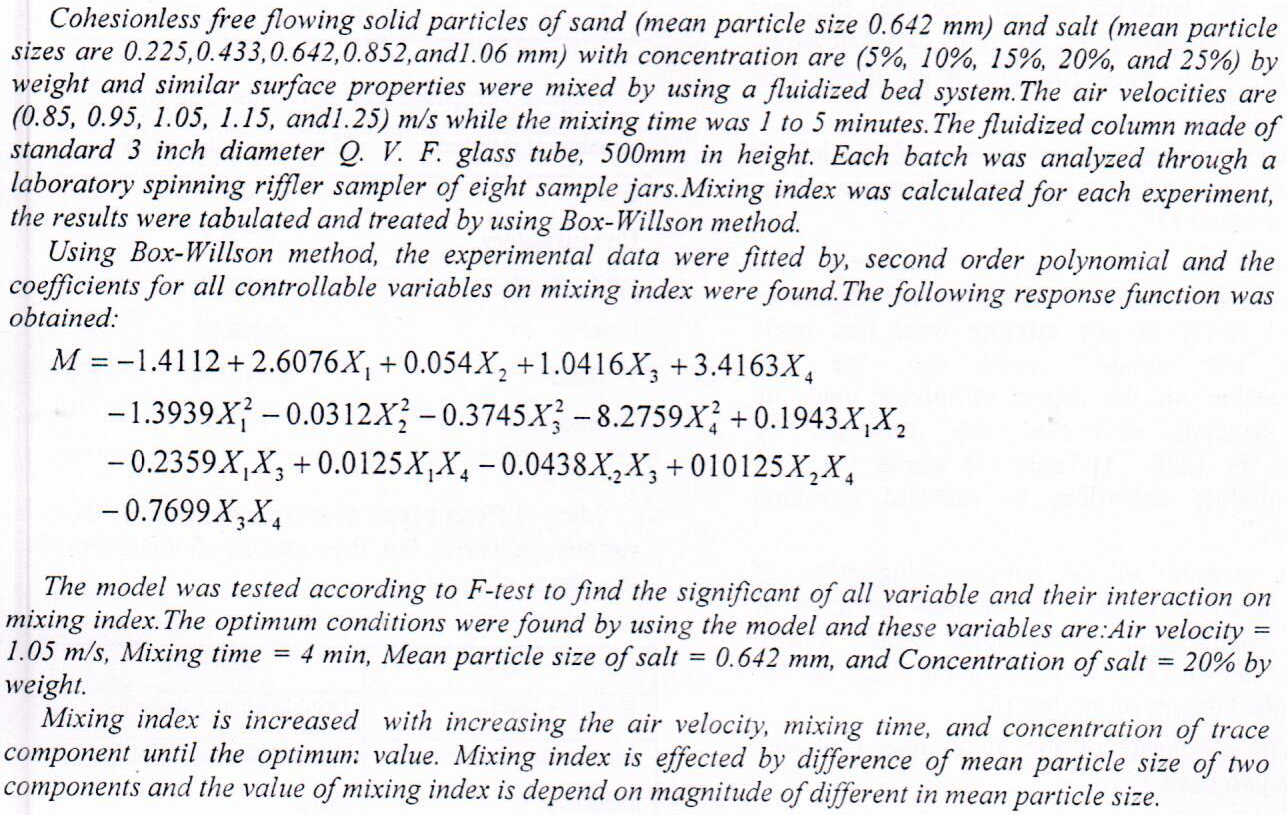

 (9)
(9)

 (1)
(1)
 (13)
(9)
(13)
(9)

The tunnel’s stability during construction is a very important matter. Some methods have been proposed for stability evaluation, but the hazard warning levels (HWLs) are more applicable among these methods. Despite monitoring and applying HWLs, several collapses in Shibli twin tunnels in Iran have cast doubts on the accuracy of this criterion in the presence of water. In this study, the critical strains under different water contents were measured through uniaxial compressive strength tests on 11 different shale and marl samples. A comparison of laboratory tests and numerical results shows that the influence of the moisture content on the critical strain is negligible. In addition, the results show that there is no dir
... Show More
(2)
(1)
(23)
(20)
The importance of specifying proper aggregate grading for achieving satisfactory performance in pavement applications has long been recognized. To improve the specifications for superior performance, there is a need to understand how differences in aggregate gradations within the acceptable limits may affect unbound aggregate base behavior. The effects of gradation on strength, modulus, and deformation characteristics of high-quality crushed rock base materials are described here. Two crushed rock types commonly used in constructing heavy-duty granular base layers in the State of Victoria, Australia, with three different gradations each were used in this study. The gradations used represent the lower, medium, and upper gradation li
... Show More
(5)
(4)
In this study, a new class of polymeric nanocomposites was synthesized and characterized. One mole of dimethyl adipate and two moles of thiosemicarbazide in ethanol first reacted to form the compound [C1]. Compound [C1] then reacted with sodium hydroxide to produce compounds [C2]. Hydrazine hydrate reacted with compound [C2] to generate compound [C3]. Compound [C4] was synthesized from compound [C3] and maleic anhydride. A polymer [C5] is formed by the reaction of the compound [C4] with ammonium persulfate as an initiator. This polymer was then combined with nano: ZnNPs, AgNPs, SiNPs, or IONPs using a hotplate stirrer for 3 hours to produce nanocomposites [C6-C9]. FTIR, 1H-NMR, and Field Emission Scanning Electron Microscope (FESEM) were
... Show MoreBackground: The materials and techniques of orthodontic bonding systems remain a pivotal concern in orthodontic research. This issue is further complicated by orthodontists' preferences. To assess the effect of knowledge and practice on the attitudes of orthodontists towards bonding materials and techniques. Methods: A cross-sectional, questionnaire-based study was conducted using Google Forms. The questionnaire comprised 17 multiple-choice questions that targeted orthodontists' awareness, knowledge, and attitude towards bonding materials. It was distributed via email or social networking platforms to specialist Iraqi orthodontists. Results: A total of 176 participants responded with nearly equal representation between the sexes. Th
... Show More
The use of sugarcane molasses (SCM) as a sustainable stabilizing agent for geomaterials, particularly granular subbase soils, has recently attracted growing attention as an alternative to traditional stabilization methods employing cement, lime, or bitumen, which are often associated with high costs and environmental concerns. This study presents a mechanistic–experimental evaluation of SCM for stabilizing granular subbase materials at dosages of 2.5%, 5%, 7.5%, and 10% by weight of dry granular material. A comprehensive testing program was conducted, including compaction characteristics, California Bearing Ratio (CBR), resilient modulus (Mr), permanent deformation under repeated loading, optical microscopy, and FTIR spectroscopy.
... Show More
Blend solid polymer electrolytes (BSPEs) comprising PVA/HPMC/CuSO4 were prepared using a solution casting approach. BSPEs were synthesized with varying weight percentages of CuSO4 (0, 10, 20, and 30 wt.%). A variety of experimental methods, including X-ray diffraction (XRD), Fourier transform infrared (FTIR) spectroscopy, scanning electron microscopy (SEM), electrochemical impedance spectroscopy (EIS), cyclic voltammetry (CV), and linear sweep voltammetry (LSV), were used to characterize these BSPE systems. The polymer blend matrix underwent structural alterations, according to the XRD data. The standard data from JCPDS card numbers for copper sulfate matches well with the observed strong peaks of PVA/HPMC+20 wt.% of CuSO4 BSPE. The complex
... Show More
(19)
(22)