Preferred Language
Articles
/
ijcpe-701
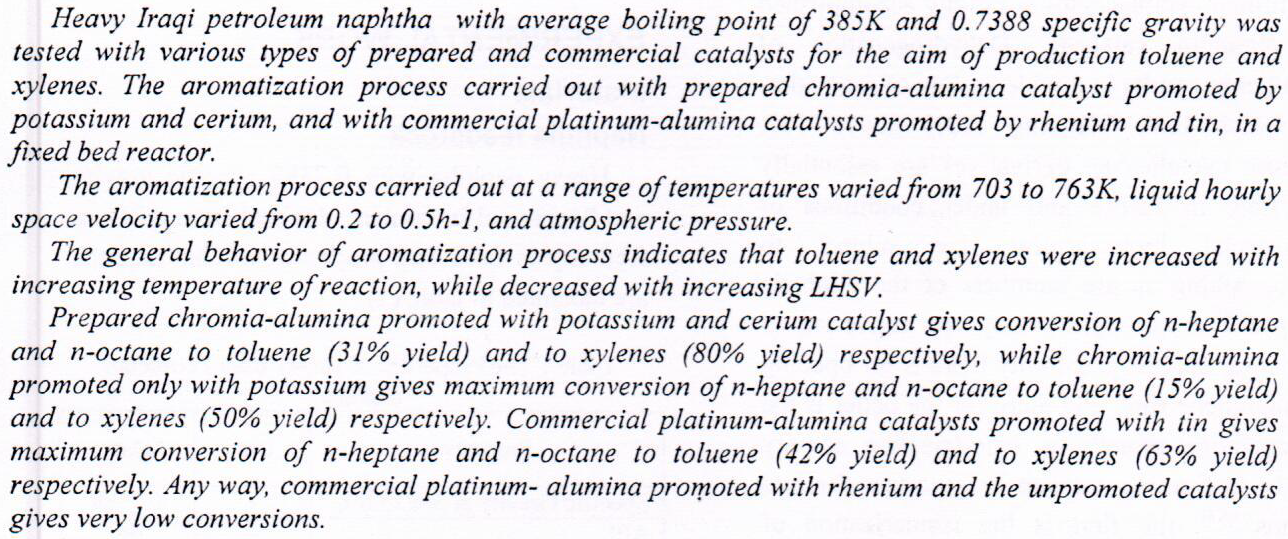
Catalytic Aromatization of Naphtha using Different Catalysts
...Show More Authors

View Publication Preview PDF
Quick Preview PDF
Publication Date
Fri Dec 01 2023
Journal Name
Iraqi Journal Of Physics
Study of the Optical Properties of 3MPA CdTe and 3MPA CdTe/CdSe Quantum Dots at PH 12 in Different Periods of Time
...Show More Authors

This research aims to study the optical characteristics of semiconductor quantum dots (QDs) composed of CdTe and CdTe/CdSe core-shell structures. It utilizes the refluxed method to synthesize these nanoscale particles and aims to comprehend the growth process by monitoring their optical properties over varied periods of time and pH 12. Specifically, the optical evolution of these QDs is evaluated using photoluminescence (PL) and ultraviolet (UV) spectroscopy. For CdTe QDs, a consistent absorbance and peak intensity increase were observed across the spectrum over time. Conversely, CdTe/CdSe QDs displayed distinctive absorbance and peak intensity variations. These disparities might stem from irregularities in forming selenium (Se) layers a

... Show More
View Publication Preview PDF
Crossref (1)
Crossref
Publication Date
Thu Mar 15 2018
Journal Name
Journal Of Baghdad College Of Dentistry
The Surface Hardness Measurement of Stone and Improved Die Stone After the Addition of a Mixture of Chemical Additives with Different Proportion
...Show More Authors

Background: Incorporation of chemical additives has long been a technique used to improve properties of the gypsum products. The purpose of this work was to study the effects of adding a combination of gum Arabic and calcium hydroxide to a type III dental stone and type IV improved die stone with different proportion. The effect on water/powder ratio, and surface hardness was determined. Material and method: Both material stone and die stone were blended with two proportion of additives so that each material was mixed twice but with different proportion of gum Arabic (0.1% and 0.2%) and calcium hydroxide (0.5 % and 0.3%). Data for hardness were subjected to two-way analysis of variance. Results: The results revealed that the chemical additi

... Show More
View Publication
Crossref (2)
Crossref
Publication Date
Wed Jan 01 2025
Journal Name
Lecture Notes In Networks And Systems
Diagnosis of Diabetes Using Artificial Intelligence Programs
...Show More Authors

Scientific development has occupied a prominent place in the field of diagnosis, far from traditional procedures. Scientific progress and the development of cities have imposed diseases that have spread due to this development, perhaps the most prominent of which is diabetes for accurate diagnosis without examining blood samples and using image analysis by comparing two images of the affected person for no less than a period. Less than ten years ago they used artificial intelligence programs to analyze and prove the validity of this study by collecting samples of infected people and healthy people using one of the Python program libraries, which is (Open-CV) specialized in measuring changes to the human face, through which we can infer the

... Show More
View Publication Preview PDF
Scopus (1)
Scopus Crossref
Publication Date
Sun Nov 01 2020
Journal Name
Journal Of Engineering
Dewatering of Kerosene using Hydrocyclone
...Show More Authors

Water/oil emulsion is considered as the most refractory mixture to separate because of the interference of the two immiscible liquids, water and oil. This research presents a study of dewatering of water / kerosene emulsion using hydrocyclone. The effects of factors such as: feed flow rate (3, 5, 7, 9, and 11 L/min), inlet water concentration of the emulsion (5%, 7.5%, 10%, 12.5%, and 15% by volume), and split ratio (0.1, 0.3, 0.5, 0.7, and 0.9) on the separation efficiency and pressure drop were studied. Dimensional analysis using Pi theorem was applied for the first time to model the hydrocyclone based on the experimental data. It was shown that the maximum separation efficiency; at split ratio 0.1, was 94.3% at 10% co

... Show More
View Publication Preview PDF
Crossref
Publication Date
Mon Mar 13 2017
Journal Name
Journal Of Baghdad College Of Dentistry
Gingival microleakage of composite restorations with different bonding protocol in class II cavity treated with chlorhexidine (an in-vitro study)
...Show More Authors

ABSTRACT Background: One of the challenges to use chlorhexidine is its effect on the amount of microleakage after restoration; however, use of the materials with antibacterial properties after tooth preparation and before restoration has been widespread. The objective of this, in-vitro, study was to evaluate the influence of consepsis (chlorhexidine gloconate disinfectant) application on microleakage in class II cavities restored with light cured composite using universal adhesive system; etch and rinse technique –self etch technique. Materials and Methods: Forty class II cavities were prepared on mesial and distal surfaces of 20 non-carious mandibular third molars. The cavities were divided into four groups; (n =10 for each group).

... Show More
View Publication Preview PDF
Crossref
Publication Date
Sun Oct 15 2023
Journal Name
Sumer 3
Treatment of shallow and deep white spot lesions with three different mouthwashes evaluated by laser fluorescence (an in vitro study)
...Show More Authors

This research aims to find how three different types of mouthwashes affect the depth of artificial white spot lesions. Teeth with various depths of white spot lesions were immersed in either splat mouthwash, Biorepair mouthwash, Sensodyne mouthwash, or artificial saliva (control)twice daily for one minute for 4 weeks and 8 weeks at 37°C. After this immersion procedure, lesion depth was measured using a diagnosed pen score. A one-way analysis of variance, Dunnett T3 and Tukey's post hoc α = .05 were used to analyze the testing data. Splat mouthwash enhanced the WSL remineralization and made the lowest ΔF compared with other mouthwashes in shallow and deep enamel after 4 and 8 weeks of treatment. In the repair groups, after 4 weeks

... Show More
View Publication Preview PDF
Crossref (1)
Scopus Crossref
Publication Date
Thu Jun 04 2026
Journal Name
Journal Of Baghdad College Of Dentistry
A study to compare the efficiency of different instrumentation systems for cleaning oval-shaped root canals (An in vitro study)
...Show More Authors

Background: Proper cleaning and shaping of the whole root canal space have been recognized as a real challenge, particularly in oval-shaped canals.This in vitro study was conducted to evaluate and compare the efficiency of different instrumentation systems in removing of dentin debris at three thirds of oval-shaped root canals and to compare the percentage of remaining dentin debris among the three thirds for each instrumentation system. Materials and methods: Fifty freshly extracted human mandibular molars with single straight oval-shaped distal root canals were randomly divided into five groups of ten teeth each. Group One: instrumentation with ProTaper Universal hand instruments, Group Two: instrumentation with ProTaper Universal rotary

... Show More
View Publication Preview PDF
Publication Date
Mon Jun 01 2009
Journal Name
Al-khwarizmi Engineering Journal
Study the Effect Different Radioactive Dose on Mechanical Properties of Composite Material from Novolak Resin Exposure to High – Energy Radiation
...Show More Authors

The research involves using phenol – formaldehyde (Novolak) resin as matrix for making composite material, while glass fiber type (E) was used as reinforcing materials. The specimen of the composite material is reinforced with (60%) ratio of glass fiber.

      The impregnation method is used in test sample preparation, using molding by pressure presses.

      All samples were exposure to (Co60) gamma rays of an average energy (2.5)Mev. The total doses were (208, 312 and 728) KGy.

      The mechanical tests (bending, bending strength, shear force, impact strength and surface indentation) were performed on un irradiated and irrad

... Show More
View Publication Preview PDF
Publication Date
Mon Feb 01 2016
Journal Name
Journal Of Engineering
Dust Effect on the Efficiency of Silicon Mono Crystalline Solar Modules at Different Tilt Angles at Al-Jadryia Climate Conditions
...Show More Authors

Solar energy usage in Iraq is facing many issues; one of those is the accumulation “of the dust on the surface of the solar module which” would highly lower its efficiency. The present work study the effect of dust accumulation” on installing fixed solar modules with different inclined angles 15o, 33o, 45o, 60o. Evaluation of the solar modules performance under different circumstance conditions such as rain, wind and humidity are considered in study of dust effect on solar module performance. The results show that the lowest output average efficiencies of solar modules occurs at 15o horizontally inclined angle are 7.4% , 6.7% , 8.0% , 8.1%, and 8.4% for the cor

... Show More
View Publication Preview PDF
Publication Date
Wed Feb 01 2017
Journal Name
Journal Of Natural Gas Science And Engineering
Experimental determination of hydrate phase equilibrium for different gas mixtures containing methane, carbon dioxide and nitrogen with motor current measurements
...Show More Authors

Hydrate dissociation equilibrium conditions for carbon dioxide + methane with water, nitrogen + methane with water and carbon dioxide + nitrogen with water were measured using cryogenic sapphire cell. Measurements were performed in the temperature range of 275.75 K–293.95 K and for pressures ranging from 5 MPa to 25 MPa. The resulting data indicate that as the carbon dioxide concentration is increased in the gas mixture, the gas hydrate equilibrium temperature increases. In contrast, by increasing the nitrogen concentration in the gas mixtures containing methane or carbon dioxide decreased the gas hydrate equilibrium temperatures. Furthermore, the cage occupancies for the carbon dioxide + methane system were evaluated using the Van der Wa

... Show More
Scopus (95)
Crossref (92)
Scopus Clarivate Crossref