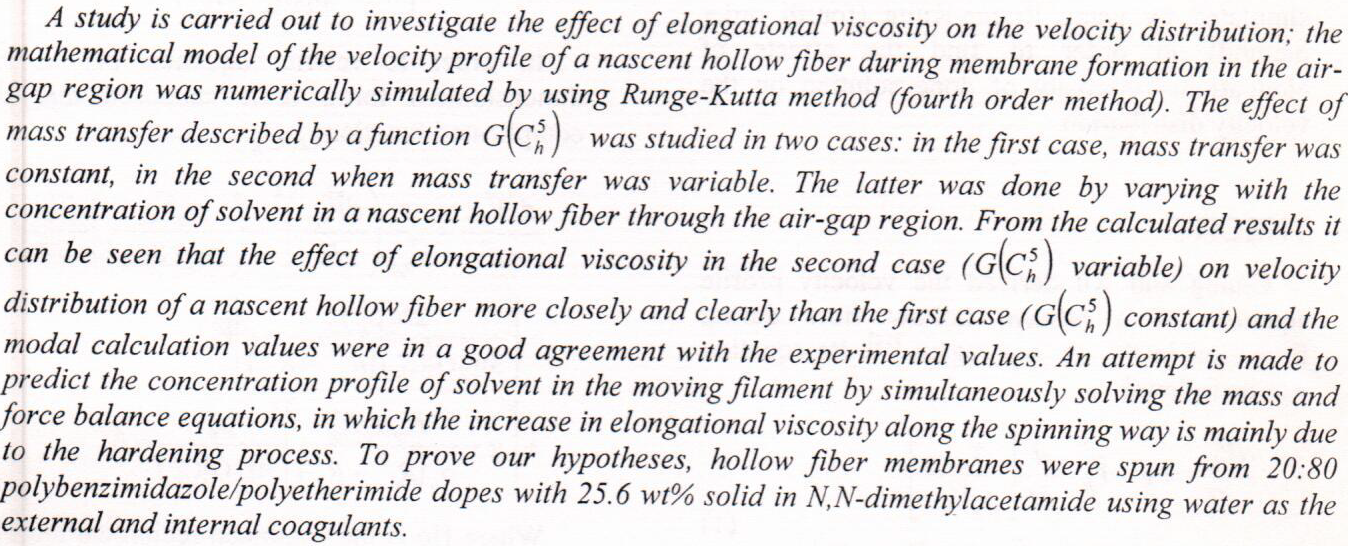
Studying Effect of Elongational Viscosity on the Velocity Distribution for Dry/Wet-Spun Nascent Hollow Fiber Membrane

The present study involves experimental analysis of the modified Closed Wet Cooling Tower (CWCT) based on first and second law of thermodynamics, to gain a deeper knowledge in this important field of engineering in Iraq. For this purpose, a prototype of CWCT optimized by added packing under a heat exchanger was designed, manufactured and tested for cooling capacity of 9 kW. Experiments are conducted to explore the effects of various operational and conformational parameters on the towers thermal performance. In the test section, spray water temperature and both dry bulb temperature and relative humidity of air measured at intermediate points of the heat exchanger and packing. Exergy of water and air were calculated by applying the exergy
... Show MoreThis paper is concerned with finding solutions to free-boundary inverse coefficient problems. Mathematically, we handle a one-dimensional non-homogeneous heat equation subject to initial and boundary conditions as well as non-localized integral observations of zeroth and first-order heat momentum. The direct problem is solved for the temperature distribution and the non-localized integral measurements using the Crank–Nicolson finite difference method. The inverse problem is solved by simultaneously finding the temperature distribution, the time-dependent free-boundary function indicating the location of the moving interface, and the time-wise thermal diffusivity or advection velocities. We reformulate the inverse problem as a non-
... Show More (4)
(4)
 (4)
(4)


 (3)
(1)
(6)
(5)
(2)
(1)
(3)
(1)
(6)
(5)
(2)
(1)
This paper is focused on studying the effect of cutting parameters (spindle speed, feed and depth of cut) on the response (temperature and tool life) during turning process. The inserts used in this study are carbide inserts coated with TiAlN (Titanum, Aluminium and Nitride) for machining a shaft of stainless steel 316L. Finite difference method was used to find the temperature distribution. The experimental results were done using infrared camera while the simulation process was performed using Matlab software package. The results showed that the maximum difference between the experimental and simulation results was equal to 19.3 , so, a good agreement between the experimental and simulation results was achieved. Tool life w
... Show More
(1)
(3)
(1)
To achieve sustainability, use waste materials to make concrete to use alternative components and reduce the production of Portland cement. Lime cement was used instead of Portland cement, and 15% of the cement's weight was replaced with silica fume. Also used were eco-friendly fibers (copper fiber) made from recycled electrical. This work examines the impact of utilizing sustainable copper fiber with different aspect ratios (l/d) on some mechanical properties of high-strength green concrete. A high-strength cement mixture with a compressive strength of 65 MPa in line with ACI 211.4R was required to complete the assignment. Copper fibers of 1% by volume of concrete were employed in mixes with four different aspect ratios
... Show More
(4)
(6)
In the present work, leaching process studiedusing organic acids (acetic acid and lactic acid) to extract phosphate from the Iraqi Akashat phosphate ore by separation of calcareous materials (mainly calcite). This approach characterized by energy conservation, environmental enhancement by recovery of calcite as calcium sulfate (gypsum), keeping the physical and chemical properties of apatite. Samples were analyzed using X-ray diffraction and FTIR spectrophotometer. From the obtained experimental data it was found that using the two organic acids yields closed purity values of the produced apatite at the optimum conditions, while at different acid concentrations, it was found that the efficiency of acetic acid is higher at the low acid co
... Show MoreThe current study examines the combined impacts of ultrasonic waves and nano silica (NS) on reducing the viscosity Sharqy Baghdad heavy crude oil with an API gravity of 20.32. NS of an average particle size of 59.93 nm and 563.23 m²/g surface area were produced utilizing the sol-gel technique from Iraqi sand. The XRD analysis indicates the existence of an amorphous silica, the SEM analysis showed that NS tends to agglomerate, and the FTIR spectra exhibited the presence of siloxane and silanol groups. In addition, the TGA analysis demonstrated a total weight loss of 15.62%, validating the thermal stability of the NS. The experiments included a study of the impact of ultrasonic power, exposure time, duty cycle, temperature, and the c
... Show More
(3)