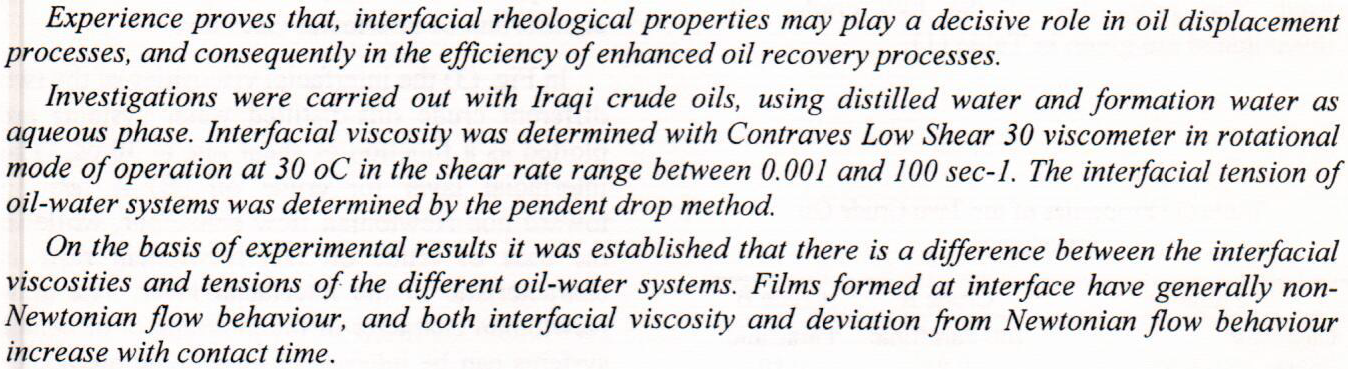
Interfacial Rheological Properties of Iraqi Crude Oils Water System

The steady 3-D raw water turbulent flow is numerically investigated. This flow is formed of solid silica sand (quartz) carried by water in stainless steel pipe. The flow in a straight pipe and flow in a pipe with a sudden contraction are analyzed using a two-way coupled Eulerian-Lagrangian approach. Erosion rate is estimated by Oka erosion model combined with the constant coefficient of restitution. The effect of solid particles mass flow rate, inlet velocity, particle diameter, internal pipe diameter, orientation, contraction coefficient, and wall pipe contraction angle on erosion rate are examined. The predicted erosion is distributed homogenously for straight pipe, while the step wall area of the contraction is the most eroded part. The
... Show More (3)
(3)
 (1)
(1)


ABSTRACT In dam construction stages when an earth embankment has retained a reservoir with constant water surface elevation for a long time, seepage conditions within the embankment will be reach a steady state. If it is necessary to drain the reservoir quickly, the pore-water pressures in the embankment may remain relatively high while the stabling effect of the reservoir's weight along the upstream (U/S) side for the embankment has removed. This process is referring to as "Rapid Drawdown" and may be cause instability in the upstream (U/S) face of the embankment. Kongele dam is one of the proposed earth dams to be implement within the current plan in Iraq. The authors study pore water pressure and the effect of rapid drawdown for the dam d
... Show MoreABSTRACT The antibacterial and antbiofilm activities of water extract of Calendula officinalis flowers against some of enteropathogenic bacteria was studied, also phytochemical screening and determination of antioxidant activity of the extract has been investigated. The results showed that the water extract of C. officinalis exhibited a good antibacterial activity against all pathogenic bacterial isolates (Salmonella, Shigella dysenteriae, Shigella flexneri, Shigella sonnei and E. coli) especially at concentration 100 µg/ml in contrast with the control cefotan antibiotic. S. sonnei was more sensitive to extract than other bacteria with highest inhibition zone (23 mm). The preliminary phytochemical tests results indicated the presence
... Show MoreThe present work aimed to study the efficiency of thermal osmosis process for recovery of water from organic wastewater solution and study the factors affecting the performance of the osmosis cell. The driving force in the thermo osmosis cell is provided by a difference in temperature across the membrane sides between the draw and feed solution. In this research used a cellulose triacetate (CTA), as flat sheet membranes for treatment of organic wastewater under orientation membrane of active layer facing feed solution (FS) and draw solution (DS) is placed against the support layer. The organic materials were phenol, toluene, xylene and BTX (benzene, toluene, and xylene) used as feed solution. The osmotic agent in draw solution was
... Show MoreHuwaiza marsh is considered the largest marsh in the southern part of Iraq. It is located between 31° and 31.75° latitude and extends over the Iraqi-Iranian border; but the largest part lies in Iraq. It is located to the east of Tigris River in Messan and Basra governorates.
In this research, the variation of some water quality parameters at different locations of Huwaiza marsh were studied to find out its efficacy in the treatment of the contamination coming from the wastewater outfall of Kahlaa brokendown sewage treatment plant which lies on the Kahlaa River. This rive is the main feeder of Huwaiza marsh. Ten water quality sampling locations were chosen in this marsh. The water samples were taken during 2009 for three months; Janu
This study was performed on the Tigris River (Baghdad city section) during the period between December 2016 and December 2018 to assess seasonal variation in water quality using the Overall Index of Pollution (OIP). The OIP is one of the reliable tools for the assessment of surface water quality. To calculate OIP-values, eight parameters were measured ( pH, Dissolved Oxygen "DO", Biological Oxygen Demand "BOD", Total Dissolved Solid "TDS", Total Hardness "TH", calcium "Ca", Sulphate "SO4" and Alkalinity). The results showed the anthropogenic activities impact of Baghdad population that directly discharge of "inadequate treated" waste water to the river. OIP values were acceptable (1˃OIP˃ 1.7) in 2011, 2012, 2013 and 2018. However, in
... Show More
(24)
(9)

Summary:The anatomy of the arterial and venous vessels of the mammalian oviduct is well describedin women and in laboratory and farm animals. The arteries are derived from the ovarian anduterine stems; the relative contribution of these vessels, however, or variations in that contributionwith the menstrual or estrus cycle and/or gamete or embryo transport is unknown.
The increasing number of orphans and their organizations and institutes in our community makes it increasingly important to design and develop an expert system that supports decisions concerning orphans and their families. This system can be used by any orphans organization to facilitate its work.
The proposed work is designed to manage the Orphans and Families of Martyrs of Terrorism Expert System (OFMTES) by registry all information about all orphans to display mostly orphan deserves bill, data is entered for each orphan, and with each entry a counter is increased according to this input information; the output result represents the score for that orphan. Different orphans have different scores. Coloring is used to know the degree o
(9)
(7)