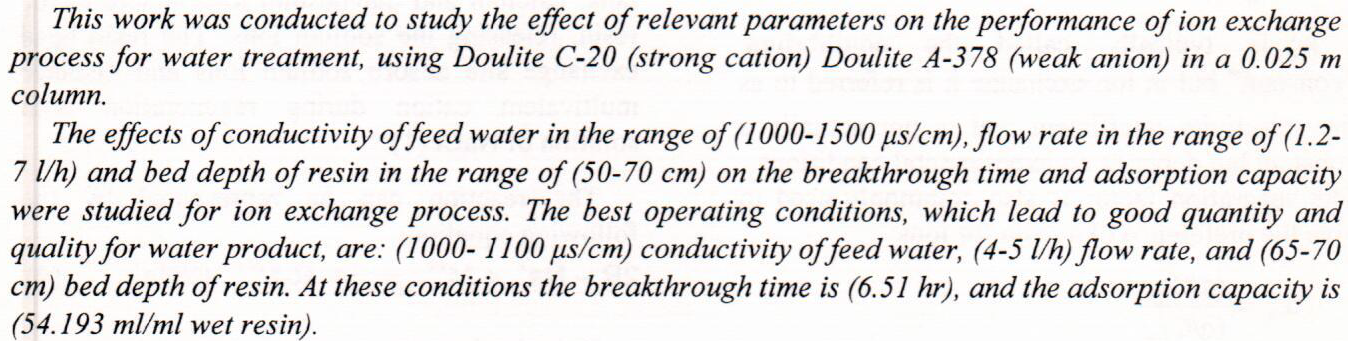
Water Treatment of Cooling Towers Blowdown by Ion Exchange

Two EM techniques, terrain conductivity and VLF-Radiohm resistivity (using two
different instruments of Geonics EM 34-3 and EMI6R respectively) have been applied to
evaluate their ability in delineation and measuring the depth of shallow subsurface cavities
near Haditha city.
Thirty one survey traverses were achieved to distinguish the subsurface cavities in the
investigated area. Both EM techniques are found to be successfiul tools in study area.
In this work, pure and doped Vanadium Pentoxide (V2O5) thin films with different concentration of TiO2 (0, 0.1, 0.3, 0.5) wt were obtained using Pulse laser deposition technique on amorphous glass substrate with thickness of (250)nm. The morphological, UV-Visible and Fourier Transform Infrared Spectroscopy (FT-IR) were studied. TiO2 doping into V2O5 matrix revealed an interesting morphological change from an array of high density pure V2O5 nanorods (~140 nm) to granular structure in TiO2-doped V2O5 thin film .Transform Infrared Spectro
... Show More (6)

The permeable reactive barrier (PRB) is one of the promising innovative in situ groundwater remediation technologies, in removing of copper from a contaminated shallow aquifer. The 1:1- mixture of waste foundry sand (WFS) and Kerbala’s sand (KS) was used for PRB. The WFS was represented the reactivity material while KS used to increase the permeability of PRB only. However, Fourier-transform infrared (FTIR) analysis proved that the carboxylic and alkyl halides groups are responsible for the sorption of copper onto WFS. Batch tests have been performed to characterize the equilibrium sorption properties of the (WFS+KS) mix in copper- containing aqueous
solutions. The sorption data for Cu+2 ions, obtained by batch experiments, have be
(15)
In this study, the investigation of Local natural Iraqi rocks kaolin with the addition of different proportions of bauxite and its effect on the physical and mechanical properties of the produced refractories was conducted. Kaolin/bauxite mixture was milled and classified into various size fractions, the kaolin (less than 105 μm) and the bauxite (less than 70μm). The specimens were mixed from kaolin and bauxite in ranges B1 (95+5)%, B2 (90+10)%, B3(85+15)%, and B4 (80+20)% respectively. The green specimens were shaped by the semi-dry method using a hydraulic press and a molding pressure of 7 MPa with the addition of (9-12) %wt. of PVA ratio. After molding and drying, the specimens were fired at (1100, 1200 and 13
... Show More
(2)
In this study, (50–110 nm) magnetic iron oxide (α-Fe2O3) nanoparticles were synthesized by pulsed laser ablation of iron target in dimethylformamide (DMF) and sodium dodecyl sulfate (SDS) solutions. The structural properties of the synthesized nanoparticles were investigated by using Fourier Transform Infrared (FT-IR) spectroscopy, UV–VIS absorption, scanning electron microscopy (SEM), atomic force microscopy (AFM), and X-ray diffraction (XRD). The effect of laser fluence on the characteristics of these nanoparticles was studied. Antibacterial activities of iron oxide nanoparticles were tested against Gram-positive; Staphylococcus aureus and Gram-negative; Escherichia coli, Pseudomonas aeruginosa and Serratia marcescens. The results sh
... Show More (237)
(228)


In this study, nano TiO2 was prepared with titanium isopropoxide (TTIP) as a resource to titanium oxide. The catalyst was synthesized using phosphotungstic acid (PTA) and, stearyl trimethyl ammonium bromide (STAB) was used as the structure-directing material. Characterization of the product was done by the X-ray diffraction (XRD), X-ray fluorescent spectroscopy (XRF), nitrogen adsorption/desorption measurements, Atomic Force Microscope (AFM) and Fourier transform infrared (FTIR) spectra, were used to characterize the calcined TiO2 nanoparticles by STAB and PWA. The TiO2 nanomaterials were prepared in three crystalline forms (amorphous, anatase, anatase-rutile). The results showed that the
... Show More
(13)
Zygapophyseal joints (or facet joints), are a plane synovial joint which located between the articular facet processes of the vertebral arch which is freely guided movable joints. Ten dried vertebrae were used for the lumbar region and taking (L4) as a sample to reveal stress pathways across the joints by using ANSYS program under different loading conditions which used Finite Elements Analysis model. Results obtained from the ANSYS program are important in understanding the boundary conditions for load analysis and the points of stress concentration which explained from the anatomical point of view and linked to muscle and ligament attachments. This model used as a computational tool to joint biomechanics and to prosthetic im
... Show MoreReinforcing asphalt concrete with polyester fibers considered as an active remedy to alleviate the harmful impact of fatigue deterioration. This study covers the investigation of utilizing two shapes of fibers size, 6.35 mm by 3.00 mm and 12.70 mm by 3.00 mm with mutual concentrations equal to 0.25 %, 0.50 % and 0.75 % by weight of mixture. Composition of asphalt mixture consists of different optimum (40-50) asphalt cement content, 12.50 mm nominal aggregate maximum size with limestone dust as a filler. Following the traditional asphalt cement and aggregate tests, three essential test were carried out on mixtures, namely: Marshall test (105 cylindrical specimens), indirect tensile strength test (21 cylindrical specimens)
... Show MoreBaTiO3 thin films have been deposited on Si (111) and glass substrates by using pulsed laser deposition technique. The films were characterized by using X-ray diffraction, atomic force microscope and optical transmission spectra. The films growth on Si after annealing at 873K showed a polycrystalline nature, and exhibited tetragonal structure, while on glass substrate no growth was noticed at that temperature. UV-VIS transmittance measurements showed that the films are highly transparent in the visible wavelength region and near-infrared region for sample annealing on glass substrate. The optical gap of the film were calculated from the curve of absorption coefficient (αhν) 2 vs. hν and was found tobe 3.6 eV at substrate temperature 5
... Show More
(98)