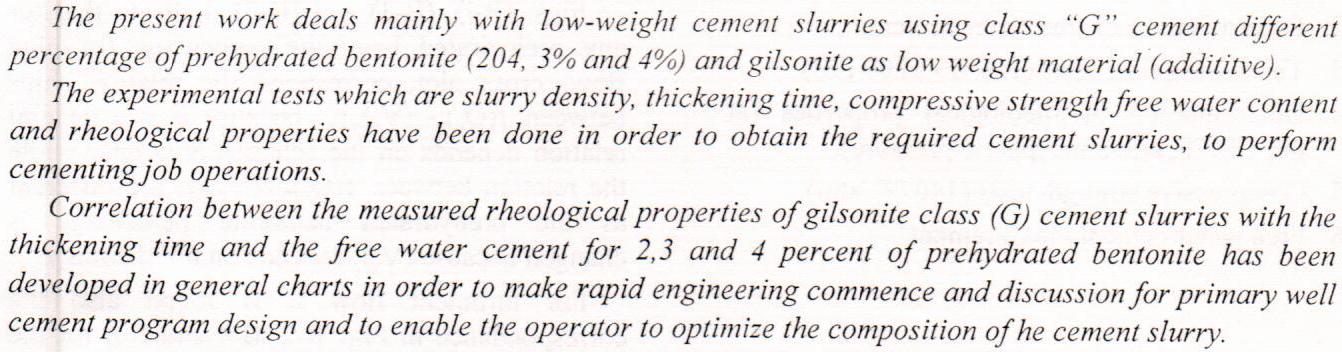
Physical and Rheological Properties of Class "G" Gilsonite Cement Slurries (Experimental Study)

Modified asphalt is considered one of the alternatives to address the problems of deficiencies in traditional asphalt concrete, as modified asphalt addresses many of the issues that appear on the pavement layers in asphalt concrete, resulting from heavy traffic and vehicles loaded with loads that exceed the design loads and the large fluctuations in the daily and seasonal temperatures of asphalt concrete. The current study examined the role of polyphosphoric acid (PPA) as a modified material for virgin asphalt when it was added in different proportions (1%, 2%, 3%, 4%) of the asphalt weight. The experimental program includes the volumetric characteristics associated with the Marshall test, the physical properties, and th
... Show More (3)
(3)


The spectral characteristics and the nonlinear optical properties of the mixed donor (C-480) acceptor (Rh-6G) have been determined. The spectral characteristics are studied by recording their absorption and fluorescence spectra. The nonlinear optical properties were measured by z-scan technique, using Q-switched Nd: YAG laser with 1064 nm wavelength. The results showed that the optimum concentration of acceptor is responsible for increasing the absorption and the emission bandwidth of donor to full range and to 242 nm respectively by the energy transfer process, also the efficiency of the process was increased by increasing the donor and acceptor concentration. The obtained nonlinear properties results of the mixture C-480/ Rh-6G showed
... Show MoreThe different parameters on mechanical and microstructural properties of aluminium alloy 6061-T6 Friction stir-welded (FSW) joints were investigated in the present study. Different welded specimens were produced by employing variable rotating speeds and welding speeds. Tensile strength of the produced joints was tested at room temperature and the the effecincy was assessed, it was 75% of the base metal at rotational speed 1500 rpm and weld speed 50 mm/min. Hardness of various zones of FSW welds are presented and analyzed by means of brinell hardness number . Besides to thess tests the bending properties investigat
... Show MoreExperiments were conducted to study axial liquid dispersion coefficient in slurry bubble column of 0.15 m inside diameter and 1.6 m height using perforated plate gas distributor of 54 holes of a size equal to 1 mm diameter and with a 0.24 free area of holes to the cross sectional area of the column. The three phase system consists of air, water and PVC used as the solid phase. The effect of solid loading (0, 30 and 60 kg/m3) and solid diameter (0.7, 1.5 and 3 mm) on the axial liquid dispersion coefficient at different axial location (25, 50 and 75 cm) and superficial gas velocity covered homogeneous-heterogeneous flow regime (1-10 cm/s) were studied in the present work. The results show that the axial liquid dispersion coeffic
... Show More
(4)
 (4)
(4)
The research is concerned about studying the absorption spectrum of the solution coumarin dye C47. The chloroform solvent was used with C47 dye in three different concentrations 10-4, 10-5 and 10-6 M. The laser dye solution was prepared by dissolving the required amount of dye in chloroform alcohol, while studying absorption spectrum before and after irradiation with gamma ray by cobalt-60 source 60Co at exposure time, which are 0, 4, 6 and 18 hours with different absorbed doses 0, 136, 204 and 612 Gy. The results show that red shift in the absorption spectrum was increased by increasing the concentration of laser dye solutions , while the increase of gamma dose led to increase the red shift after irradiation, as the exposure period and irr
... Show More
(3)

The problem of soil contamination is increased recently due to increasing the industrial wastes such as petroleum hydrocarbon, organic solvents, and heavy metals as well as maximizing the use of agricultural fertilizers. During this period, wide development of data collection methods, using remote sensing techniques in the field of soil and environment applications appear and state the suitable technique for remediation. This study deals with the application of remote sensing techniques in geoenvironmental engineering through a field spectral reflectance measurements at nine spots of naturally hydrocarbons contaminated soil in Al-Daura Refinery Company site which is located to the south west of Baghdad using radiometer device to get stan
... Show More
(5)
This research was aimed to determine the petrophysical properties (porosity, permeability and fluid saturation) of a reservoir. Petrophysical properties of the Shuiaba Formation at Y field are determined from the interpretation of open hole log data of six wells. Depending on these properties, it is possible to divide the Shuiaba Formation which has thickness of a proximately 180-195m, into three lithological units: A is upper unit (thickness about 8 to 15 m) involving of moderately dolomitized limestones; B is a middle unit (thickness about 52 to 56 m) which is composed of dolomitic limestone, and C is lower unit ( >110 m thick) which consists of shale-rich and dolomitic limestones. The results showed that the average formation water
... Show More
(2)
Rutting is a predominant distress in asphalt pavements, particularly in hot climatic regions. This study systematically investigated the high-temperature performance of hot mix asphalt modified with five nanomaterials, namely, nano-silica (NS), nano-alumina (NA), nano-titanium (NT), nano-zinc (NZ), and carbon nanotubes (CNTs), under consistent laboratory conditions. Modification dosages were selected up to 10% for NS, NA, and NT, and up to 5% for NZ and CNTs. The experimental methodology comprised the following: (i) binder rheological characterization through rotational viscosity, G*/sinδ, and multiple stress creep recovery (MSCR) to quantify rutting susceptibility; (ii) chemical and microstructural assessments using Fourier transf
... Show More
(5)
(6)
In past years, structural pavement solution has been combined with destructive testing; these destructive methods are being replaced by non-destructive testing methods (NDT). Because the destructive test causes damage due to coring conducted for testing and also the difficulty of adequately repairing the core position in the field. Ultrasonic pulse velocity was used to evaluate the strength and volumetric properties of asphalt concrete, of binder course. The impact of moisture damage and testing temperature on pulse velocity has also been studied. Data were analyzed and modeled. It was found that using non-destructive testing represented by pulse velocity could be useful to predict the quality of asphalt c
... Show More
(5)