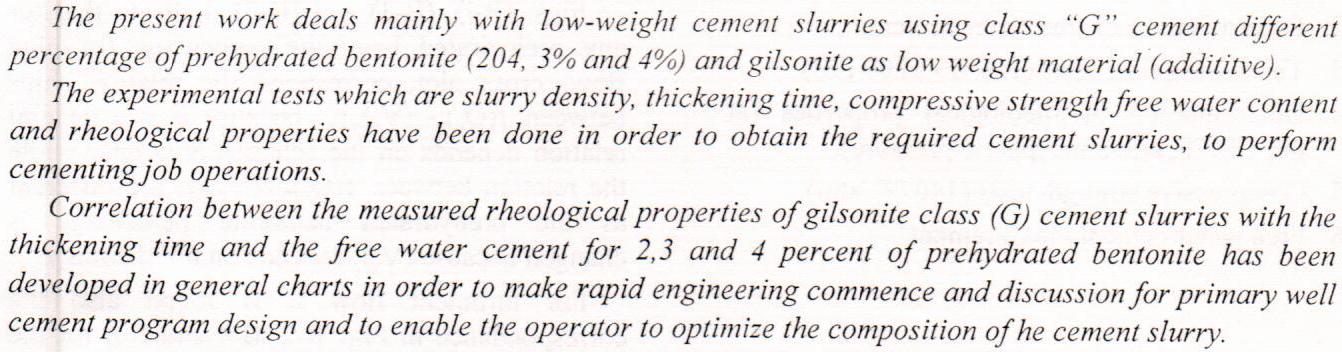
Physical and Rheological Properties of Class "G" Gilsonite Cement Slurries (Experimental Study)

Background: Poly (methyl methacrylate) has several disadvantages (poor mechanical properties) like impact and transverse strength. In order to overcome these disadvantages, several methods were used to strengthen the acrylic resin by using different fibers or fillers. This study was conducted to evaluate the effect of Plasma treatment of the fiber on mechanical properties Poly (methyl methacrylate) denture base material. Materials and methods: Specimens were prepared from poly methyl metha acrylic (PMMA) divided according to present of fiber into 4 groups (first group without fiber as control group, second group with Plasma treated polyester fibers, third group with Plasma treated polyamide fibers and fourth group Plasma treated combination
... Show More (2)
(2)

Preparation of superposed thin film (CdTe)1-xSex / ZnS) with concentration of (x= 0.1, 0.3, 0.5) at a temperature of substrate (Ts= 80 0C) by using Thermal Vacuum Evaporation System. The measurement of X-ray diffraction shows that the compounds CdTe, ZnS, (CdTe)1-xSex and (CdTe)1-xSex / ZnS have a polycrystalline structure, the C-V characteristic shows that the capacitance degrease by increasing the concentration (x) in reverse bias, while the I-V characteristic shows the current dark (Id) increase in forward and reverse bias by increasing (x) and the photocurrent (Iph) increase in reverse bias by increasing the concentration (x), the values of photocurrent are greater than from the values of the dark current for all concentrations
... Show More
In this work; copper oxide films (CuO) were fabricated by PLD. The films were analyzed by UV-VIS absorption spectra and their thickness by using profilometer. Pulsed Nd:YAG laser was used for prepared CuO thin films under O2 gas environment with varying both pulse energy and annealing temperature. The optical properties of as-grown film such as optical transmittance spectrum, refractive index and energy gap has been measured experimentally and the effects of laser pulse energy and annealing temperature on it were studied. An inverse relationship between energy gap and both annealing temperature and pulse energy was observed.
(5)
High temperature superconductors materials with composition Bi1.6-xSbxPb0.4Sr2Ca2-yCdyCu3OZ (x = 0, 0.1, 0.2 and 0.3) and (y = 0.01 and 0.02), were prepared by using the chemical reaction in solid-state ways, and test influence of partial replacement of Bi and Ca with Sb and Cd respectively on the superconducting properties, all samples were sintered at the same temperature (850 oC) and for the same time (195 h). The structural analysis of the prepared samples was carried out using X-ray diffraction (XRD) measurements performed at room temperature, scanning electron microscope (SEM) and dc electrical resistivity was measured as a function of temperature. It was found that the sample prepared by partial substitution of Sb at ratio (x= 0.2
... Show More
In this research ,Undoped Nio and 1%Li doped Nio thin films were deposited utilizing chemical spray pyrolysis on the glass substrates heated (450C). The effects of non-thermal plasma on the structural and optical properties were studied. XRD measurement shows that Nio and Nio:1%Li films were found to be polycrystalline and have cubic structure with a preferred orientation (111). Decreased crystal size after exposure especially at (7) sec. AFM data indicate that the surface roughness average and (RMS) values of the prepared doped films are increasing after exposure to plasma, the transmittance increases after doped samples exposure to plasma, it was found that the energy gap value decreased when doped samples exposure to plasma, also, thickn
... Show More
(1)

Tin dioxide doped silver oxide thin films with different x content (0, 0.03, 0.05, 0.07) have been prepared by pulse laser deposition technique (PLD) at room temperatures (RT). The effect of doping concentration on the structural and electrical properties of the films were studied. Atomic Force Measurement (AFM) measurements found that the average value of grain size for all films at RT decrease with increasing of AgO content. While an average roughness values increase with increasing x content. The electrical properties of these films were studied with different x content. The D.C conductivity for all films increases with increasing x content. Also, it found that activation energies decrease with increasing of AgO content for all films.
... Show More
 (6)
(8)
(6)
(8)
Alloys were performed from In2O3 doped SnO2 with different doping ratio by quenching from the melt technique. Pulsed Laser Deposition PLD was used to deposit thin films of different doping ratio In2O3 : SnO2 ( 0, 1, 3, 5, 7 and 9 % wt.) on glass substrate at ambient temperature under vacuum of 10 -3 bar thickness of ~100nm. The structural type ,grain size and morphology of the prepared alloys compounds and thin films were examined using X-ray diffraction and atomic force microscopy . The results showed that all alloys have polycrystalline structures and the peaks belonged to the preferred plane for crystal growth were identical with the ITO (Indium – Tin –Oxide) standard cards also another peaks were ob
... Show More
(12)
(5)