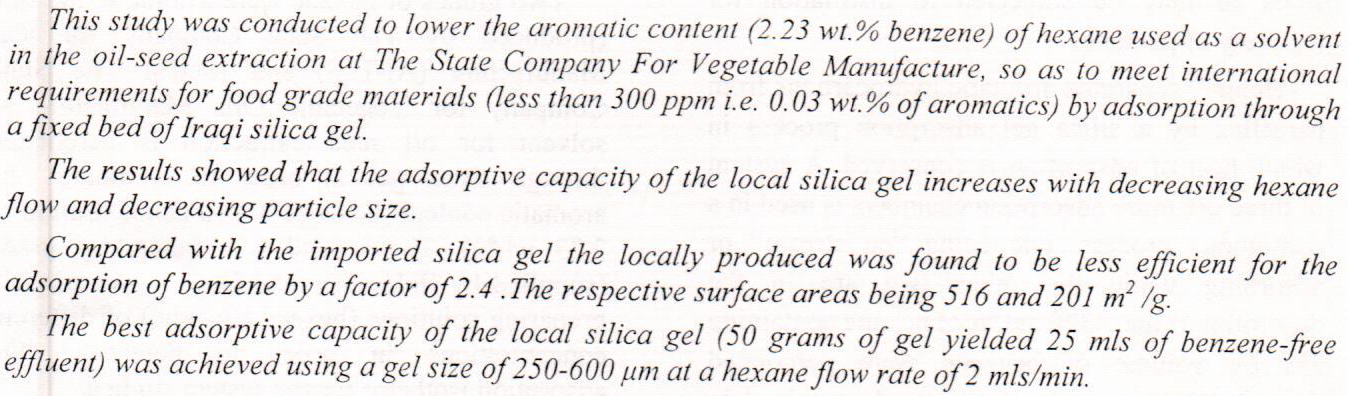
Reduction of Aromatic Content from Hexane by Silica Gel

Poly urea formaldehyde –Bentonite (PUF-Bentonite) composite was tested as new adsorbent
for removal of mefenamic acid (MA) from simulated wastewater in batch adsorption
procedure. Developed a method for preparing poly urea formaldehyde gel in basic media by
using condensation polymerization. Adsorption experiments were carried out as a function of
water pH, temperature, contact time, adsorbent dose and initial MA concentration .Effect of
sharing surface with other analgesic pharmaceuticals at different pH also studied. The
adsorption of MA was found to be strongly dependent to pH. The Freundlich isotherm model
showed a good fit to the equilibrium adsorption data. From Dubinin–Radushkevich model the
mean free
The development of economic and environmentally friendly extractants to recover cobalt metal is required due to the increasing demand for this metal. In this study, solvent extraction of Co(II) from aqueous solution using a mixture of N,N0-carbonyl difatty amides (CDFAs) synthesised from palm oil as the extractant was carried out. The effects of various parameters such as acid, contact time, extractant concentration, metal ion concentration and stripping agent and the separation of Co(II) from other metal ions such as Fe(II), Ni(II), Zn(III) and Cd(II) were investigated. It was found that the extraction of Co(II) into the organic phase involved the formation of 1:1 complexes. Co(II) was successfully separated from commonly associated metal
... Show More (27)
(27)
 (14)
(14)



A liquid membrane process of Alkaloids extraction from Datura Innoxia solution was studied applying pertraction process in rotating discs contactor (RDC). Decane as a liquid membrane and dilute sulphuric acid as stripping solution were used. The effect of the fundamental parameters influencing the transport process, e.g. type of solvent used, effect of disks speed, amount of liquid membrane and effect of pH for feed and strip solution. The transport of alkaloids was analysed on the basis of kinetic laws of two consecutive irreversible first order reactions. Thus, the kinetic parameters (k1, k1, , tmax, and ) for the transport of alkaloids were determined. The effect of organic membrane type on percentage of Alkaloids transport was found
... Show MoreA liquid membrane process of Alkaloids extraction from Datura Innoxia solution was studied applying pertraction process in rotating discs contactor (RDC). Decane as a liquid membrane and dilute sulphuric acid as stripping solution were used. The effect of the fundamental parameters influencing the transport process, eg type of solvent used, effect of disks speed, amount of liquid membrane and effect of pH for feed and strip solution. The transport of alkaloids was analysed on the basis of kinetic laws of two consecutive irreversible first order reactions. Thus, the kinetic parameters (k1, k1,, tmax, and) for the transport of alkaloids were determined. The effect of organic membrane type on percentage of Alkaloids transport was found to be i
... Show MoreThe extraction of Eucalyptus oil from Iraqi Eucalyptus Camadulensis leaves was studded using water distillation methods. The amount of Eucalyptus oil has been determined in a variety of extraction temperature and agitation speed. The effect of water to Eucalyptus leaves (solvent to solid) ratio and particle size of Eucalyptus leaves has been studied in order to evaluate the amount of Eucalyptus oil. The optimum experimental condition for the Eucalyptus oil extraction was established as follows: 100 C extraction temperature, 200 rpm agitation speed; 0.5 cm leave particle size and 6: 1 ml: g amount of water to eucalyptus leaves Ratio.
(23)
(25)
Development and population expansion have the lion's share of driving up the fuel cost. Biodiesel has considerable attention as a renewable, ecologically friendly and alternative fuel source. In this study, CaO nanocatalyst is produced from mango leaves as a catalysis for the transesterification of waste cooking oil (WCO) to biodiesel. The mango tree is a perennial plant, and its fruit holds significant economic worth due to its abundance of vitamins and minerals. This plant has a wide geographical range and its leaves can be utilized without any negative impact on its growth and yield. An analysis was conducted to determine the calcium content in the fallen leaves, revealing a significant quantity of calcium that holds potential fo
... Show More
(18)
(14)
A simple and rapid high performance liquid chromatographic with fluorescence detection method for the determination of the aflatoxin B1, B2, G1 and G2 in peanuts, rice and chilli was developed. The sample was extracted using acetonitrile:water (90:10, v/v%) and then purified by using ISOLUTE multimode solid phase extraction. After the pre-column derivatisation, the analytes were separated within 3.7 min using Chromolith performance RP-18e (100–4.6 mm) monolithic column. To assess the possible effects of endogenous components in the food items, matrix-matched calibration was used for the quantification and validation. The recoveries of aflatoxins that were spiked into food samples were 86.38–104.5% and RSDs were <4.4%. The method was
... Show More
(95)
(85)
Removal of solar brown and direct black dyes by coagulation with two aluminum based
coagulants was conducted. The main objective is to examine the efficiency of these
coagulants in the treatment of dye polluted water discharged from Al-Kadhymia Textile
Company (Baghdad-Iraq). The performance of these coagulants was investigated through
jar test by comparing dye percent removal at different wastewater pH, coagulant dose,
and initial dye concentration. Results show that alum works better than PAC under acidic
media (5-6) and PAC works better under basic media (7-8) in the removal of both solar
brown and direct black dyes. Higher doses of PAC were required to achieve the
maximum removal efficiency under optimum pH co
Toxic dyes are commonly discharged into waste waters and dyes are extensively used in the textile industry so it is necessary to find out efficient and eco-friendly method for treating waste waters resulting from industrial effluences. To achieve this aim the fungus Trichoderma sp. is employed into two lines: first line was self – immobilized fungal pellets in (Czapek – Dox medium) to adsorbs two dyes crystal violet, congo red by concentrations 0.01, 0.02, 0.03, 0.04, 0.05, 0.06 mg/L to both dyes, PH 2, room temperature with shaker in ( hrs.2,hrs.4,hrs.24) , by Uv- Visible spectrum . the removal efficiency of 0.05 mg/L crystal violet by Trichoderma sp was 96%. but there was no remova
... Show More
(9)
(4)