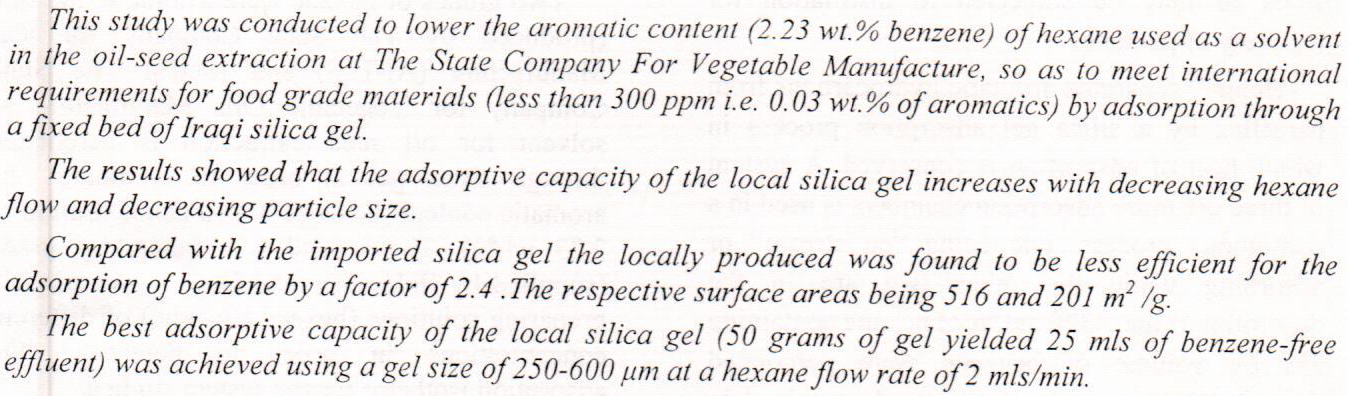
Reduction of Aromatic Content from Hexane by Silica Gel

The escalating generation of industrial waste alongside the growing demand for high-performance, environmentally sustainable drilling fluids presents critical challenges to the oil and gas sector. Conventional drilling fluid additives are predominantly synthesized from virgin materials, contributing to resource depletion and environmental burden. Objectives: This study pioneers a circular economy approach by synthesizing silica nanoparticles (SiO2NPS) and alumina nanoparticles (Al2O3NPs) entirely from locally sourced industrial waste — bentonite clay and aluminum scrap, respectively — and evaluating their performance as functional additives in water-based drilling fluids (WBDFs). Novelty: To the best of our knowledge, this represents th
... Show More

Abstract
Objective: the idea of this study to improve transdermal permeability of Methotrexate using eucalyptus oil, olive oil and peppermint oil as enhancers.
Method: eucalyptus oil (2% and 4%), peppermint oil (2% and 4%) and olive oil (2% and 4%) all used as natural enhancers to develop transdermal permeability of Methotrexate via gel formulation. The gel was subjected to many physiochemical properties tests. In-vitro release and permeability studies for the drug were done by Franz cell diffusion across synthetic membrane, kinetic model was studied via korsmeyer- peppas equation.
Result: the results demonstrate that safe, nonirritant or cause necrosis to rats' skin and stable till 60 days gel was successfully formulated.<
 (9)
(9)
 (3)
(12)
(16)
(12)
(3)
(12)
(16)
(12)
Abstract
In this study, the effect of carboxylic methyl cellulose (CMC), and sodium dodcyl benzene sulfonate (SDBS) as an aqueous solution on the drag reduction was investigated. Different concentrations of (CMC) and (SDBS) such as (50, 100, 150, 200, 250, 300, 350, 400, 450, and 500 ppm) were used to analyze the aqueous solution properties, including surface tension, conductivity, and shear viscosity. The optimum four concentrations (i.e., 50, 100, 200, and 300 ppm) of fluid properties were utilized to find their effect on the drag reduction. Two different PVC pipe diameters (i.e., 1" and 3/4") were used in this work. The results showed that blending CMC with SDBS gives
... Show More
(19)
(15)

This study aims to develop a thermosensitive mucoadhesive periodontal in situ gel of secnidazole for local release of drug for treatment of periodontitis, in order to increase the drug residence time and to increase patient compliance while lowering the side effects of the drug.
Cold method was used to prepare 30 formulas of secnidazole periodontal in situ gel, using different concentrations of thermosensitive polymers (poloxamer407 alone or in combination with poloxamer 188) and methyl cellulose (MC ) or hydroxypropyl methylcellulose (HPMC K4M )in different concentrations used as mucoadhesive polymer and the resultant formulations were subjected to several tests such as gelation temperature GT, appearance and pH value. The fo
... Show More
(16)
(12)
The current study examines the combined impacts of ultrasonic waves and nano silica (NS) on reducing the viscosity Sharqy Baghdad heavy crude oil with an API gravity of 20.32. NS of an average particle size of 59.93 nm and 563.23 m²/g surface area were produced utilizing the sol-gel technique from Iraqi sand. The XRD analysis indicates the existence of an amorphous silica, the SEM analysis showed that NS tends to agglomerate, and the FTIR spectra exhibited the presence of siloxane and silanol groups. In addition, the TGA analysis demonstrated a total weight loss of 15.62%, validating the thermal stability of the NS. The experiments included a study of the impact of ultrasonic power, exposure time, duty cycle, temperature, and the c
... Show More
(3)
The current study examines the combined impacts of ultrasonic waves and nano silica (NS) on reducing the viscosity Sharqy Baghdad heavy crude oil with an API gravity of 20.32. NS of an average particle size of 59.93 nm and 563.23 m²/g surface area were produced utilizing the sol-gel technique from Iraqi sand. The XRD analysis indicates the existence of an amorphous silica, the SEM analysis showed that NS tends to agglomerate, and the FTIR spectra exhibited the presence of siloxane and silanol groups. In addition, the TGA analysis demonstrated a total weight loss of 15.62%, validating the thermal stability of the NS. The experiments included a study of the impact of ultrasonic power, exposure time, duty cycle, temperature, and the c
... Show More
(4)