Reduction of Aromatic Content from Hexane by Silica Gel
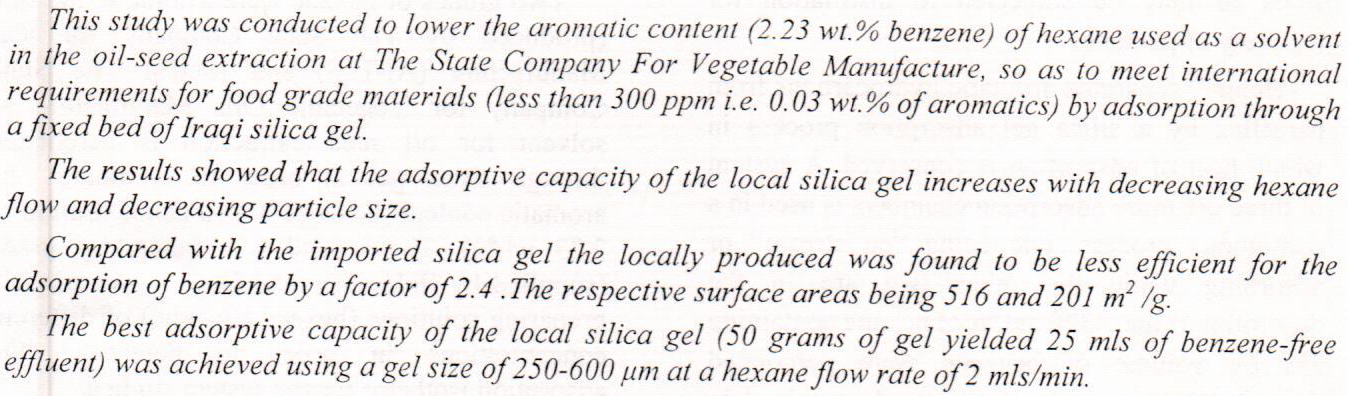

Activated carbon was Produced from coconut shell and was used for removing sulfate from industrial waste water in batch Processes. The influence of various parameter were studied such as pH (4.5 – 9.) , agitation time (0 – 120)min and adsorbent dose (2 – 10) gm.
The Langmuir and frandlich adsorption capacity models were been investigated where showed there are fitting with langmmuir model with squre regression value ( 0.76). The percent of removal of sulfate (22% - 38%) at (PH=7) in the isotherm experiment increased with adsorbent mass increasing. The maximum removal value of sulfate at different pH experiments is (43%) at pH=7.
The biochar prepared from sawdust raw material was applied in this study for the treatment of wastewater polluted with methyl orange dye. The effect of pH (2-11), initial concertation (50-250 mg/L) and time were studied. The isotherm of Langmuir, Frendluch and temkin models studied. The Langmuir model was the best to explain the adsorption process, maximum uptake was 136.67 mg/g at 25Co of methyl orange dye. Equilibrium reached after four hours of contact for most adsorbents.The values of thermodynamic parameters ∆G were negative at various temperatures, so the process spontaneous, while ∆H values were 16683 j/mol and ∆S values was 60.82 j/mol.k.
 (16)
(16)

New technologies have risen into popularity causing the Liquid membrane techniques to evolve over other separation techniques due to its high selectivity and recovery, increased fluxes, and reduced investment and operating cost. This work focuses on extracting Methylene Blue (MB), a cationic dye using a simple BLM separation technique from its aqueous phase. It combines extraction and stripping in a single unit operation. The feed phase was an aqueous solution of MB, the solvent chosen was soybean oil for the liquid/organic membrane phase, and tri-octyl amine acted as a carrier. The strip phase was a hydrochloric acid solution for this study. A two-phase equilibrium study was done to choose the correct solvent, carrier,
... Show More (4)
(3)
(4)
(3)

The influence of SDBS, SLS, SLES, and SS as drag reducing agents on flow of Iraqi crude oil in pipelines was investigated in the present work. The effect of additive type, additive concentration, pipe diameter, solution flow rate, and the presence of elbows on the percentage of drag reduction (%Dr) and the amount of flow increases (%FI) was addressed. The maximum drag reduction was 55% obtained at 250 ppm SDBS surfactant flowing in straight pipes of 0.0508 m I.D. The dimensional analysis was used for grouping the significant quantities into dimensionless groups to reduce the number of variables. The results showed good agreement between the observed drag reduction percent values and the predicted ones with high value of the co
... Show More
(25)
(18)
In this research, the performance of a two kind of membrane was examined to recovering the nutrients (protein and lactose) from the whey produced by the soft cheese industry in the General Company for Food Products inAbo-ghraab.Wheyare treated in two stages, the first including press whey into micron filter made of poly vinylidene difluoride (PVDF) standard plate type 800 kilo dalton, The membrane separates the whey to permeate which represent is the main nutrients and to remove the fat and microorganisms.The second stage is to isolate the protein by using ultra filter made of polyethylsulphone(PES)type plate with a measurement of 10,60 kilo dalton and the recovery of lactose in the form of permeate.
The results showed that the percen
Low oil extraction and early high water production are caused in part by reservoir heterogeneity. Huge quantities of water production are prevalent issues that happen in older reservoirs. Polyacrylamide polymer gel systems have been frequently employed as plugging agents in heterogeneous reservoirs to regulate water output and increase sweep efficiency. Polyacrylamide polymer gel systems are classified into three classes depending on their composition and application conditions, which are in-situ monomer gel, in-situ polymer gel, and preformed particle gel (PPG).
This paper gives a comprehensive review of PPG’s status, preparation, and mechanisms. Many sorts of PPGs are categorized, for example, millimeter-sized preformed p
... Show More
(3)
Sera samples were collected from 60 children aged 4-60 months, all were clinically and serologically proven cases of visceral leishmaniasis, as well as from 10 healthy children, all were seronegative with no history of parasitic infection who serve as a control during the study. Serum total protein and albumin were measured and compared between the control and visceral leishmaniasis patients. Serum protein profiles have been investigated using the conventional sodium dodecyl sulphate – polyacrylamide gel electrophoresis (SDS-PAGE). Serum of control group showed the specific protein pattern with five protein bands, while serum protein profile in visceral leishmaniasis pat
... Show More
Sumatriptan(ST) is a selective agonist at serotonin 5-HTI receptors, as well as 5-HT1B/1D subtypes. It is effective for acute migraine attacks, but has a short half life (about 2 hours) and low oral bioavailability (15%). The purpose of this study was to develop and optimize nasal mucoadhesive in-situ gel(IG) of ST to enhance nasal residence time for migraine management. Cold method was used to prepare different formulas of ST nasal IG, using thermosensitive polymers (poloxamer 407 alone or with poloxamer 188) with a mucoadhesive polymer hyaluronic acid (HA) which were examined for gelation temperature and gelation time, pH, drug content, gel strength, spreadability, muc
... Show More
(42)
(25)