The Optimal Corrosion Inhibition of Aluminum in 0.1M NaCl Solution
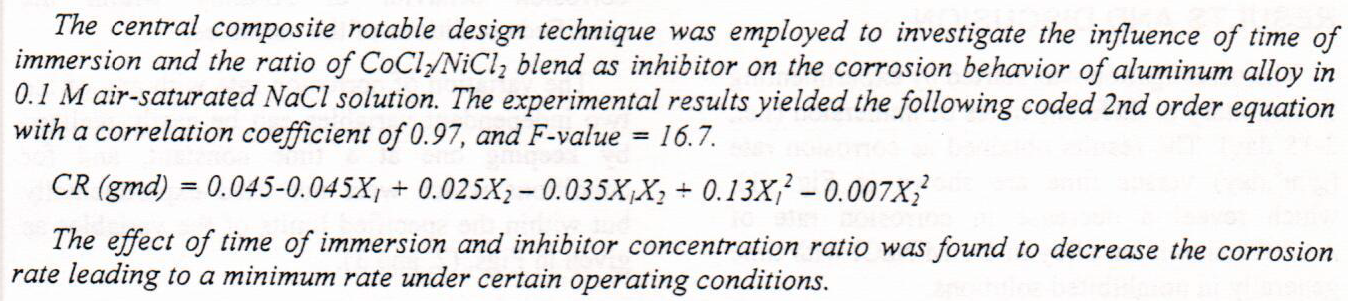

The corrosion behavior of bare and chemical conversion coated (through anodizing) aluminum ASA 606 I in stagnant chromic acid solutions . Solutions of 2, 6 & J O wt. % Cr03 at 45°C, have been investigated using polarization technique. The anodizing experiments were conducted under fixed conditions of 35 minute exposure time and 30 volt supplied voltage. The most important feature achieved was the great difference in behavior between the anodic polarization curves for bare and anodized aluminum in different concentrations of chromic acid solutions.
Aluminum alloy 5052 had been anodized by sulfuric acid as an electrolyte under constant voltage and the anodic oxide film produce will be testing by potentiostatic anodic polarization .Two variables, which were considered as important variables, were studied. These variables are anodizing time 15,30 min. and sealing time 10,20 min., and the test by potentiostatic anodic polarization through electro chemical polarization measurements in solutions of 1N na2so4 ( PH= 1 ). The results are discussed in light of the rate of ionic current flow through the coating during anodic polarization measurements.
 (22)
(22)
 (19)
(19)


The Planning and Resource Development Department of the Iraqi Ministry of Health is very interested in improving medical care, health education, and village training programs. Accordingly, and through the available capabilities of the ministry, itdesires to allocate seven health centers to four villages in Baghdad, Iraq therefore the ministry needs to determine the number of health centers allocated to each of these villages which achieves the greatest degree of the overall effectiveness of the seven health centers in a fuzzy environment. The objective of this study is to use a fuzzy dynamic programming(DP) method to determine the optimal allocation of these centers, which allows the greatest overall effectiveness of these health centers
... Show More
(3)
(1)

Bacteria could produce bacterial nanocellulose through a procedure steps: polymerization and crystallization, that occur in the cytoplasm of the bacteria, the residues of glucose polymerize to (β-1,4) lineal glucan chains that produced from bacterial cell extracellularly, these lineal glucan are converted to microfbrils, after that these microfbrils collected together to shape very pure three dimensional pored net. It could be obtained a pure cellulose that created by some M.O, from the one of the active producer organism like Acetic acid bacteria (AAB), that it is a gram -ve, motile and live in aerobic condition. The bacterial nanocellulose (BNC) have great consideration in many fields because of its flexible properties, features
... Show More
This study aims to model the flank wear prediction equation in metal cutting, depending on the workpiece material properties and almost cutting conditions. A new method of energy transferred solution between the cutting tool and workpiece was introduced through the flow stress of chip formation by using the Johnson-Cook model. To investigate this model, an orthogonal cutting test coupled with finite element analysis was carried out to solve this model and finding a wear coefficient of cutting 6061-T6 aluminum and the given carbide tool.
Plant extracts occupied a big place in diseases treatment and preserving human health because, they contain many active substances that can be exploited in the field of pharmaceutical manufacturing from natural materials. Therefore, this study was conducted to evaluate the effect of different concentrations of plant extracts for each of Nigella sativa, Alliumsativum and Allium cepa against the fungal growth of Candida albicans that cause many skin diseases and infections to humans as well as Trichophyton mentagrophytes, which affects the hair, skin and nails. These two fungi have been isolated and diagnosed from people who have skin infection. Both fungal isolates were treated with extracts of Nigella sativa, Alliumsativum and Allium cepa
... Show More
(2)
(18)
(15)
This study evaluated the effect of two different types of amino group-containing pharmacological inhibitors on titanium corrosion under acidic conditions. The first inhibitor examined was the antibiotic trimethoprim. The second inhibitor studied was the nonsteroidal anti-inflammatory drug voltaren. The results showed that titanium had a high corrosion current in the absence of a corrosion inhibitor, however, trimethoprim notably enhanced corrosion resistance and protection percentages of titanium (%IE) at higher concentrations by adhering to the metal surface, as evidenced by improved protection percentages. Furthermore, the results showed that as Voltaren concentration was increased, both corrosion resistance and inhibition efficie
... Show More
(1)
The corrosion of low carbon steel boiler tubes in demi water had been investigated. The purpose of this investigation was to determine the change produced in corrosion behavior of the carbon steel as a result of the specific presence of chloride and copper ions in the water under different temperatures. For low carbon steel experiments, the temperature was taken in three levels (125, 175, and 215°C) under about 27 bar pressure and 1500 rpm in autoclave. Using weight loss technique, the corrosion rate ranges from (85 to 789 gmd) for low carbon steel boiler tubes.