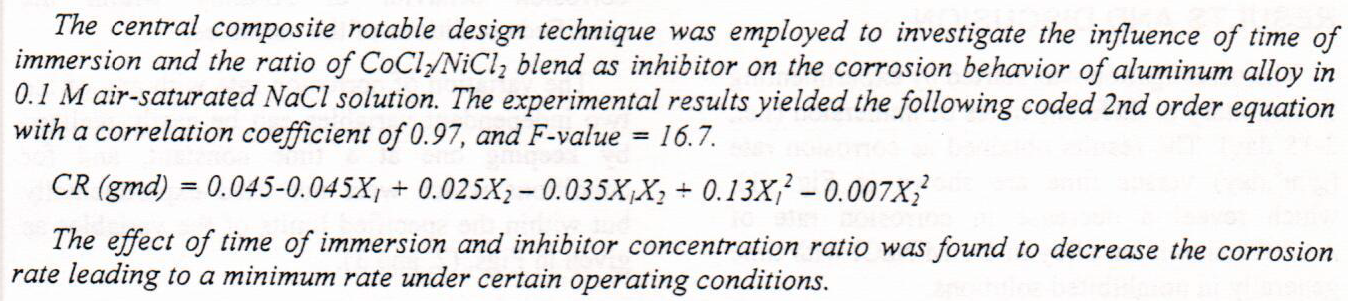
The Optimal Corrosion Inhibition of Aluminum in 0.1M NaCl Solution

The deployment of UAVs is one of the key challenges in UAV-based communications while using UAVs for IoT applications. In this article, a new scheme for energy efficient data collection with a deadline time for the Internet of things (IoT) using the Unmanned Aerial Vehicles (UAV) is presented. We provided a new data collection method, which was set to collect IoT node data by providing an efficient deployment and mobility of multiple UAV, used to collect data from ground internet of things devices in a given deadline time. In the proposed method, data collection was done with minimum energy consumption of IoTs as well as UAVs. In order to find an optimal solution to this problem, we will first provide a mixed integer linear programming m
... Show More (6)
(6)
 (2)
(2)



KE Sharquie, AA Noaimi, AM Oweid, JSSDDS, 2009 - Cited by 2
One of the most essential components of asphalt pavements is the filler. It serves two purposes. First, this fine-grained material (diameter less than 0.075 mm) improves the cohesiveness of aggregate with bitumen. Second, produce a dense mixture by filling the voids between the particles. Aluminum dross (AD), which is a by-product of aluminum re-melting, is formed all over the world. This material causes damage to humans and the environment; stockpiling AD in landfills is not the best solution. This research studies the possibility of replacing part of the conventional filler with aluminum dross. Three percent of dross was used, 10, 20, and 30% by filler weight. The MarshallMix design method was adopted to obtain the op
... Show More
(3)
(2)
The goal (purpose) from using development technology that require mathematical procedure related with high Quality & sufficiency of solving complex problem called Dynamic Programming with in recursive method (forward & backward) through finding series of associated decisions for reliability function of Pareto distribution estimator by using two approach Maximum likelihood & moment .to conclude optimal policy
المستودع الرقمي العراقي. مركز المعلومات الرقمية التابع لمكتبة العتبة العباسية المقدسة
In cognitive radio networks, there are two important probabilities; the first probability is important to primary users called probability of detection as it indicates their protection level from secondary users, and the second probability is important to the secondary users called probability of false alarm which is used for determining their using of unoccupied channel. Cooperation sensing can improve the probabilities of detection and false alarm. A new approach of determine optimal value for these probabilities, is supposed and considered to face multi secondary users through discovering an optimal threshold value for each unique detection curve then jointly find the optimal thresholds. To get the aggregated throughput over transmission
... Show More
(1)
(1)
(25)
(23)
This study evaluates the performance of magnetic abrasive finishing (MAF) of aluminum alloy in terms of achieving materials removal (MR). A vertical milling machine is used to perform the finishing process using a developed MAF unit that consists of an inductor made out of a 150 mm long and 20 mm diameter iron core wound with 1500 turns and 0.5 mm copper wire. The commutator and magnetic pole are attached at the top and bottom of the inductor, respectively. The required current is supplied using a DC power supply. The South Pole workpiece is a 100×50×3 mm3 plate of AA 1100 aluminum alloy, whereas the magnetic pole represented the North Pole. Pole rotational speed, applied current, and abrasive finishing time was selected as
... Show More
(1)