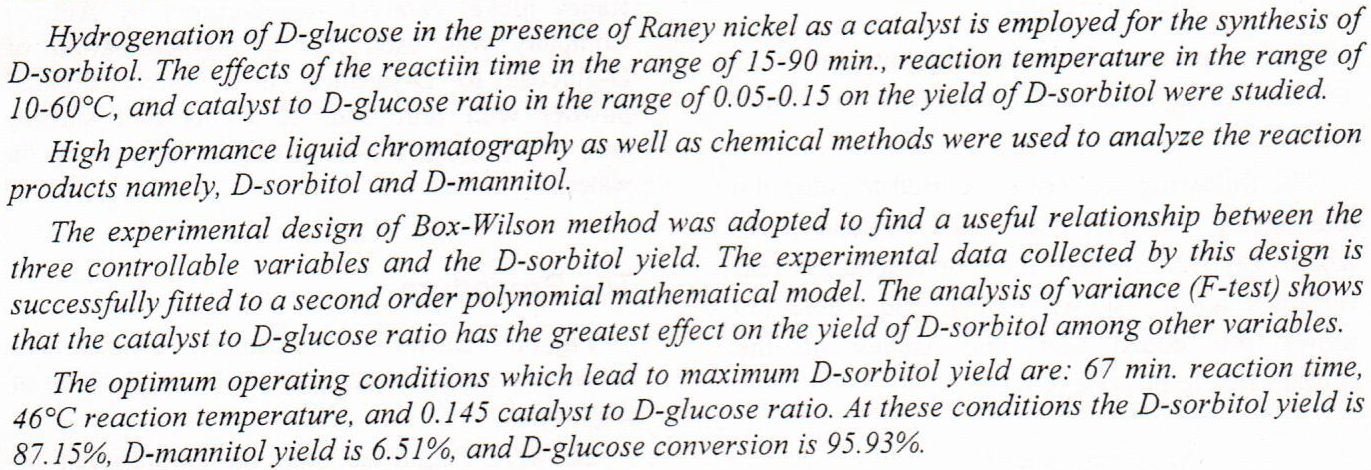
D-Sorbitol Production by Catalytic Hydrogenation of D-Glucose



Catalytic reforming of naphtha occupies an important issue in refineries for obtaining high octane gasoline and aromatic compounds, which are the basic materials of petrochemical industries. In this study, a novel of design parameters for industrial continuous catalytic reforming reactors of naphtha is proposed to increase the aromatics and hydrogen productions. Improving a rigorous mathematical model for industrial catalytic reactors of naphtha is studied here based on industrial data applying a new kinetic and deactivation model. The optimal design variables are obtained utilizing the optimization process in order to build the model with high accuracy and such design parameters are then applied to get the best configuration of this pro
... Show MoreThe crystalline zeolite, namely faujasite type Y with SiO2/Al2O3 mole ratio of 5 was used as raw material for preparation of isomerization catalysts. A 0.5 wt % Pt/HY-zeolite catalyst was prepared by impregnation of the decationized HY-zeolite with chloroplatinic acid. The dectionized HY-zeolite was treated with HCl, HNO3 and HI promoters using different normalities and with different concentrations of Sn, Ni and Ti promoters by impregnation method to obtain acidic and metallic promoters' catalysts, respectively. A 0.5 wt% of Pt was added to above catalysts using impregnation method. Isomerization of n-hexane was carried out at different prepared catalysts. The isomerization temperature varied from 250–325° C over weight hourly space
... Show MoreAeromonas hydrophila have been isolated as a cause of a cute gastroenteritis in 23 (5.6%) of 410 patients. Other bacterial enteropathogens have been isolated from 387 patients with diarrhea, were 19 different strains. A. hydrophila occurred more commonly in children with acute diarrhea, the results showed that 18(78.26%) isolates of A. hydrophila found in children under 10 years old ,distributed to 10(43.47%) in male and 8(34.78%) in female ,and in adults with diarrhea 5 (21.73%). In the other hand, we noticed frequency of isolation was higher in male 14(60.86%) when compared with 9(39.14%) in female. Six strains of A. hydrophila have been observed to have bacteriocin activity against 12 of 23 different A. hydrophila ,as well as Staphy
... Show More
Anaerobic digestion (AD) is the most common process for dealing with primary and secondary wastewater sludge. In the present work, four pre-treatment methods (ultrasonic, chemical, thermal, and thermo-chemical) are investigated in Al-Rustumya Wastewater Treatment plant in order to find their effect on biogas production and volatile solid removal efficiency during anaerobic digestion.
Two frequencies of ultrasonic wave were used 30 KHz and 50 KHz during the pre-treatment. Sodium hydroxide was added in different amounts to give three pH values of 9, 10 and 11 in chemical pre-treating processes. The sludge was heated at 60oC and 80oC through thermal pre-treatment experiment. Also, the sludge was treated thermo-chemically at 80 oC and pH
This study was carried out to obtain the optimum conditions necessary for the process of soya protein hydrolysis by using hydrochloric acid (as a chemical catalyst) instead of the papain enzyme (as a biological catalyst), for the production of soya peptone. These conditions are implemented to test the effect of the variables of the process of hydrolysis on the nature and quality of the product.
The production of soya peptone was studied for their importance in the process of preparing and producing the culture media used in medical and microbiological laboratories.
The process of production of soya peptone includes four main
... Show MoreResearch summarized in applying the model of fuzzy goal programming for aggregate production planning , in General Company for hydraulic industries / plastic factory to get an optimal production plan trying to cope with the impact that fluctuations in demand and employs all available resources using two strategies where they are available inventories strategy and the strategy of change in the level of the workforce, these strategies costs are usually imprecise/fuzzy. The plant administration trying to minimize total production costs, minimize carrying costs and minimize changes in labour levels. depending on the gained data from th
... Show More
Thirty local fungal isolates according to Aspergillus niger were screened for Inulinase production on synthetic solid medium depending on inulin hydrolysis appear as clear zone around fungal colony. Semi-quantitative screening was performed to select the most efficient isolate for inulinase production. the most efficient isolate was AN20. The optimum condition for enzyme production from A. niger isolate was determined by busing a medium composed of sugar cane moisten with corn steep liquor 5;5 (v/w) at initial pH 5.0 for 96 hours at 30 0C . Enzyme productivity was tested for each of the yeast Kluyveromyces marxianus, the fungus A. niger AN20 and for a mixed culture of A. niger and K. marxianus. The productivity of A. niger gave the highest
... Show More (3)
(3)
Biogas is one of the most important sources of renewable energy and is considered as an environment friendly energy source. The major goal of this research is to see if rice husk (Rh) waste and pomegranate peels (PP) waste are suitable for anaerobic digestion and what effect NaOH pre-treatment has on biogas generation. Rice husk and pomegranate peels were tested in anaerobic digestion under patch anaerobic conditions as separate wastes as well as blended together in equal proportions. The cumulative biogas output for the blank test (no pretreatment) was 1923 and 2526 ml, respectively using a single rice husk (Rh) and pomegranate peel (PP) substrates. The 50% rice husk digestion and 50% of pomegranate peels for blank test gave the result 224
... Show MoreModifying of HY/Zeolite is by loading nickel for applying catalyst in thermal catalytic cracking of furfural extract-40 from the lubricating base oil unit. The study involved the characterizing of HY-zeolite and promoted catalyst with nickel by X-ray diffraction analysis, Scanning electron microscopy (SEM), BET (Brunauer, Emmett, and Teller), and infrared ray analyses FTIR. The catalytic thermal cracking tubular reactor with a fixed bed with two type catalysts; HY/zeolite and Ni HY/zeolite, individually at a temperature of 580oC with LHSV 5h-1 was investigated. The results indicated that increase the conversion of catalytic cracking of furfural extract-40 also increases the yield of useful petroleum
... Show More