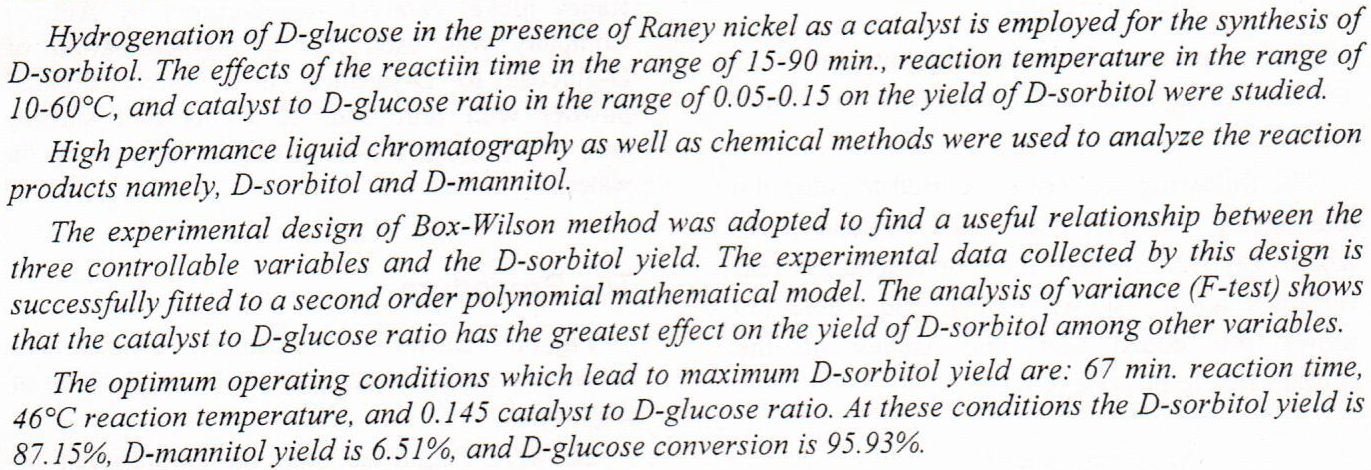
D-Sorbitol Production by Catalytic Hydrogenation of D-Glucose

This study aimed to obtain a local isolation of Aspergillus niger and then studied its ability to produce citric acid from raw materials available locally using solid state fermentation. Six local isolates were collected from different sources including some samples of the damaged fruits such as grapefruit, oranges and sindi. Wheat bran was used as a raw material or as culture medium for the production of citric acid from the collected isolates. The conditions for citric acid production were determined by humidity percentage of 1: 1 (water: culture medium), temperature of 28 C, pH 4 and inoculum dose with 5× 10⁶ spore/ml and for 3 days of incubation. The orange was the best model for citric acid production with a concentration of 12.8 mg/m
... Show More (5)
(5)
 (2)
(2)


The aim of this study was to increasing natural carotenoides production by a locally isolate Rodotorula mucilagenosa M. by determination of the optimal conditions for growth and production of this agents, for encouragest to use it in food application permute artificial pigments which harmfull for consumer health and envieronmental. The optimal condition of carotenoides production from Rhodotorula mucilaginosa M were studied. The results shows the best carbon and nitrogen source were glucose and yeast extract. The carotenoids a mount production was 47430 microgram ̸ litter and 47460 microgram ̸ litter, respectively, and the optimum temperature was 30°C, PH 6, that the carotenoides a mount was 47470 microgram ̸ litter and 47670 microgr
... Show MoreCatalytic microwave-assisted pyrolysis of biomass is gaining popularity as an alternative to fossil fuels due to health, environmental, climate, and economic issues. This study conducted a catalytic pyrolysis process of the Albizia plant's branches using an Iraqi clay catalyst (bentonite) focusing on the variables including the biomass-particle size, experimental time, microwave power level, and the catalyst-to-biomass ratio. The physical and chemical properties of the resulting biofuel were analyzed presented by HHV, acidity, density, viscosity, GC-MS, FTIR for bio-oil and SEM, EDX, BET, HHV, FTIR for biochar. The study revealed that addition of bentonite as a catalyst led to enhanced production of biogas produced from 5% to 45% an
... Show More
(6)
Abstract
The hydrometallurgical method was used to platinum and palladium leaching with aqua regia solution (3HCl: HNO3). The leaching experiments were designed to obtain the optimum conditions by using Taguchi method with 16 experiments at three different factors (time, temperature and solid to liquid ratio), and each factor has four different levels. In this study, leaching the powder sample of catalytic converter that contains platinum and palladium was conducted on the basis of the formation of chloro complexes platinum and palladium (PtCl62-, PdCl42-) with different concentrations in the acidic solution. The optimum condi
... Show More
(32)
In this study, iron was coupled with copper to form a bimetallic compound through a biosynthetic method, which was then used as a catalyst in the Fenton-like processes for removing direct Blue 15 dye (DB15) from aqueous solution. Characterization techniques were applied on the resultant nanoparticles such as SEM, BET, EDAX, FT-IR, XRD, and zeta potential. Specifically, the rounded and shaped as spherical nanoparticles were found for green synthesized iron/copper nanoparticles (G-Fe/Cu NPs) with the size ranging from 32-59 nm, and the surface area was 4.452 m2/g. The effect of different experimental factors was studied in both batch and continuous experiments. These factors were H2O2 concentration, G-Fe/CuNPs amount, pH, initial DB15
... Show More
(13)
(8)
(153)
(141)

Development and population expansion have the lion's share of driving up the fuel cost. Biodiesel has considerable attention as a renewable, ecologically friendly and alternative fuel source. In this study, CaO nanocatalyst is produced from mango leaves as a catalysis for the transesterification of waste cooking oil (WCO) to biodiesel. The mango tree is a perennial plant, and its fruit holds significant economic worth due to its abundance of vitamins and minerals. This plant has a wide geographical range and its leaves can be utilized without any negative impact on its growth and yield. An analysis was conducted to determine the calcium content in the fallen leaves, revealing a significant quantity of calcium that holds potential fo
... Show More
(18)
(14)
