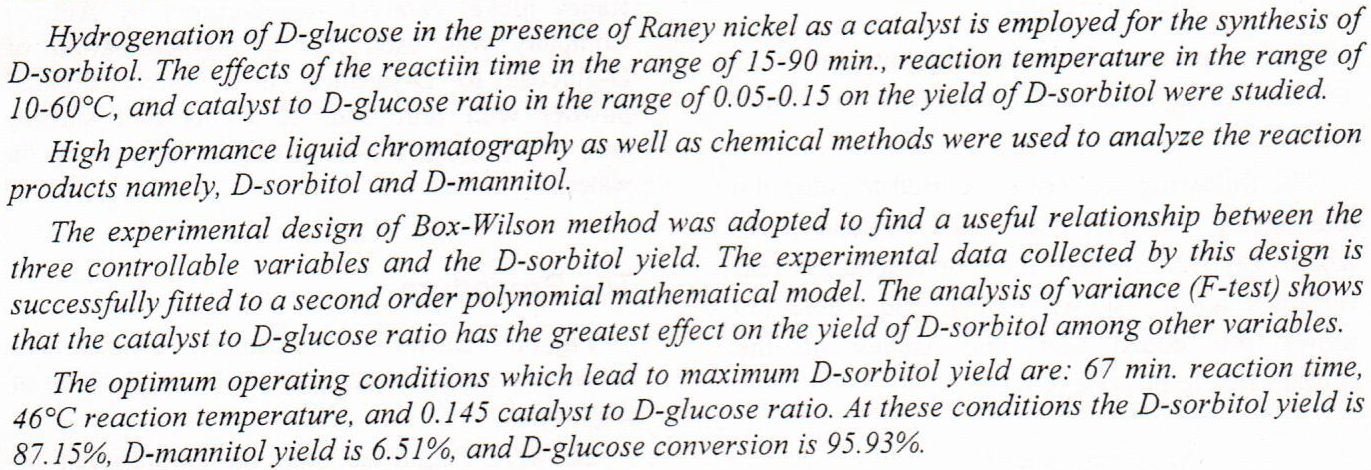
D-Sorbitol Production by Catalytic Hydrogenation of D-Glucose

In the present work, zeolite Y has been synthesized successfully by sol-gel method.Zeolite was synthesized by crystallization of the final gel which consist from seeding and feed stock gels at 85 oC. HY zeolite was prepared by an ion exchange process with ammonium chloride solution and then loaded with different percentages of platinum and titanium by the wet - impregnation method.
X-ray Diffraction (XRD), X-ray Florescence (XRF), Scanning Electron Microscopy (SEM), BET surface area and, Crushing strength were used to characterize the synthesized and prepared catalysts . Results showed high crystallinity 90% with silica to alumina ratio 5 for HY, high surface area of 600 m2/g and pore
... Show MoreCatalytic wet air oxidation of aqueous phenol solution was studied in a pilot plant trickle bed reactor using copper
oxide catalyst supported on alumina and silica. Catalysts were prepared by impregnating method. Effect of feed solution
pH (5.9, 7.3, and 9.2), gas flow rate (20%, 50%, 80%, and 100%), WHSV (1, 2, and 3 h-1), temperature (120°C, 140°C,
and 160°C), oxygen partial pressure (6, 9, 12 bar), and initial phenol concentration (1, 2, and 4 g/l).Generally, the
performance of the catalysts was better when the pH of feed solution was increased. The catalysts deactivation is related
to the dissolution of the metal oxides from the catalyst surface due to the acidic conditions. Phenol oxidation reaction
was strongly
Catalytic wet air oxidation of aqueous phenol solution was studied in a pilot plant trickle bed reactor using copperoxide catalyst supported on alumina and silica. Catalysts were prepared by impregnating method. Effect of feed solutionpH (5.9, 7.3, and 9.2), gas flow rate (20%, 50%, 80%, and 100%), WHSV (1, 2, and 3 h-1), temperature (120°C, 140°C,and 160°C), oxygen partial pressure (6, 9, 12 bar), and initial phenol concentration (1, 2, and 4 g/l).Generally, theperformance of the catalysts was better when the pH of feed solution was increased. The catalysts deactivation is relatedto the dissolution of the metal oxides from the catalyst surface due to the acidic conditions. Phenol oxidation reactionwas strongly affected by WHSV,
... Show More (2)
(2)

A total of (25) stool samples were collected from children and adults (2- 4) years old suffering from diarrhea to isolate E. coli strains that produce heat-stable enterotoxin a (STa), and after performing microscopic examination, cultural characterization and biochemical identification only (11) isolates showed positive E. coli. STa activity was estimated by using suckling mouse assay (SMA) and from these (11) isolates only (5) showed STa activity and the one with the highest STa activity was selected for large scale production of STa, which was followed by partial purification using ion-exchange chromatography (normal phase) using DEAE sephadex A-50 column. After purification and determination of protein concentration by using the standard
... Show MoreThis study aims to remove Cd(II) ions from simulated wastewater by using Chlorophyceae algae (CA). Different parameters were studied to show their effects on the biosorption efficiency of CA. These parameters are: the effect of pH 3-7, initial metal ion concentration 20-200 mg/L, sorbent dos-age 0.05-2 g/L, contact time 5-180 min, and agitation speed 100-300 rpm. We found that both the Langmuir and Freundlich models appropriate for characterizing the metal removal process. The biosorption data fit best with the results of the pseudo-second-order kinetic model, demonstrating that the chemisorption process is the dominant mechanism controlling the removal. CA was char-acterized using the scanning electron microscopy test, prior to and post bi
... Show More (10)
(6)
(10)
(6)


The present study was conducted to estimate the antimicrobial activity and the potential biological control of the killer toxin produced by
(48)
(39)
(30)
(27)
The glycated haemoglobin A1c(HbA1c) and Fasting blood glucose(FBG) effect on type1 diabetic pateints as a screening tests and as a gold standard for assessing glycemic control in subjects with diabetes were studied . Ninety one blood samples were collected in a peroid between June and the end of November 2012 at AL- Kindy Diabetic Center and Central Child Hospital,48 Females and 43 Males , aging between (11 month- 18 year), are divided into three groups, newly diagnosed , ongoing and healthy control group, with duration of disease between(1 day-3months) and (from birth-8 years) for newly diag
... Show More
(1)
Although G6PD deficiency is the most common genetically determined blood disorder among Iraqis, its molecular basis has only recently been studied among the Kurds in North Iraq, while studies focusing on Arabs in other parts of Iraq are still absent.
A total of 1810 apparently healthy adult male blood donors were randomly recruited from the national blood transfusion center in Baghdad. They were classified into G6PD deficient and non-deficient individuals based on the results of methemoglobin reduction test (MHRT), with confirmation of deficiency by subsequent enzyme assays. DNA from defi
(21)
(17)
Increasing demands on producing environmentally friendly products are becoming a driving force for designing highly active catalysts. Thus, surfaces that efficiently catalyse the nitrogen reduction reactions are greatly sought in moderating air-pollutant emissions. This contribution aims to computationally investigate the hydrodenitrogenation (HDN) networks of pyridine over the γ-Mo2N(111) surface using a density functional theory (DFT) approach. Various adsorption configurations have been considered for the molecularly adsorbed pyridine. Findings indicate that pyridine can be adsorbed via side-on and end-on modes in six geometries in which one adsorption site is revealed to have the lowest adsorption energy (
... Show More
(5)