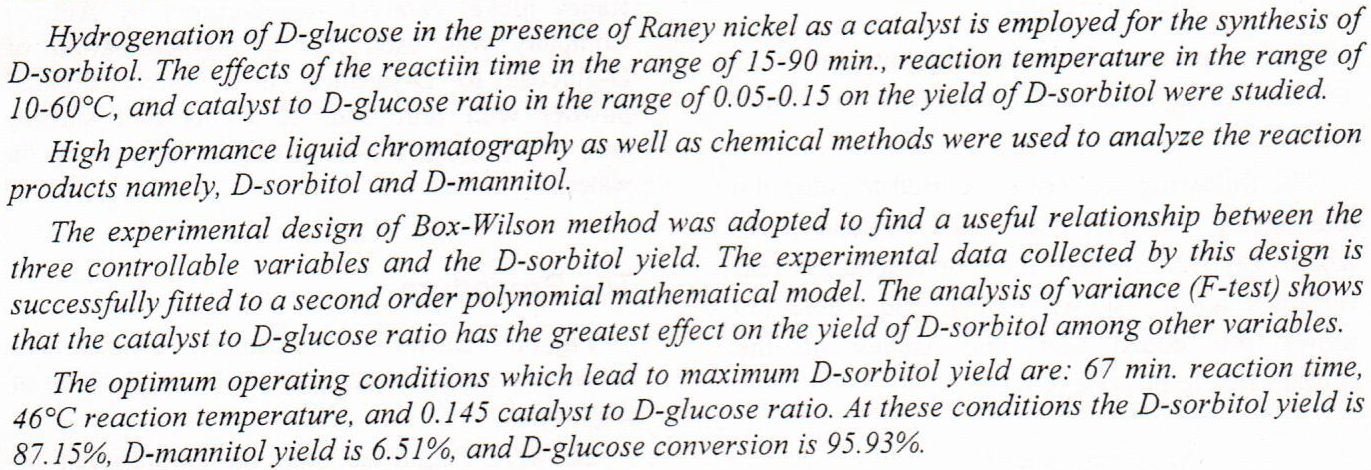
D-Sorbitol Production by Catalytic Hydrogenation of D-Glucose

 (6)
(6)
 (2)
(2)


In this study used three methods such as Williamson-hall, size-strain Plot, and Halder-Wagner to analysis x-ray diffraction lines to determine the crystallite size and the lattice strain of the nickel oxide nanoparticles and then compare the results of these methods with two other methods. The results were calculated for each of these methods to the crystallite size are (0.42554) nm, (1.04462) nm, and (3.60880) nm, and lattice strain are (0.56603), (1.11978), and (0.64606) respectively were compared with the result of Scherrer method (0.29598) nm,(0.34245),and the Modified Scherrer (0.97497). The difference in calculated results Observed for each of these methods in this study.
(14)
(14)

An innovative desalination method called electrosorption or capacitive deionization (CDI) has significant benefits for wastewater treatment. This process is performed by using a carbon fiber electrode as a working electrode to remove hexavalent chromium ions from an aqueous solution. The pH, NaCl concentration, and cell voltage were optimized using the Box-Behnken experimental design (BDD) in response surface methodology (RSM) to study the effects and interactions of selected variables. To attain the relationship between the process variables and chromium removal, the experimental data were subjected to an analysis of variance and fitted with a quadratic model. The optimum conditions to remove Cr(VI) ions were: pH of 2, a cell voltage of 4.
... Show More
(11)
(9)
Dyes are extensively water-soluble and toxic chemicals. The disposing of wastewater rich with such chemicals has severely impacted surface water quality (rivers and lakes). In the current study, an anionic dye, methyl orange, were extracted from wastewater fluids using bulk liquid membranes supplemented with an anionic carrier (Aliquat 336 (QCI)). Parameters including solvent type (carbon tetrachloride and chloroform), membrane stirring speed (100-250 rpm), mixing speed of both phases (50-100 rpm), The feed pH (2-12) and implemented temperature (35-60 °C) were thoroughly analyzed to determine the effect of such variables on extraction effectiveness. Furthermore, the effect of methyl orange (10-50 ppm) in the feed stage and NaOH (0
... Show More
(9)
(1)
Biologically active natural compounds are molecules produced by plants or plant-related microbes, such as endophytes. Many of these metabolites have a wide range of antimicrobial activities and other pharmaceutical properties. This study aimed to evaluate (in vitro) the antifungal activities of the secondary metabolites obtained from Paecilomyces sp. against the pathogenic fungus Rhizoctonia solani. The endophytic fungus Paecilomyces was isolated from Moringa oleifera leaves and cultured on potato dextrose broth for the production of the fungal metabolites. The activity of Paecilomyces filtrate against the radial growth of Rhizoctonia solani was tested by mixing the filtrate with potato dextrose agar medium at concentrations of 15%,
... Show More
(37)
(31)
(7)
Combining ultrasonic irradiation and the Fenton process as a sono-Fenton process, the chemical oxygen demand (COD) in refinery wastewater was successfully eliminated using response surface methodology (RSM) with central composite design (CCD). The impact of two main influential operational parameters (iron dosage and reaction time) on the COD removal from wastewater generated by an Iraqi petroleum refinery facility was explored. Removal of 85.81% was attained under the optimal conditions of 21 minutes and 0.289 mM of concentration. Additionally, the results revealed that the concentration of has the highest effect on the COD elimination, followed by reaction time. The high R2 value (96.40%) validated the strong fit of the mo
... Show More
(13)
(12)
(57)
(52)
High-volume traffic with ultra-heavy axle loads combined with extremely hot weather conditions increases the propagation of rutting in flexible pavement road networks. Several studies suggested using nanomaterials in asphalt modification to delay the deterioration of asphalt pavement. The current work aims to improve the resistance of hot mix asphalt (HMA) to rutting by incorporating Nano Silica (NS) in specific concentrations. NS was blended into asphalt mixtures in concentrations of 2, 4, and 6% by weight of the binder. The behavior of asphalt mixtures subjected to aging was investigated at different stages (short-term and long-term aging). The performance characteristics of the asphalt mixtures were evaluated using the Marshall s
... Show More
(29)
(22)
Biologically active natural compounds are molecules produced by plants or plant-related microbes, such as endophytes. Many of these metabolites have a wide range of antimicrobial activities and other pharmaceutical properties. This study aimed to evaluate (in vitro) the antifungal activities of the secondary metabolites obtained from Paecilomyces sp. against the pathogenic fungus Rhizoctonia solani. The endophytic fungus Paecilomyces was isolated from Moringa oleifera leaves and cultured on potato dextrose broth for the production of the fungal metabolites. The activity of Paecilomyces filtrate against the radial growth of Rhizoctonia solani was tested by mixing the filtrate with potato dextrose agar medium at concentrations of 15%,
... Show More
(37)
(31)