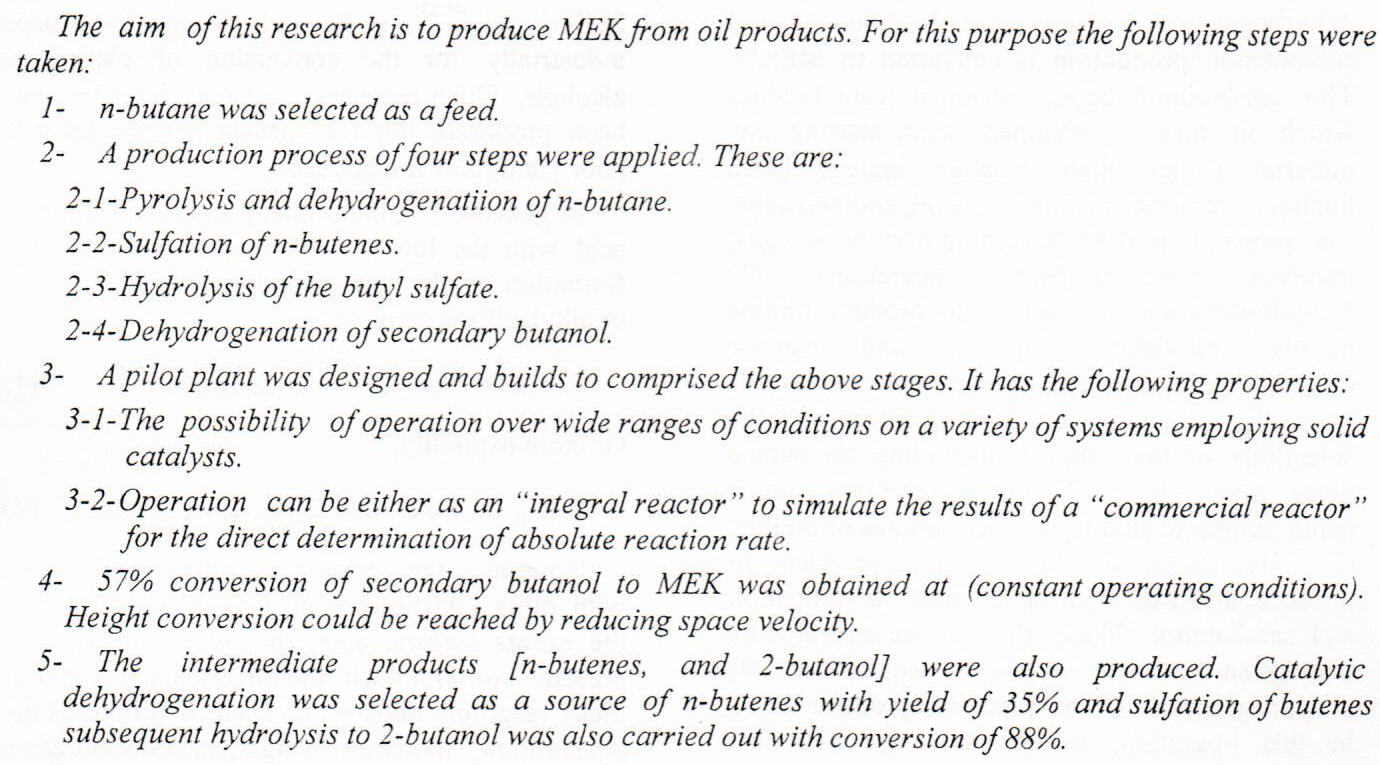
Production of Methyl Ethyl Ketone from N-Butane

The study included the collection of samples of raw cow milk to isolate Leuconostoc bacteria, samples were sub cultured on De-Man Rogosa Sharpe-Vancomycin medium, the pure colonies were selected and subjected to the cultural and microscopically tests, according to that 25 cocci bacterial isolates were obtained, then isolates were subjected to biochemical tests. Result of tests showed that 12 isolates belong to the genus Leuconostoc out of 25 cocci bacterial isolates, Vitek2 system was used as a supplementary step. Results of final identification showed that 3 sub species were obtained included Leuconostoc mesenteroides ssp. cremoris 9 out of 12 isolates, while it was 2 isolates of Leuconostoc mesenteroides ssp. mesenteroides and one isol
... Show More (15)
(15)
 (8)
(8)



Metal complexes of Mn(II), Co(II), Ni(II), Cu(II), Cd(II), Zn(II), Hg(II), Pd(II), and Pt(II) with Schiff base ligand (LH) derived from 2,5-dichloroaniline and 2-hydroxy-5-metheylbenzalaldehyde were synthesized and characterized using a variety of spectrophotometric techniques The findings of the spectroscopic analysis indicated that (LH) behaved as a binary coordinating agent to the metal ion by the N and O atoms, and the geometry shape of the complexes was octahedral, with the exception of the Pd and Pt complexes, which had a square planar geometry. Using the DPPH radical scavenging method, we investigated the antimicrobial activity of the compound against Staphylococcus aureus and Escherichia coli, as well as the antifungal activity of t
... Show MoreThe mixed ligand complexes of Schiff base ligand (Z)-2-(((4-bromo-2-methylphenyl) imino) methyl)-4-methylphenol (L) with some metals ion (II); Mn(1), Co(2), Ni(3), Cu(4), Zn(5) Cd(6) and Hg(7) and 1,10-Phenanthroline (phen) were Synthesis and characterized by the mass and 1HNMR spectrometry (ligand Schiff base), the FTIR, UV-visible and the flame atomic absorption (A.A) spectrum, the C.H.N analysis and the chlorine content, in addition to measuring the magnetic sensitivity of the complexes. All the complexes had octahedral geometry. The bioactivity activity for compounds against; Rhizopodium, Staphylococcus aureus and Escherichia coli, the compounds showed different efficacy towards these microorganisms
In this study, the photodegradation of Congo red dye (CR) in aqueous solution was investigated using Au-Pd/TiO2 as photocatalyst. The concentration of dye, dosage of photocatalyst, amount of H2O2, pH of the medium and temperature were examined to find the optimum values of these parameters. It has been found that 28 ppm was the best dye concentration. The optimum amount of photocatalyst was 0.09 g/75 mL of dye solution when the degradation percent was ~ 96 % after irradiation time of 12 hours, while the best amount of hydrogen peroxide was 7μl/75 mL of dye solution at degradation percent ~97 % after irradiation time of 10 hours, whereas pH 5 was the best value to carry out the reaction at the highest degradation percent. In additio
... Show More
(20)
(13)
In this study, the photodegradation of Congo red dye (CR) in aqueous solution was investigated using Au-Pd/TiO2 as photocatalyst. The concentration of dye, dosage of photocatalyst, amount of H2O2, pH of the medium and temperature were examined to find the optimum values of these parameters. It has been found that 28 ppm was the best dye concentration. The optimum amount of photocatalyst was 0.09 g/75 mL of dye solution when the degradation percent was ~ 96 % after irradiation time of 12 hours, while the best amount of hydrogen peroxide was 7μl/75 mL of dye solution at degradation percent ~97 % after irradiation time of 10 hours, whereas pH 5 was the best value to carry out the reaction at the highest degradation percent. In additio
... Show More
(20)
(13)
The phenyl hydrazine was react readily with acetic acid chloride in [1:2] ratio in alkyl of ethanolic solution, and refluxe for five hours to produce a new ligand of (N-Carboxymethyl-N-phenyl-hydrazino)-acetic acid [H2L].
(1)
Giardia lamblia parasite was isolated from the diarrhea samples of patients with Giardiasis dysentery and was developed in HSP media, four mice groups have been used to find in vivo efficacy of two concentrations (128,256) mg/ml of chlorophorm extracts from Cladophora glomerata algae against Giardia lamblia parasite as compared with (Flagyl) by measuring several biochemical markers as ( GPT and GOT) enzymes ,sodium ,potassium and iron concentration as well as counting the number of parasitic cysts in each mice groups. The results demonstrate that levels of GPTA GOT enzymes have been decreased in mice treated with algal extract. As for the concentration of the Sodium, Potassium and Iron increased in mice treat
... Show More
(4)
(1)
In this study, iron oxide nanoparticles (α-Fe₂O₃ NPs) were prepared using a readily available chili pepper plant extract from local markets. This study aims to evaluate the magnetic properties of α-Fe₂O₃ prepared in green chemistry from Capsicum plant extract. After several simple preparatory steps, such as washing and cutting, they were treated with an inorganic complex (potassium hexacyanoferrate) (K3[Fe(CN)₆]). In the first analytical step, the in vitro detection of the plant extract solution after reaction with the potassium hexacyanoferrate (III) complex revealed characteristic adsorption bands of the cyanide group, which disappeared upon complexation. The iron oxide NPs were characterized using various methods, including X
... Show MoreThe research discussed the possibility of adsorption of Brilliant Blue Dye (BBD) from wastewater using 13X zeolite adsorbent, which is considered a byproduct of the production process of potassium carbonate from Iraqi potash raw materials. The 13X zeolite adsorbent was prepared and characterized by X-ray diffraction that showed a clear match with the standard 13X zeolite. The crystallinity rate was 82.15% and the crystal zeolite size was 5.29 nm. The surface area and pore volume of the obtained 13X zeolite were estimated. The prepared 13X zeolite showed the ability to remove BBD contaminant from wastewater at concentrations 5 to 50 ppm and the removal reached 96.60% at the lower pollutant concentration. Adsorption measurements versus tim
... Show More
(9)