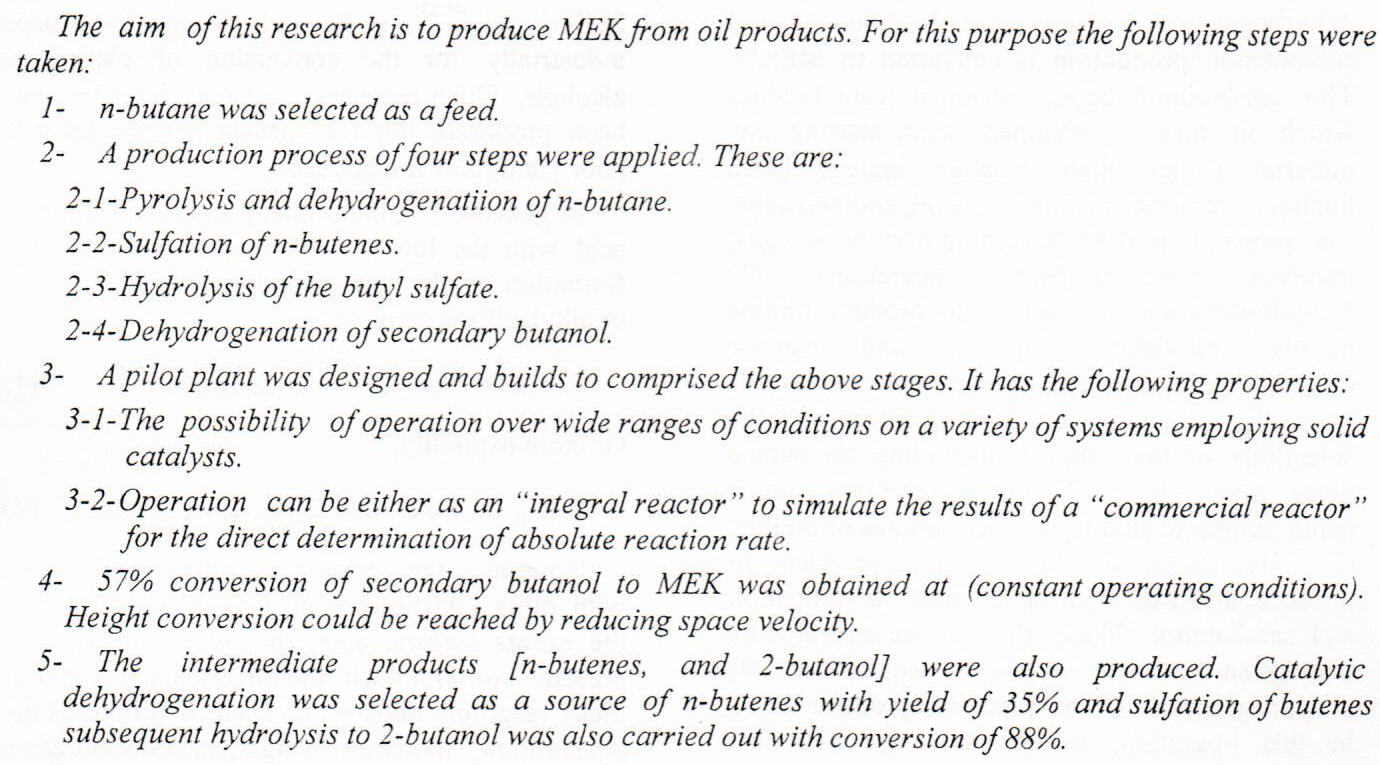
Production of Methyl Ethyl Ketone from N-Butane

Many stone tools were found on a hill south of the Hor Al-Dalmaj which is located in the central part of the alluvial plain of Mesopotamia, between the Tigris and Euphrates Rivers. The types of rocks from which the studied stone tools were made are not found in the alluvial plain, because it consists of friable sand, silt, and clay. All existing sediments were precipitated in riverine environments such as point bar, over bank, and floodplain sediments. The collected stone tools were described with a magnifying glass (10 x) and a polarized microscope after they were thin sectioned. Microscopic analysis showed that these stone tools are made of sedimentary, volcanic igneous and metamorphic rocks, such as: sandstones, limestones, chert, con
... Show More (1)
(1)


The foreguts of a total of 515 fish of Chondrostoma regium (Heckel, 1843) (locally: Bala’aot Malloky) were studied. These fish were collected from Tigris River at Salah Al-Deen Province (between Al-Hagag & Yathrib) for 20 months between March and October of the next year. Detritus, plant in origin materials (19.6%, 23.0% & 24.9%); green and blue green algae, mostly Cladophora, Cosmarium and Merismpedia sp. (17.1%, 12.9% & 12.2%) and diatoms, mostly Diatoma, Chanathes, Amphora and Cyulbella sp. (16.9%, 8.8% & 8.2%) were the main food categories taken by these fishes according to occurrence (O%), volumetric methods (V%) and ranking index (R%). Debris (not part of the diet) took 45.3% of the studied fish foreguts by volume. Detritus was also
... Show More
A qualitative chemical test was performed on functional groups extracted from fenugreek plant and its extracts (aqueous, alcoholic and volatile oil). Results revealed that fenugreek seeds contain the main functional groups, while extracts are varied accorodihg to their content of functional groups qualitatively and quantitively. Moreover, inhibition activity was tested for extracts of fenugreek seeds (aqueous, alcoholic and volatile oil). against gram negative (Salmonella typhimurium, Escherichia coli and Pseudomonas aeruginosa) and gram positive (Staphylococcus aureus) by the ager well diffusion method. Data have revealed that inhibition activity was different in accoradance with extract solvent and the tested microorgan. Oil extract (15)%
... Show MoreThe purpose of this study to synthesize and characterize silver nanoparticles using phenolic compounds obtained from Camellia sinensis, to test the antibacterial properties of biosynthesized nanoparticles on the formation of biofilms in multidrug-resistant Pseudomonas aeruginosa. Ten isolates of P. aeruginosa were obtained from the Genetic Engineering and Biotechnology Institute laboratories of the University of Baghdad. By using the VITEK-2 system and culturing the isolates on cetrimide agar, the diagnosis was confirmed. Camellia sinensis silver nanoparticles (CAgNPs) were created using an extract of the plant's aqueous and methanolic leaves. Based on the results of the nanoparticle synthesis, spherical nanoparticles that may be single or
... Show More (5)
(5)
Commercial, industrial, and military activity, largely in the 19th and 20th centuries, have led to environmental pollution that can threaten human health and ecosystem function, liquid gas petroleum (LPG) products are the major sources of energy for industry and daily life that cause environmental contamination during various stages of production, transportation, refining and use. Screening of bacterial isolate by using clear zone techniques and biomass and optical density. Results revealed that isolate Burkholdaria cepatia showed a high ability for hydrocarbons biodegradation and this isolate identified depending on morphological cultural, gram stain, microscopic features, biochemical tests, and VITEK2 compact. In this study,
... Show More
(1)
(61)
(44)
 (2)
(2)
(2)
(2)
Titanium oxide nanoparticles-modified smectite (SMC-nTiO2) as a low-cost adsorbent was investigated for the removal of Rhodamine B (RhB) from aqueous solutions. The adsorbents (SMC and SMC-nTiO2) were characterized by scanning electron microscopy, Fourier transforms infrared spectroscopy, and energy-dispersive X-ray spectroscopy. The effects of various parameters like contact time, adsorbent weight, pH, and temperatures were examined. Three kinetic equations (pseudo-first-order (PFO), pseudo-second-order (PSO), and intra-particle diffusion) were used to evaluate the experimental kinetic of the data and the results showed that the adsorption process is in line with the PSO kinetic model. Adsorption equilibrium isotherms were modeled using La
... Show MoreThis article reviews the technical applicability of nanofiltration membrane process for the removal of nickel, lead, and copper ions from industrial wastewater.
Synthetic industrial wastewater samples containing Ni(II), Pb(II), and Cu(II) ions at various concentrations (50, 100, 150 and 200 ppm), under different pressures (1, 2, 3 and 4 bar), temperatures (10, 20, 30 and 40 oC), pH (2, 3, 4, 5 and 5.5), and flow rates (1, 2, 3 and 4 L/hr), were prepared and subjected treated by NF systems in the laboratory. Suitable NF membrane was chosen after testing a number of NF membranes (University of Technology-Baghdad), in terms of production and removal. NF system was capable of removing more than (85%, 78%, and 66% for Ni(II
... Show More