Removal of Chromium from Wastewater by Adsorption
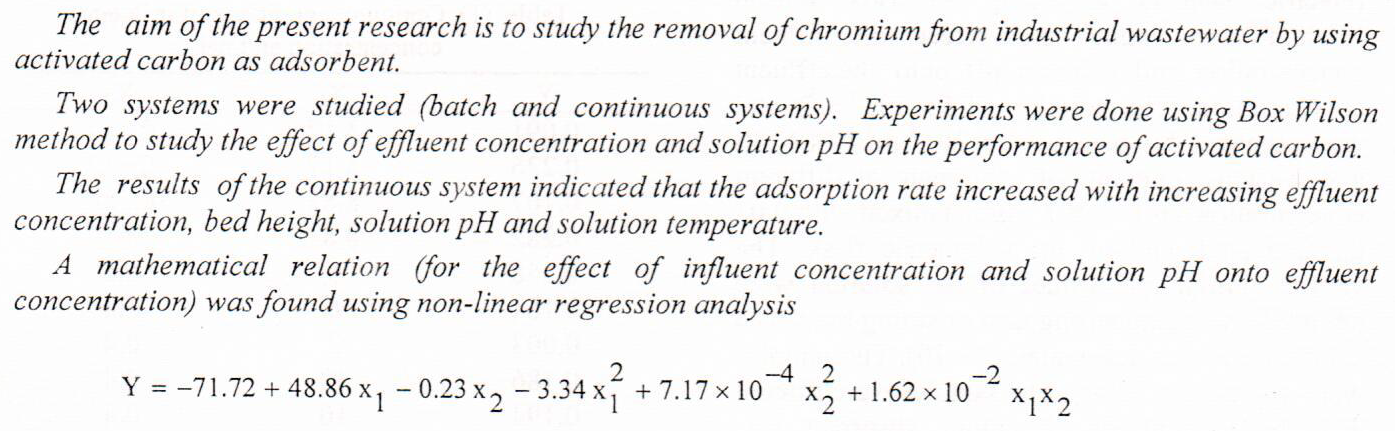

 (26)
(26)
 (25)
(25)


To assess the biochemical, mechanical and structural characteristics of retained dentin after applying three novel bromelain‑contained chemomechanical caries removal (CMCR) formulations in comparison to the conventional excavation methods (hand and rotary) and a commercial papain‑contained gel (Brix 3000). Seventy‑two extracted permanent molars with natural occlusal carious lesions (score > 4 following the International Caries Detection and Assessment System (ICDAS‑II)) were randomly allocated into six groups (n = 12) according to the excavation methods: hand excavation, rotary excavation, Brix 3000, bromelain‑contained gel (F1), bromelain‑chloramine‑T (F2), and bromelain chlorhexidine gel (F3). The superficial and deepe
... Show More
(6)
(7)

Characterizing dementia is a global challenge in supporting personalized health care. The electroencephalogram (EEG) is a promising tool to support the diagnosis and evaluation of abnormalities in the human brain. The EEG sensors record the brain activity directly with excellent time resolution. In this study, EEG sensor with 19 electrodes were used to test the background activities of the brains of five vascular dementia (VaD), 15 stroke-related patients with mild cognitive impairment (MCI), and 15 healthy subjects during a working memory (WM) task. The objective of this study is twofold. First, it aims to enhance the recorded EEG signals using a novel technique that combines automatic independent component analysis (AICA) and wave
... Show More
(77)
(78)
In addition to the primary treatment, biological treatment is used to reduce inorganic and organic components in the wastewater. The separation of biomass from treated wastewater is usually important to meet the effluent disposal requirements, so the MBBR system has been one of the most important modern technologies that use plastic tankers to transport biomass with wastewater, which works in pure biofilm, at low concentrations of suspended solids. However, biological treatment has been developed using the active sludge mixing process with MBBR. Turbo4bio was established as a sustainable and cost-effective solution for wastewater treatment plants in the early 1990s and ran on minimal sludge, and is easy to maintain. This
... Show More
This study aimed to investigate the effect of total suspended solids (TSS) on the performance of a continuously operated dual-chamber microbial fuel cell (MFC) proceeded by primary clarifier to treat actual potato chips processing wastewater. The system was also tested in the absence of the primary clarifier and the results demonstrated a significant effect of TSS on the polarization curve of the MFC which was obtained by operating the graphite anodic electrode against Ag/AgCl reference electrode. The maximum observed power and current densities were decreased form 102.42 mW/m2 and 447.26 mA/m2 to 80.16 mW/m2 and 299.10 mA/m2, respectively due to the adverse effect of TSS. Also
... Show More
(6)
(62)
(59)
(20)
(17)
A new adsorbent was developed by integrating algae biomass (AG) into a chitosan (CN) matrix, followed by structural enhancement via crosslinking with pyromellitic dianhydride (PMDA) through a hydrothermal synthesis approach. This process resulted in the formation of a robust AG@CN-PMDA composite with improved physicochemical characteristics suitable for advanced adsorption applications. The AG@CN-PMDA composite was evaluated for its efficiency in removal of the cationic dye methyl violet 2B (MV 2B) from aqueous solution. The adsorption process was refined through the Box-Behnken design (RSM-BBD), evaluating three essential parameters: adsorbent dosage (A: 0.02–0.1 g/100 mL), pH (B: 4–10), and time (C: 5–20 min). The ideal conditions f
... Show More
(2)
(2)
Thirty uropathogenic E. coli isolates were isolated from hospitalized and non hospitalized patients, complaining of urinary tract infections, of Al-Kadhymia Teaching Hospital and subjected to tRNA extraction. A method of tRNA extraction was modified by adding sodium dodecyl sulfate (SDS) instead of urea. Polyacrylamide gel electrophoresis and two methods of staining, ethidium bromide staining and silver staining, as well as spectrophotometric detection were used.
Biofilms formation by pathogens microbial Control considered important in medical research because it is the hazarded virulence factor leading to becoming difficult to treat because of its high resistance to antimicrobials. Glycopeptide antibiotic a (Vancomycin) and the commercial bacteriocin (Nisin A) were used to comparative with purification bacteriocin (MRSAcin) against MRSA biofilm. One hundred food samples were collected from Baghdad markets from July 2016 to September 2016, including (cheese, yogurt, raw milk, fried meat, grilled meat, and beef burger). All samples were cultures; S. aureus was confirmation by macroscopic culture and microscopic examination, in addition to biochemical tests. Methicillin resistance S. asureus (
... Show More
(16)
(4)