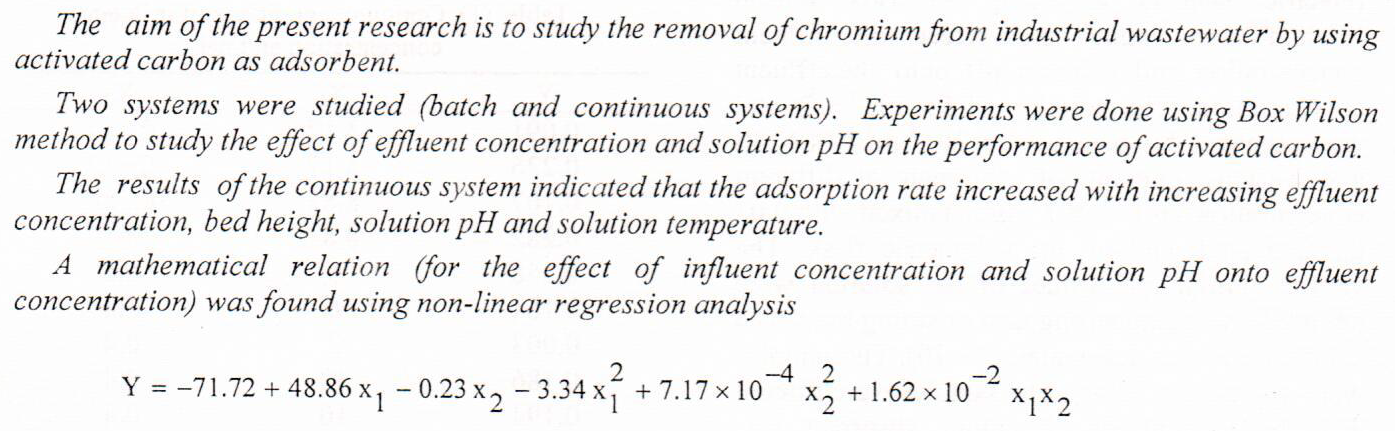
Removal of Chromium from Wastewater by Adsorption

Emulsion Liquid Membrane (ELM) is an emerging technology that removes contaminants from water and industrial wastewater. This study investigated the stability and extraction efficiency of ELM for the removal of Chlorpyrifos Pesticide (CP) from wastewater. The stability was studied in terms of emulsion breakage. The proposed ELM included n-hexane as a diluent, span-80 as a surfactant, and hydrochloric acid (HCl) as a stripping agent. Parameters such as mixing speed, aqueous feed solution pH, internal-to-organic membrane volume ratio, and external-to-emulsion volume ratio were investigated. A minimum emulsion breakage of 0.66% coupled with a maximum chlorpyrifos extraction and stripping efficiency were achieved at 96.1% and 95.7% at b
... Show More (14)
(14)

This research was conducted to measure the safety of heat stable enterotoxin a (STa) produced by enterotoxigenic Escherichia coli, through studying its toxic effect on human blood lymphocyte, since it showed a promising effect in reducing the proliferation of colorectal cancer cells. the cytogenetic effects of (STa) by using five different concentrations (100, 200, 400, 800 and 1600μg/ml) in comparison with negative (PBS, Phosphate buffer saline) and positive (MMC, Mitomycin C) at concentration of 5μg/ml, controls on human blood lymphocytes obtained from both (10) normal healthy persons and (20) colorectal cancer patients was measured by employing the following parameters: mitotic index, blast index, chromosomal aberrations and micronucle
... Show MoreDiabetic mellitus is one of the main risk factors of fungal infections because poor glycemic control is associated with a high level of glucose in blood and saliva which could be treated as nutrient to fungi. This study aimed to isolate and identification of pathogenic fungi from diabetic patient. 140 samples were taken from different places of human body from the national center of diabetic patients that related to Mustansiriyah University / college of medicine and Al-yarmuk Hospital in Baghdad. 84 sample (60%) tested positive to fungi and 56 sample (40%) tested negative to fungi. The most frequented fungi isolated have been chosen for molecular identification by PCR (Millerozyma farinosa and Candida orthopsilosis) using specific pri
... Show More (2)
(2)

This research paper studies the use of an environmentally and not expensive method to degrade Orange G dye (OG) from the aqueous solution, where the extract of ficus leaves has been used to fabricate the green bimetallic iron/copper nanoparticles (G-Fe/Cu-NPs). The fabricated G‑Fe/Cu-NPs were characterized utilizing scanning electron microscopy, BET, atomic force microscopy, energy dispersive spectroscopy, Fourier-transform infrared spectroscopy and zeta potential. The rounded and shaped as like spherical nanoparticles were found for G-Fe/Cu‑NPs with the size ranged 32-59 nm and the surface area was 4.452 m2/g. Then the resultant nanoparticles were utilized as a Fenton-like oxidation catalyst. The degradation efficiency of
... Show More
(31)
(11)

In the present work the performance of semifluidized bed adsorber was evaluated for removal of phenolic compound from wastewater using commercial activated carbon as adsorbent. P-chlorophenol (4-Chlorophenol) and o-cresol (2-methylphenol) was selected as a phenolic compound for that purpose. The phenols percent removal, in term of breakthrough curves were studied as affected by hydrodynamics limitations which include minimum and maximum semifluidization velocities and packed bed formation in the column by varying various parameters such as inlet liquid superficial velocity (from Uminsf to 8Uminsf m/s), and retaining grid (sometimes referred to as adsorbent loading) to initial static bed height ratio (from 3-4.5). In
... Show MoreThe twelve samples of agricultural soils from four regions in Al-Najaf governorate with sampling plant with soil. Physical properties of the soil where studied, such as electrical conductivity ranged from (136.33-1070.00)μS/cm-3, and moisture which ranged between the values (0.39-36.48)%. The chemical analysis of the soil have included the proportion of calcium carbonate the ratio between (44.00-48.00%) has been observed increasing amounts of calcium carbonate in surface models. The pH where results indicate that pH values were close to study models ranged between (6.88-7.42) these values generally within the normal range for the measured pH values of the Iraqi soil. The amount of gypsum ranged betwe
... Show MoreBackground: Postoperative morbidity after extraction of the impacted mandibular third molar (IMTM) is inevitable. One of the most common postoperative complication is alveolar osteitis (AO) which is a painful non healed socket. Many researches were attempted to prevent the occurrence of AO by introducing and applying a new materials inside the extraction socket. Platelet rich fibrin (PRF) is a biological complex fibrin matrix where autologous platelets and leucocytes are present, used to enhance tissue healing process and reduce the early adverse effects of the inflammation. Aims: To evaluate the effect of PRF on the incidence of AO. Also to assess PRF effect on pain, swelling, and trismus following the surgical removal of IMTM and
... Show More
(10)
(5)