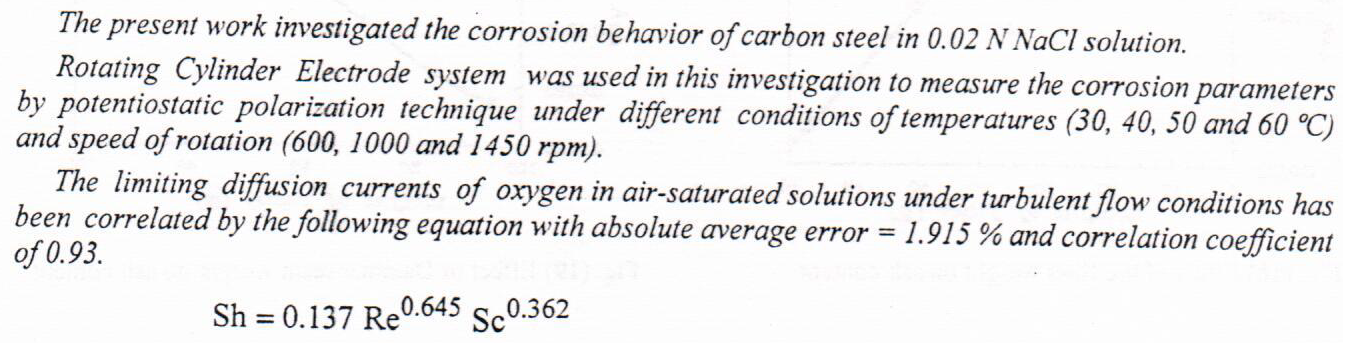
Effect of Velocity and Temperature on Mass Transfer of Oxygen in Corrosion Processes

The advancements in horizontal drilling combined with hydraulic fracturing have been historically proven as the most viable technologies in the exploitation of unconventional resources (e.g., shale and tight gas reservoirs). However, the number of fractures, well timing, and arrangement pattern can have a significant impact on the project economy. Therefore, such design and operating parameters need to be efficiently optimized for obtaining the best production performance from unconventional gas reservoirs. In this study, the process of selecting the optimal number of fractures was conducted on a section of a tight gas reservoir model (based on data from the Whicher Range (WR) tight gas field in Western Australia). Then, the optimal number
... Show More (4)
(4)

 (6)
(2)
(6)
(2)

Perfluorooctanoic acid (PFOA) is a synthetic fluor-surfactant chemical used widely in products that resist oil, heat, grease, stains, and water. It is also used in producing other fluoropolymers. The main sources of exposure to PFOA are water, soil, and animal-origin food (meat, fish, and dairy products). The aim of this study to evaluate the renal function following oral gavage of sub-lethal dose of PFOA in diabetic and non-diabetic guinea pigs. The experiment run for 4 weeks, total of 40 male guinea pigs, (Cavia porcellus), were randomly selected and grouped into four equal groups. The first group (G1) served as the negative control; 2nd group (G2) alloxan induced diabetic, 3rd group (G3) non-diabeti
... Show More
(3)
Metal foam has recently been used in many engineering applications, such as solar collectors, heat exchangers, and cooling of electronic devices, which calls for studying different cases of using metal foam in these applications. The current study conducts a numerical analysis of heat transfer and fluid flow characteristics for air in a rectangular channel filled with high-porosity copper foam. The study examined the thermal performance for two cases of gradient pore density, which are arranged as (10-20-40) PPI and (40-20-10) PPI. These cases were compared with two other cases for constant pore density, 10 and 40 PPI, and empty cases. The ANSYS FLUENT 20.0 employed the Darcy-Forchheimer extended Brickman model in the two-dimensiona
... Show More
(2)
(2)
Inherent fluctuations in the availability of energy from renewables, particularly solar, remain a substantial impediment to their widespread deployment worldwide. Employing phase-change materials (PCMs) as media, saving energy for later consumption, offers a promising solution for overcoming the problem. However, the heat conductivities of most PCMs are limited, which severely limits the energy storage potential of these materials. This study suggests employing circular fins with staggered distribution to achieve improved thermal response rates of PCM in a vertical triple-tube heat exchanger involving two opposite flow streams of the heat-transfer fluid (HTF). Since heat diffusion is not the same at various portions of the PCM unit,
... Show More
(52)
(52)

the behavior of the first-order black and gray solitons propagtedin optical fiber in the presence of frequency chirp is studied analytically and numerically results show that phase profile of black solitons changes abruptly
(3)
(1)
This study was conducted in a laboratory experiment at the University of Baghdad, College of Science, computing Department, 5 km from the center of Baghdad city, in 2021 to evaluate the sorting method for the tomato crop. The experiments were conducted in a factorial experiment under a complete randomized design with three replications and using SAS analysis, artificial neural network, image processing, the study of external characteristics, and physical features; fruit surface area and fruit circumference were 1334.46 cm2,57.53 cm2 and free diseases. The error value was less than zero, while training with outputs recorded the highest value and which was 5. The neural network's performance between the input and the mean square of th
... Show More
(2)
(1)
A laboratory experiment was carried out according to a completely randomized design with four repetitions on the seeds resulting from a field experiment applied for the two seasons, 2020 and 2021, to find out the effect of the cultivars (Ambar 33, Yasamin, Dijlah, Ambar Al-Baraka and Furat 1) and the harvest dates (at physiological maturity and after 7 and 14, 21 and 28 days of physiological maturity) on the vigour of rice seeds. The results showed the superiority of the seeds of the cultivar Anbar Al-Baraka at first and final counting, dry weight of the seedling, seedling vigor index and electrical conductivity, and the superiority of the seeds of Dijla cultivar at accelerated aging test and cold test without significant difference with th
... Show More
(1)
The current report dealt with the effect of pesticides on the ecosystem through their impact on soil, water, and microorganisms and their impact on human health. As well as this study dealt with the biodegradation process of pesticides and the organisms involved in this process, even some previous studies proved that Bacillus spp. And Pseudomonas sp. Bacteria is the most efficient in the biodegradation of pesticides, at the same time, other previous studies dealt with the environmental factors that affect the biodegradation process of pesticides. It proved that each of the incubation periods, pH, and temperature have different effects on biodegradation. Most of the studies indicated that the best incubation period for biodegradation is 7-8
... Show More