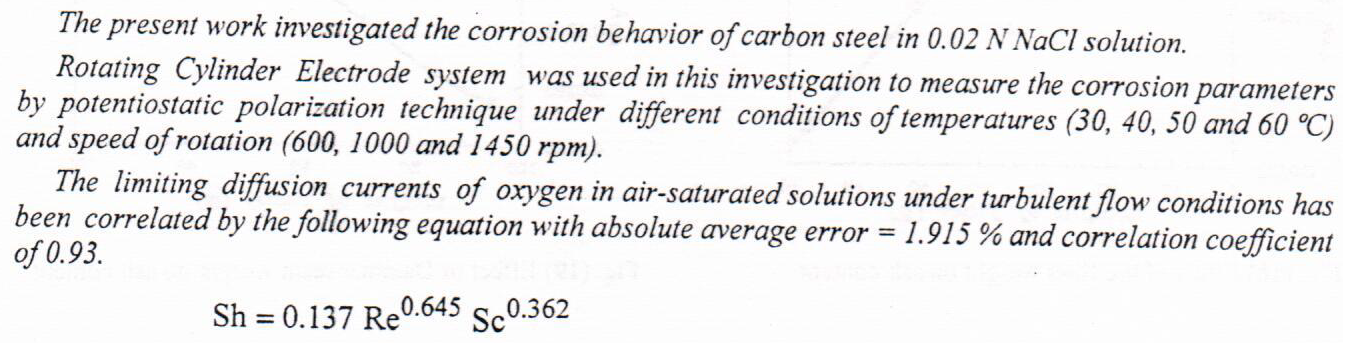
Effect of Velocity and Temperature on Mass Transfer of Oxygen in Corrosion Processes

Two years field experiment was carried out at Agricultural Fields, College of Agriculture, Baghdad University, Al-Jadriya during 2014-2015 and 2015-2016 to determine the effect of salinity of irrigation water on growth and grain yield of three oat cultivars. The experiments were laid out according to randomized complete blocks design having split plot arrangements with two factors; first factor included three oat cultivars (Shifaa, Hamel and Pimula) while the second factor included three levels of salinity of irrigation water (3, 6 and 9 dS.m-1 ) in addition to the control (river water with salinity level of 1.164 dS.m-1 ) with three replicates. Results revealed a significant effect of salinity of irrigation water on all studied traits. Mea
... Show MoreIn this research, the study effect of irradiation on structural and optical properties of thin film (CdO) by spray pyrolysis method, which deposited on glasses substrates at a thickness of (350±20)nm , The flow rate of solution was 5 ml/min and the substrate temperature was held constant at 400˚C.The investigation of (XRD) indicates that the (CdO) films are polycrystalline and type of cubic. The results of the measuring of each sample from grain size, micro strain, dislocation density and number of crystals the grain size decreasing after irradiation with gamma ray from(27.41, 26.29 ,23.63)nm . The absorbance and transmittance spectra have been recorded in the wavelength range (300-1100) nm in order to study the optical properties. the op
... Show MoreBackground: The main drawback of soft lining materials was that they debonded from the denture base after a certain period of usage. Therefore, the purpose of this research was to determine the impact of oxygen and argon plasma treatment on the shear bonding strength of soft liners to two different kinds of denture base materials: conventional acrylic resin and high impact acrylic resin. Materials and Methods: Heat cure conventional and high impact acrylic blocks (40 for each group) were prepared. A soft liner connected the final test specimen of two blocks of each acrylic material. Shear bond strength (SBS) was assessed using universal testing machine. Additional blocks were also prepared for analyzing Vickers microhardness, contact ang
... Show More (14)
(14)
 (4)
(4)


Objective: The aim of this study was to evaluate the effect of pumice, burning investment material
and black sand on the surface roughness of heat cure acrylic resin.
Methodology: Sixty specimens were prepared from pink heat cure acrylic resin, the specimens
where grouped into; 20 specimens which polished with pumice and water (control group); 20
specimens which polished with investment material (after burning it) and water; and 20 specimens
which polished with black sand and water. The average surface roughness of specimens after
polishing procedure had been determined by profilometer (surface roughness tester).
Results: Through the application of ANOVA and LSD tests, the result of this study showed that there
wa
The aim of this work is to evaluate some mechanical and physical
properties (i.e. the impact strength, hardness, flexural strength,
thermal conductivity and diffusion coefficient) of
(epoxy/polyurethane) blend reinforced with nano silica powder (2%
wt.). Hand lay-up technique was used to manufacture the composite
and a magnetic stirrer for blending the components. Results showed
that water had affected the bending flexural strength and hardness,
while impact strength increased and thermal conductivity decreased.
In addition to the above mentioned tests, the diffusion coefficient
was calculated using Fick’s 2nd law.
(3)
(127)
(119)

Abstract
The current research aims to identify the typical effect of Flower and Coscroft on expressive performance and the development of lateral thinking among literary fifth-grade students. To achieve the research objective, the researcher chose a sample of (90) female students from the fifth literary grade, with two experimental groups and a control group. The research groups are of six subjects. The research found that the two experimental groups have more expressive performance than the control group. Students of the first experimental group outperformed the students of the second experimental group in expressive performance and lateral thinking tests. In light of the findings of the research, the researcher
... Show MoreThe changes that have occurred in the business environment and scientific and technological progress, as well as the complexity of administrative problems resulting from its practice of various activities, have led to an increase in the responsibilities entrusted to it, and for the purpose of achieving its strategic objectives, which has made the pillars of corporate governance an inevitable matter required by the nature of modern scientific management of the governorate, the success that companies seek is based on the fertile environment and the dialectical relationship between the individual and the company, and to achieve this success there must be a compatible and harmonious audit environment between the internal and external
... Show MoreBackground: The aim of the study was to investigate the effect of surface treatments of zirconia (grinding and sandblast with 50μm, 100 μm) on shear bond strength between zirconia core and veneering ceramic. Material and methods: Twenty-eight presintered Y-TZP ceramic specimens (IPS e.max ZirCAD, Ivoclar vivadent) were fabricated and sintered according to manufacturer’s instructions. The core specimens were divided randomly in to 4 groups, group 1: no surface treatment, group2: zirconia specimens were ground with silicon carbide paper up to1200 grit under water cooling, group3: zirconia specimens were ground and sandblast with 100 μm alumina, group 4: zirconia specimens were ground and sandblast with 50 μm alumina. Surfa
... Show MoreThis work has been done with using of epoxy resin mixed with Granite powder were weighted by percent volume (5,10,15, and 20)%and then mixed with epoxy polymer to compose polymer composite. Hand lay-up technique is used in fabrication of the composite samples. Hardness test was carried out for the proper samples in both normal condition and after immersion in HCL (1 M and 2 M) solutions for periods ranging up to 10 weeks. After comparing the results between the polymer and their composite, the hardness increased with increasing Granite weight percent, it was found that Hardness were greater for the composites before immersion compared with their values after immersion.