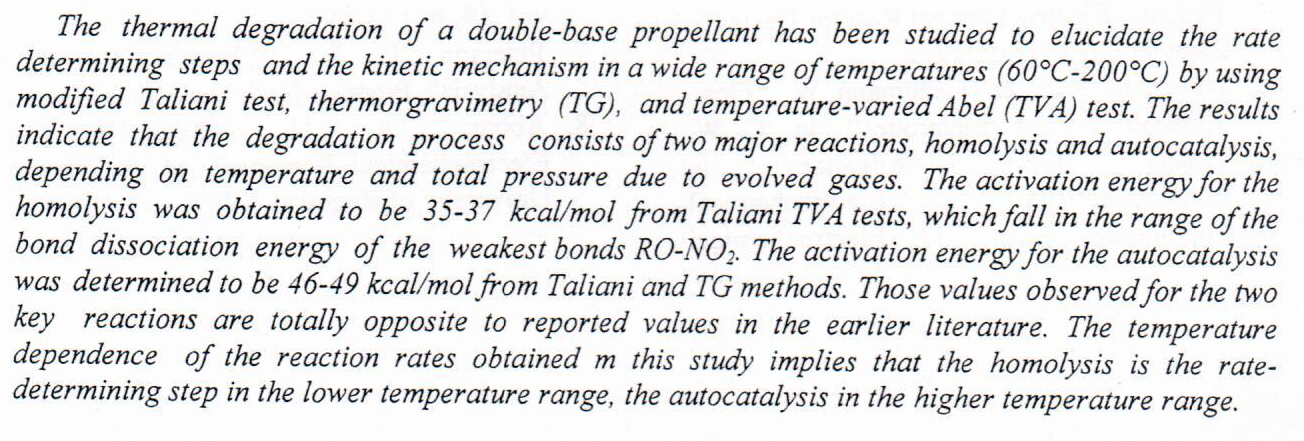
Kinetic Mechanism on Thermal Degradation of a Nitrate Ester Propellant

PVC/Kaolinite composites were prepared by the melt intercalation method. Mechanical properties, thermal properties, flammability and water absorption percentage of prepared samples were tested. Mechanical characteristic such as tensile strength, elongation at break; hardness and impact strength (charpy type) were measured for all samples. It was found that the tensile strength and elongation at break of PVC composites decreased with increasing kaolinite loading. Also, the hardness of the composites increases with increase in filler content .The impact strength of the composites at the beginning increases at lower kaolinite loadings is due to the lack of kaolin adhesion to the matrix. However, at higher kaolin loadings. This severe agglom
... Show MoreThe Cu2SiO3 composite has been prepared from the binary compounds (Cu2O, and SiO2) with high purity by solid state reaction. The Cu2SiO3 thin films were deposited at room temperature on glass and Si substrates with thickness 400 nm by pulsed laser deposition method. X-ray analysis showed that the powder of Cu2SiO3 has a polycrystalline structure with monoclinic phase and preferred orientation along (111) direction at 2θ around 38.670o which related to CuO phase. While as deposited and annealed Cu2SiO3 films have amorphous structure. The morphological study revealed that the grains have granular and elliptical shape, with average diameter of 163.63 nm. The electrical properties which represent Hall effect were investigated. Hall coeffici
... Show More
In this research work a composite material was prepared contains a matrix which is unsaturated polyester resin (UPE) reinforced with carbon nanotube the percentage weight (0.1, 0.2, 0.4.0.5) %, and Zn particle the percentage weight (0.1, 0.2,0.4,0.5)%.
All sample were prepared by hand lay-up, process the mechanical tests contains hardness test, wear rate test, and the coefficient of thermal conductivity. The results showed a significant improvement in the properties of overlapping, Article containing carbon nano-tubes and maicroparticles of zinc because of its articles of this characteristics of high quality properties led to an, an increase in the coefficient of the rmalconductivity, and increase the hardness values with increased pe
The melting duration in the photovoltaic/phase-change material (PV/PCM) system is a crucial parameter for thermal energy management such that its improvement can realize better energy management in respect to thermal storage capabilities, thermal conditions, and the lifespan of PV modules. An innovative and efficient technique for improving the melting duration is the inclusion of an exterior metal foam layer in the PV/PCM system. For detailed investigations of utilizing different metal foam configurations in terms of their convective heat transfer coefficients, the present paper proposes a newly developed mathematical model for the PV/PCM–metal foam assembly that can readily be implemented with a wide range of operating condition
... Show More (40)
(40)
 (40)
(40)

 (3)
(3)
(1)
(2)
(3)
(3)
(1)
(2)
In this study, the energy charging mechanism is mathematically modeled to determine the impact of design modifications on the thermofluidic behavior of a phase change material (PCM) filled in a triplex tube containment geometry. The surface area of the middle tube, where the PCM is placed, is supported by single or multi-internal frustum tubes in vertical triplex tubes to increase the performance of the heating and cooling of the system. In addition to the ordinary straight triplex tubes, three more scenarios are considered: (1) changing the middle tube to the frustum tube, (2) changing the inner tube to the frustum tube, and (3) changing both the internal and central tubes to the frustum tubes. The impact of adopting the tube desig
... Show More
(58)
(54)
This study found that one of the constructive, necessary, beneficial, most effective, and cost-effective ways to meet the great challenge of rising energy prices is to develop and improve energy quality and efficiency. The process of improving the quality of energy and its means has been carried out in many buildings and around the world. It was found that the thermal insulation process in buildings and educational facilities has become the primary tool for improving energy efficiency, enabling us to improve and develop the internal thermal environment quality processes recommended for users (student - teacher). An excellent and essential empirical study has been conducted to calculate the fundamental values of the
... Show More
(2)
The effects of using aqueous nanofluids containing covalently functionalized graphene nanoplatelets with triethanolamine (TEA-GNPs) as novel working fluids on the thermal performance of a flat-plate solar collector (FPSC) have been investigated. Water-based nanofluids with weight concentrations of 0.025%, 0.05%, 0.075%, and 0.1% of TEA-GNPs with specific surface areas of 300, 500, and 750 m2/g were prepared. An experimental setup was designed and built and a simulation program using MATLAB was developed. Experimental tests were performed using inlet fluid temperatures of 30, 40, and 50 °C; flow rates of 0.6, 1.0, and 1.4 kg/min; and heat flux intensities of 600, 800, and 1000 W/m2. The FPSC’s efficiency increased as the flow rate and hea
... Show More
(43)
This search study the effect of particle size of graphite on the mechanical and thermal properties of epoxy composites, where graphite adopted with particle sizes (45,53,75) ?m, respectively, and the percentages by weight (0,1,3,5,7,9)% for each size of this three particle sizes.Mechanical properties represented by the bending (three-point bending) and through which the conclusion is bending stress and modulus of elasticity, thermal properties were either through thermal conductivity tests.The results showed that the ratio(1%) is the maximum value of bending stress at the three particle size and the (45 ?m) is the maximum.Thermal conductivity result show is the maximum value at ratio (1%) of particle size(53 ?m)