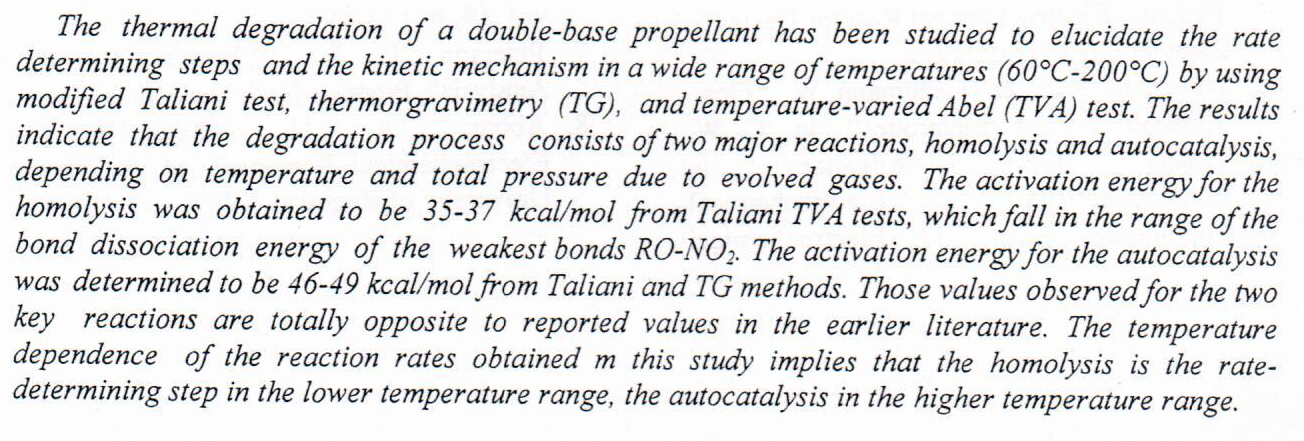
Kinetic Mechanism on Thermal Degradation of a Nitrate Ester Propellant

The oxidative degradation of Orange G dye by nanosized CeO2 catalyst has been performed in this study. The catalyst was prepared by precipitation method. Various characterization techniques were carried out to study the physical and chemical properties of the synthesized catalyst. The XRD result confirms well the formation of CeO2 cubic phase. The FTIR result showed the effect of calcination temperature for CeO2 was clearly observed due to reduction in band intensity compared to uncalcined Ce nitrate sample. Meanwhile, the diffused reflection spectra recorded reflection spectra at 414 nm with an energy gap of 3.2 ev. The decolorization of Orange G dye by oxidation process were carried out unde
... Show More (2)
(2)

 (46)
(40)
(46)
(40)


In this research prepared two composite materials , the first prepared from unsaturated polyester resin (UP) , which is a matrix , and aluminum oxide (Al2O3) , and the second prepared from unsaturated polyester resin and aluminum oxide and copper oxide (CuO) , the two composites materials (Alone and Hybrid) of percentage weight (5,10,15)% . All samples were prepared by hand layup process, and study the electrical and thermal conductivity. The results showed decrease electrical conductivity from (10 - 2.39) ×10-15 for (Up+ Al2O3) and from (10 - 2.06)×10-15 for (Up+ Al2O3+ CuO) .But increase thermal conductivity from( 0.17 - 0.505) for (Up+ Al2O3) and from (0.17 - 0.489) for (Up+ Al2O3+ CuO).
(31)
(27)
(1)
The mechanism for selecting the President of the Republic and his constitutional powers under the Constitution of the Republic of Iraq
The chemical composition of wastes of pressed grapes and found that the main components of wastes of pressed grapes, represented by the percentage of moisture was 6.47%, and the proportions are 3.71%. Either carbohydrates amounted to 85.77 %, either in fat models using petroleum ether Petroleum ether) was the increase of 0.27%. estimated the percentage of ash in the sampls was 3.78%, either fiber reached 69.47 %,, in addition to the test extracts towards the growth of seven types of bacteria, which included Bacillus subtilis, Bacillus cereus, Bacillus stearothermophilus, Escherishia coli, Staphylococcus aureus, Salmonella typhimurium and Pseudomonas fluorescens and yeast Candida albicans and Kluyveromyces marxianus, ( diffusion method ).
... Show MoreA thin CdS Films have been evaporated by thermal evaporation technique with different thicknesses (500, 1000, 1500 and 2000Å) and different duration times of annealing (60, 120 180 minutes) under 573 K annealing temperature, the vacuum was about 8 × 10⁻⁵ mbar and substrate temperature was 423 K. The structural properties of the films have been studied by X- ray diffraction technique (XRD). The crystal growth became stronger and more oriented as the film thickness (T) and duration time of annealing ( Ta) increases.
Thermal conductivity for epoxy composites filled with Al2O3 and Fe2O3 are
calculated, it found that increasing the weight ratio of Al2O3 and Fe2O3 lead to
increase in the values of thermal conductivity, but the epoxy composite filled with
Fe2O3, have values of thermal conductivity less than for epoxy composite filled with
Al2O3, for the same weight ratio. Also thermal conductivity calculated for epoxy
composites by contact to every two specimens (like sandwich) content same weight
ratio of alumina-oxide and ferrite-oxide, its found that the value of thermal
conductivity lays between the values of epoxy filled Al2O3 and of epoxy filled Fe2O3
In this search, Ep/SiO2 at (3, 6, 9, 12 %) composites is prepared by hand Lay-up method, to measure the change in the thermal conductivity and Impact Strength of epoxy resin before and after immersion in H2SO4 Solution with a 0.3N for 10 days. The results before immersion decreases with the increase of the weight ratios of the reinforcement material (SiO2), It changed from (82.6×10⁻² to 38.7×10⁻² W/m.°C) with change weight ratios from (3 to 12) % respectively, but after immersion time in the chemical solution where it was (65.6×10⁻² W/m.°C) at the weight ratios (6 %) and became (46.6 × 10⁻² W/m.°C) after immersion in sulfuric acid. The results of the Impact strength decreased by increasing the percentage weight ratio, it changed f
... Show More
(21)
(22)