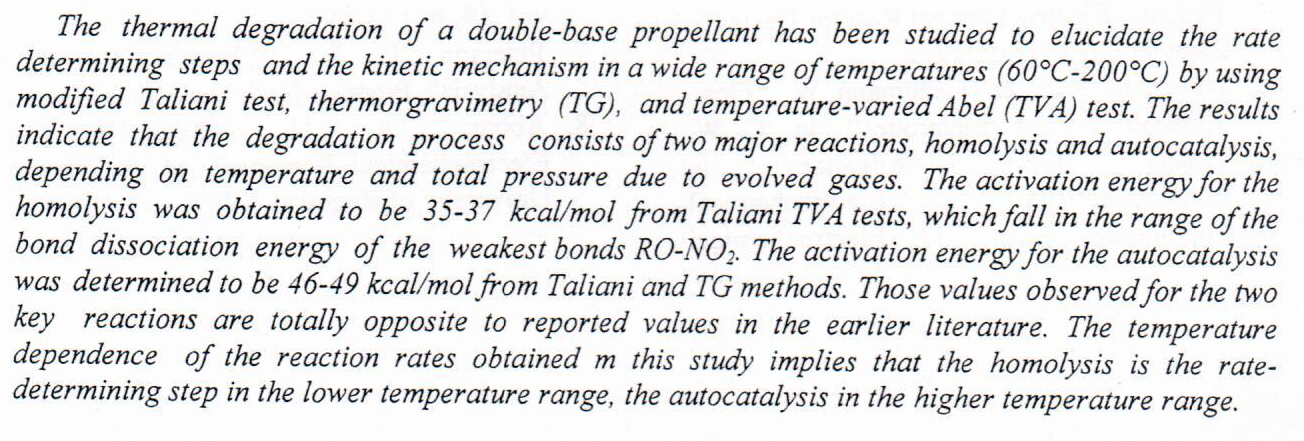
Kinetic Mechanism on Thermal Degradation of a Nitrate Ester Propellant

 (5)
(5)
 (4)
(4)



The azo dye brilliant reactive red K-2BP (λmax = 534 nm) is widely used for coloring textiles because of its low-cost and tolerance fastness properties. Wastewaters treatment that contains the dye by conventional ways is usually inadequate due to its resistance to biological and chemical degradation. During this study, the continuous reactor of an advanced oxidation method supported the use of H2O2/sunlight, H2O2/UV, H2O2/TiO2/sunlight, and H2O2/TiO2/UV for decolorization of brilliant reactive red dye from the effluent. The existence of an optimum pH, H2O2 concentration, TiO2 concentration, and d
... Show More
(8)
Mesoporous silica (MPS) nanoparticle was prepared as carriers for drug delivery systems by sol–gel method from sodium silicate as inexpensive precursor of silica and Cocamidopropyl betaine (CABP) as template. The silica particles were characterized by SEM, TEM, AFM, XRD, and N2adsorption–desorption isotherms. The results show that the MPS particle in the nanorange (40-80 nm ) with average diameter equal to 62.15 nm has rods particle morphology, specific surface area is 1096.122 m2/g, pore volume 0.900 cm3/g, with average pore diameter 2.902 nm, which can serve as efficient carriers for drugs. The adsorption kinetic of Ciprofloxacin (CIP) drug was studied and the data were analyzed and found to match well with
... Show More
(27)
(9)
Vacuum gas oil (611-833)K was distilled from Kirkuk crude oil, which was obtained by blending the following fraction,
light vacuum gas oil (611 - 650) K, medium vacuum gas oil (650-690)K, heavy vacuum gas oil (690-727)K and very
heavy vacuum gas oil (727-833)K.
The vacuum gas oil was hydrotreated on a commercial cobalt-molybdenum alumina catalyst presulfied at specified
condition in a laboratory trickle bed reactor. The reaction temperature varied from (583-643)K over liquid hourly space
velocity ranging between (1.5-3.75)h-1 , Hydrogen pressure was kept constant at 3.5 MPa with a hydrogen to oil ratio
of about 250 L/L
The conversion results for desulfurization appeared to obey the second order kinetics. According to
The present study explores the solar-induced photocatalytic degradation of reactive red (RR) and reactive turquoise (RT) dyes in a single system using TiO2 immobilized in xanthan gum (TiO2/XG), synthesized using the sol–gel dip-coating technique for direct precipitation. SEM-EDX, XRD, FTIR, and UV–Vis were used to assess the characteristics of the resulting catalyst. Moreover, the effects of different operating parameters, specifically pH, dye concentration, TiO2/XG concentration, H2O2 concentration, and contact time, were also investigated in a batch photocatalytic reactor. The immobilized TiO2/XG catalyst showed a slight adsorption degradation efficiency and then improved the RR and RT dye degradation activity (92.5 and 90.8%
... Show More
(26)
(23)
This research considers a proposed mechanism relying on frictional interactions between the grasped object and the gripper, thus attaining a case of self-locking condition for a tendon type robotic gripper. A mathematical model was derived for this proposed mechanism, upon which a special purpose apparatus was fabricated and tested. Both results, theoretically and experimentally, are in good agreement, showing that the weight of the grasped object played a major role in attaining the self-locking condition.
In this research, the influence of the fermentation treatments and baking in Iraqi’s flour type (Ibaa 99, Al-rashed, Tamus, Abu-grabe) and Turkish flour type (Muaamel) on phytic acid was investigated. In whole wheat flour, the phytic acid was (1500, 1290, 1450, 1230, 1440 ( mg/ 100 g flour respectively, and the inorganic phosphorous was (29.18, 25.15, 23.89, 20.85, 22.83) mg/100 g flour respectively. The dough prepared from flour with a higher phytic acid content also contained higher amount of phytic acid. During fermentation, degradation of phytic acid occurred. The cumulative loss of phytic acid after fermentation in all type of dough was ~ 23, 22, 34, 26 and 27% respectively،While increased of inorganic phosphorous occurred. The c
... Show More
(9)
(7)
Biomimicry, as a way of thinking to go back to nature for inspiration, has its impact on many contemporary technological achievements. Some of them are used to design and construct kinetic facades in architecture, because of the importance role of facades in reducing sun radiation, that enter the building through using shading systems and components. In light of this, research problem is determined: "Do technologies which are inspired by biomimicry effect shading in kinetic facades through its characteristics in materials and the mechanics. So the research identifies its goal as: "To identify the types of kinetic facades in buildings and their characteristics as materials and shading mechanism associated with the b
... Show More