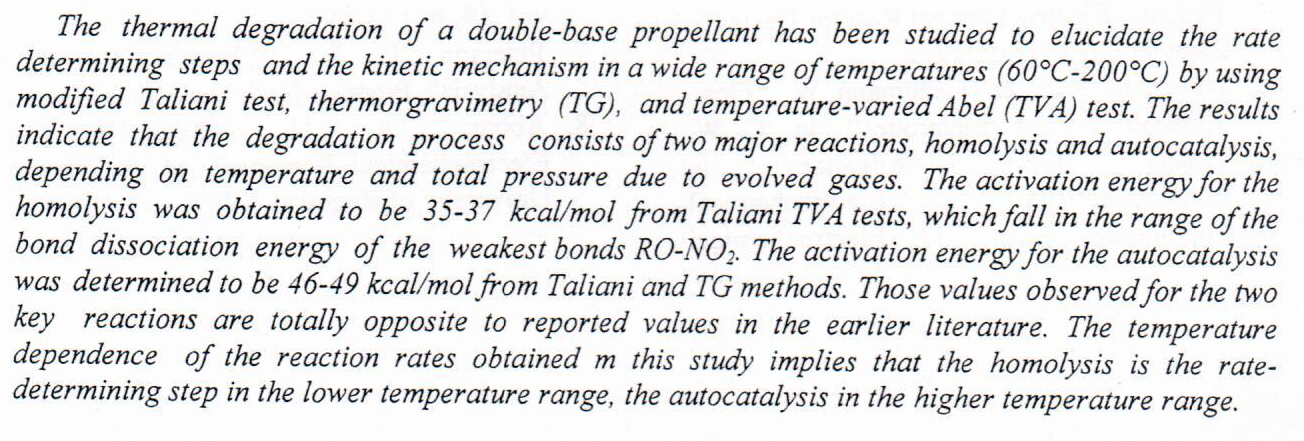
Kinetic Mechanism on Thermal Degradation of a Nitrate Ester Propellant

Ceramic coating compose from a ceramic mixture (MgO, Al2O3) and metall (Al-Ni) were produced by Thermal Spray Technique. The mixed ratio of used materials Al:Ni (50%) and 40% of Al2O3 and 10% MgO. This mixture was spray on a stainless steel substrate of type (316 L) by using thermal spray with flame method and at spraying distances (8, 12, 16 and 20) cm, then the prepared films were treated by laser and thermal treatment. After that performing a hardness and adhesion tests were eximined. The present study shows that the best value of the thermal treatment is 1000 ℃ for 30 mint; the optimum spray distance is 12 cm and most suitable laser is 500 mJ where the microscopic and mechanical character
... Show More (1)
(1)

The semiempirical (PM3) and DFT quantum mechanical methods were used to investigate the theoretical degradation of Indigo dye. The chemical reactivity of the Indigo dye was evaluated by comparing the potential energy stability of the mean bonds. Seven transition states were suggested and studied to estimate the actually starting step of the degradation reaction. The bond length and bond angle calculations indicate that the best active site in the Indigo dye molecule is at C10=C11. The most possible transition states are examined for all suggested paths of Indigo dye degradation predicated on zero-point energy and imaginary frequency. The first starting step of the reaction mechanism is proposed. The change in enthalpy, Gibbs free energ
... Show More (5)
(1)
(5)
(1)

This paper aims to study the chemical degradation of Brilliant Green in water via photo-Fenton (H2O2/Fe2+/UV) and Fenton (H2O2/Fe2+) reaction. Fe- B nano particles are applied as incrustation in the inner wall surface of reactor. The data form X- Ray diffraction (XRD) analysis that Fe- B nanocomposite catalyst consist mainly of SiO2 (quartz) and Fe2O3 (hematite) crystallites. B.G dye degradation is estimated to discover the catalytic action of Fe- B synthesized surface in the presence of UVC light and hydrogen peroxide. B.G dye solution with 10 ppm primary concentration is reduced by 99.9% under the later parameter 2ml H2O2, pH= 7, temperature =25°C within 10 min. It is clear that pH of the solution affects the photo- catalytic degradation
... Show More
Optical spectrum of SN1987A at days 4 from the explosion and its light curve through the first 1444 days after the explosion have been studied. The hydrogen lines present in the spectrum confirms the general characteristics of Type II SN that occur due to core collapse of massive star. Each of the total mass ejected from the explosion and the amount of the total mass of Nickel radioactive isotopes that produced during the explosion as well as the initial velocity of the ejecta and the explosion energy have been determined and compared with different observed and calculated models obtained by different researchers and it’s found that, about 8.8 Mʘ of the progenitor envelope mass had been ejected during the explosion and it’s mixed with
... Show More
(40)
(41)

In this paper, the researcher suggested using the Genetic algorithm method to estimate the parameters of the Wiener degradation process, where it is based on the Wiener process in order to estimate the reliability of high-efficiency products, due to the difficulty of estimating the reliability of them using traditional techniques that depend only on the failure times of products. Monte Carlo simulation has been applied for the purpose of proving the efficiency of the proposed method in estimating parameters; it was compared with the method of the maximum likelihood estimation. The results were that the Genetic algorithm method is the best based on the AMSE comparison criterion, then the reliab
... Show More
In this research, annealed nanostructured ZnO catalyst water putrefaction system was built using sun light and different wavelength lasers as stimulating light sources to enhance photocatalytic degradation activity of methylene blue (MB) dye as a model based on interfacial charges transfer. The structural, crystallite size, morphological, particle size, optical properties and degradation ability of annealed nanostructured ZnO were characterized by X-Ray Diffraction (XRD), Atomic Force Microscopy (AFM) and UV-VIS Spectrometer, respectively. XRD results demonstrated a pure crystalline hexagonal wurtzite with crystalline size equal to 23 nm. From AFM results, the average particle size was 79.25nm. All MB samples and MB with annealed nanostr
... Show MoreIt is well known that petroleum refineries are considered the largest generator of oily sludge which may cause serious threats to the environment if disposed of without treatment. Throughout the present research, it can be said that a hybrid process including ultrasonic treatment coupled with froth floatation has been shown as a green efficient treatment of oily sludge waste from the bottom of crude oil tanks in Al-Daura refinery and able to get high yield of base oil recovery which is 65% at the optimum operating conditions (treatment time = 30 min, ultrasonic wave amplitude = 60 micron, and (solvent: oily sludge) ratio = 4). Experimental results showed that 83% of the solvent used was recovered meanwhile the main water
... Show More
(1)
Sea level rise (SLR) due to climate change is affecting the coastline, causing shoreline changes, the degradation of mangrove forests, and the destruction of coastal resources. This is the cause of a huge amount of mangrove degradation in many parts of the Ganges–Brahmaputra–Meghna delta. A total of 90% of people have been forced to migrate from the island due to extreme weather conditions. In this study, remote sensing (RS) and geographic information system (GIS) techniques were used for LULC change and shoreline shift analyses of Ghoramara Island. LULC classification was carried out using thirty years of Landsat datasets with intervals of ten years (1990 and 2000) and intervals of five years (2005, 2010, 2015, and 2020). The classific
... Show More
(25)
(24)
The annual performance of a hybrid system of a flat plate photovoltaic thermal system and a solar thermal collector (PVT/ST) is numerically analyzed from the energy, exergy, and environmental (CO2 reduction) viewpoints. This system can produce electricity and thermal power simultaneously, with higher thermal power and exergy compared to conventional photovoltaic thermal systems. For this purpose, a 3D transient numerical model is developed for investigating the system's performance in four main steps: (1) investigating the effects of the mass flow rate of the working fluid (20 to 50 kg/h) on the temperature behavior and thermodynamic performance of the system, (2) studying the impacts of using glass covers on the different parts of the s
... Show More
(2)