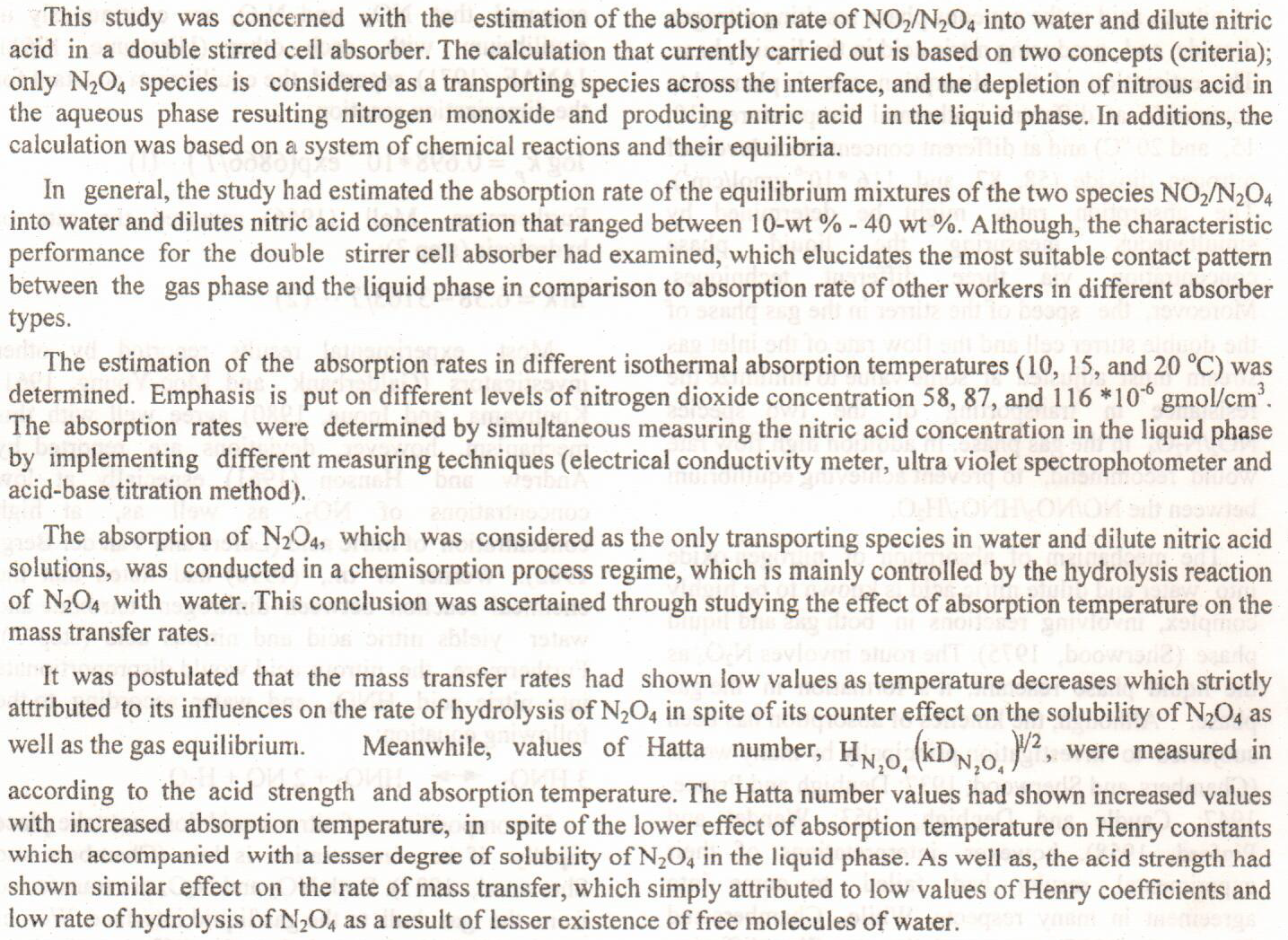
Adsorption of NO2/N2O4 into Water and Dilute Nitric Acid in a Double Stirrer Adsorber

Metal nanoparticles can serve as an efficient nano-heat source with confinement photothermal effects. Thermo-plasmonic technology allows researchers to control the temperature at a nanoscale due to the possibility of precise light propagation. The response of opto-thermal generation of single gold-silica core-shell nanoparticle immersed in water and Poly-vinylpyrrolidone surrounding media is theoretically investigated. Two lasers (CW and fs pulses) at the plasmonic resonance (532 nm) are utilized. For this purpose, finite element method is used via COMSOL multiphysics to find a numerical computation of absorption cross section for the proposed core –shell NP in different media. Thermo-plasmonic response for both lasers is studied. The
... Show More (20)
(20)
 (9)
(9)



This study presents the debonding propagation in single NiTi wire shape memory alloy into linear low-density polyethylene matrix composite the study of using the pull-out test. The aim of this study is to investigate the pull-out tests to check the interfacial strength of the polymer composite in two cases, with activation NiTinol wire and without activation. In this study, shape memory alloy NiTinol wire 2 mm diameter and linear fully annealed straight shape were used. The study involved experimental and finite element analysis and eventually comparison between them. This pull-out test is considered a substantial test because its results have a relation with behavior of smart composite materials. The pull-out test was carried out by a u
... Show More
To identify the fungi associated with water hyacinth (Eichhornia crassipes [Mart.] Solms), an aquatic weed, which presents in Tigris river from Baghdad south ward. Five regions from middle and south of Iraq (Al-Noumanya, Saeid Bin-Jubier, Al-Azizia, Al-Reyfay and Al-Hay) were selected for this study. Twelve fungal species were isolated. Alternaria alternata, Acremonium sp and Cladsporium herbarum, were the most frequently species (91.66 % ,50 % and 25 %) respectively. The fungi Alternaria alternata, Acremonium sp. and Phoma eupyrena were more aggressive to water hyacinth as (91.66%,83,33%, and 75%) in pathogenicity test.
Esterification considers the most important reaction in biodiesel production. In this study, oleic acid was used as a suggested feedstock in order to study and simulate production of biodiesel. The batch esterification reaction of oleic acid was carried out at various operating conditions; temperature from 40 to 70 °C, ethanol to oleic acid molar ratio from 3/1 and 6/1 and a reaction time up to 180 min.
The catalyst used was prepared NaY zeolite, which is added to the reaction mixture as 2, 5 and 10 wt.% of oleic acid.
The results show that the optimum conditions, gives 0.81 conversion of oleic acid, were 6/1 molar ratio of ethanol/oleic acid, 5 wt.% NaY relative to initial oleic acid, 70°C and 60 minutes. The activation energy o
Indole acetic acid (IAA) produced from F. oxysporum (F2) was purified by several steps included extraction by cold ethyl acetate ; Column chromatography using silica gel and TLC chromatography . The pure indole acetic acid (IAA) which produce by F. oxysporum (IAA) was tested by ultraviolet spectra at (200-300)nm ; and appear that the maximum absorbance at 229nm , the high performance liquid chromatography (HPLC) used to test the purity of the indole acetic acid and the results showed one peak at appearance time 3.822 min
(6)
(2)
Salicylaldehyde was reacting with 2-amino benzoic acid to produce the Schiff base ligand benzoic acid 2-salicylidene (L). The prepared ligand was identified by Microelemental Analysis, FT.IR and UV-Vis spectroscopic techniques. A new complexes of Co(II),Ni(II),Cu(II) and Zn(II) with Schiff base was prepared in aqueous ethanol with a (1:1) M:L. The prepared complexes were characterized using flame atomic absorption, (C.H.N) Analysis, FT.IR and UV-Vis spectroscopic methods as well as magnetic susceptibility and conductivity measurements. Biological activity of the ligand and complexes against three selected types of bacteria were also examined. Some of the complexes exhibit good bacterial activities. From the obtained data the tetrahedral str
... Show MoreThis search include the synthesis of some new 1,3-oxazepine derivatives have been prepared, starting from reaction of L-ascorbic acid with dry acetone in presence of dry hydrogen chloride afforded the acetal (I). Treatment of the latter with p-nitrobenzoyl chloride in pyridine yielded the ester (II) which was dissolved in (65%) acetic acid in absolute ethanol yielded the glycol (III). The reaction of the glycol (III) with sodium periodate in distilled water at room temperature produced the aldehyde (IV). The compound (V) [4-(1,3-dioxoisoindolin-2-yl)benzoic acid] was synthesized by reaction p-aminobenzoic acid and phthalic anhydride in presence of (gla. CH3COOH). Reaction of compound (V) with thionyl chloride produced [4-(1,3-dioxoisoindoli
... Show More
(3)
(2)
The remove of direct blue (DB71) anionic dye on flint clay in aqueous solution was investigated by using a batch system for various dye concentrations. The contact time, pH, adsorbent dose, and temperature was studied under batch adsorption technique. The data of adsorption equilibrium fit with isotherm Langmuar and Freiundlich ,when the correlation coefficient used to elucidate the best fitting isotherm model. The thermodynamic parameters such as, ?Hº ,?Sº and ?Gº. Thermodynamic analysis indicated that the sorption of the dyes onto Flint clay was endothermic and spontaneous.