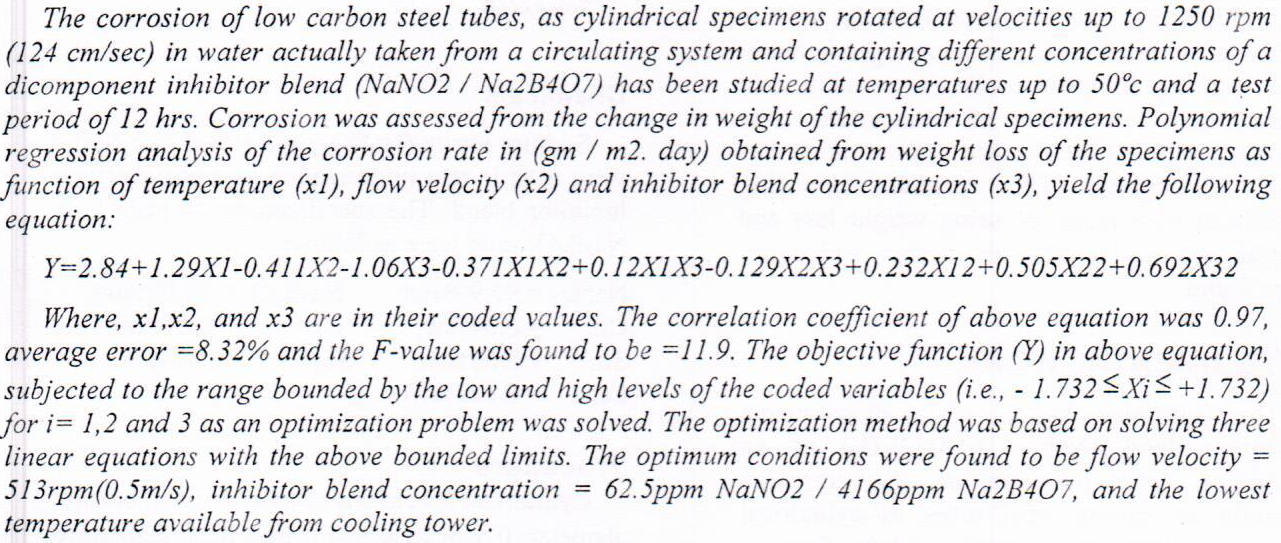
The Influence of Temperature and Flow Velocity on the Corrosion Inhibition of Low Carbon Tubes in Recirculating Water System by a Dicomponent Inhibitor Blend

 (6)
(6)
 (2)
(2)


Background: preparation of root canals is an important step in root canal treatment. Mechanical instrumentation of root canals cause an irregular layer of debris, known as the smear layer. As a result, several studies reported that preferring the removal of the smear layer. Objective: To study the influence of the energy (100 mJ) of Erbium, Chromium: Yttrium Scandium Gallium Garnet (Er,Cr:YSGG) laser at short pulse duration (60 μs) on smear layer removal of apical third after using Photon induced photoacoustic streaming technique. Materials and methods: Eighteen straight single-rooted mandibular premolars were used. The roots length were uniform to 14mm from the anatomic apex and
... Show More
(7)
(6)
The current paper investigates the effect of cut-out design parameters on load-bearing capacity and buckling behaviour of steel cylindrical shell using a nonlinear finite element analysis in modelling cylinder buckling under longitudinal compressive load. The effect of four geometry design parameters: shell diameter to thickness ratio, cut-out location, orientation, and size were investigated in this study. To enhance the prediction of buckling behaviour, both geometrical and material nonlinearities were considered. An ANSYS APDL code was written and tested by verifying its validity through comparison with former buckling study. The results showed that changing the cut-out location from mid-height of the cylindrical shell towards a
... Show More
(3)
(2)
(1)
(1)
(2)
(1)
(24)
(13)

The impacts of numerous important factors on the Energy Absorption (EA) of torsional Reinforced Concrete (RC) beams strengthened with external FRP is the main purpose and innovation of the current research. A total of 81 datasets were collected from previous studies, focused on the investigation of EA behaviour. The impact of nine different parameters on the Torsional EA of RC-beams was examined and evaluated, namely the concrete compressive strength (f’c), steel yield strength (fy), FRP thickness (tFRP), width-to-depth of the beam section (b/h), horizontal (ρh) and vertical (ρv) steel ratio, angle of twist (θu), ultimate torque (Tu), and FRP ultimate strength (fy-FRP). For the evaluation of the energy absorption capacity at di
... Show More
(16)
(17)
This study evaluates the flexural behavior of ultra-thin (50 mm) one‑way reinforced‑concrete (RC) slabs retrofitted with near‑surface mounted (NSM) carbon‑fiber‑reinforced polymer (CFRP) rods under quasi‑static loading. T300‑grade CFRP rods (≈4 mm diameter) were bonded in pre‑cut 7 mm × 7 mm grooves using a two‑part epoxy. As a proof-of-concept experimental baseline, three simply‑supported specimens (1000 mm × 500 mm × 50 mm) were tested in a six‑point bending configuration (four applied loads + two reactions): two conventional controls and one strengthened slab. A load‑control rate of ~15 kN/min was applied; the controls were cycled twice and the strengthened slab four times. Relative to the average of
... Show More
Coagulation - flocculation are basic chemical engineering method in the treatment of metal-bearing industrial wastewater because it removes colloidal particles, some soluble compounds and very fine solid suspensions initially present in the wastewater by destabilization and formation of flocs. This research was conducted to study the feasibility of using natural coagulant such as okra and mallow and chemical coagulant such as alum for removing Cu and increase the removal efficiency and reduce the turbidity of treated water. Fourier transform Infrared (FTIR) was carried out for okra and mallow before and after coagulant to determine their type of functional groups. Carbonyl and hydroxyl functional groups on the surface of
... Show More