The Influence of Temperature and Flow Velocity on the Corrosion Inhibition of Low Carbon Tubes in Recirculating Water System by a Dicomponent Inhibitor Blend
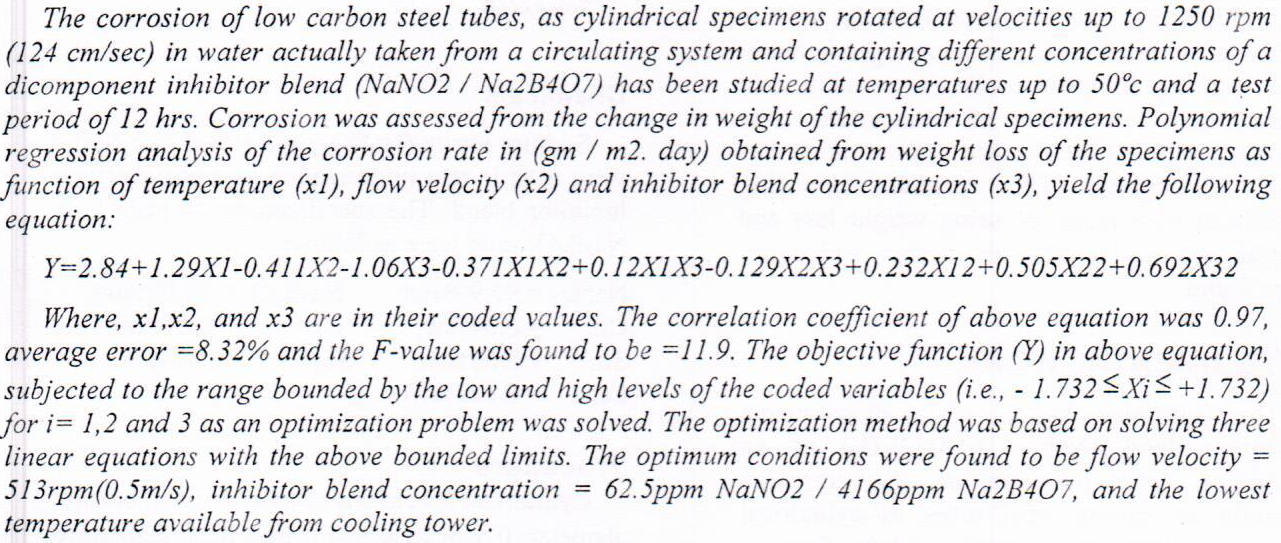

 (13)
(13)
 (12)
(12)



The aim of the research is to identify the trends of Saudi society towards visiting art galleries and museums in light of economic and social transformations after the implementation of the 2030 vision plans. The importance of the research is to track the reasons behind the reluctance of members of society to visit such cultural institutions, and to plan proposals and recommendations for how to attract members of society and motivate them. This research followed the descriptive approach, and the study sample reached 103 members of the Saudi community. several research tools were used in this research such as questionnaire, personal interviews in addition to the researcher notes. The results concluded that the art galleries attract the ap
... Show More
New metal ion complexes were synthesized with the general formula; K[PtLCl4], [ReLCl4] and K[ML(Cl)2] where M = Pd(II), Cd(II), Zn(II) and Hg(II), from the Azo ligand (HL) [2-Hydroxy-3-((5-mercapto-1,3,4-thiadiazol-2-yl)diazenyl)-1-naphth aldehyde] (HL) the ligand was synthesized from (2-hydroxy-1-naphthaldehyde) and (5-amino-1,3,4-thiadiazole-2-thiol). The ligand and its metal complexes are characterized by phisco- chemical spectroscopic techniques (FT.IR, UV-Vis and Mass spectra, elemental analysis, molar conductivity, Atomic Absorption, Chloride contain and magnetic susceptibility). The spectral data suggest that the (HL) behaves as a bidentate ligand in all complexes. These studies revealed tetrahedral geometries for all metal complexes
... Show More
Aim of the study: Using surface roughness and tensile bond strength tests, the objective of this investigation was to ascertain the impact of laser surface modification on the binding strength of injectable thermoplastic acrylic denture base material to acrylic-based soft-liner material. Materials and methods: Acrylic base soft liner material was bonded to injectable thermoplastic acrylic resin (Deflex). Forty specimens were created (20 disc, 20 dumbbells) 10 of each specimen type as control specimens, and 10 were treated with nano pulse Nd: YAG laser. The data were analyzed using the Kruskal-Wallis test and unpaired t-test (a=.05) and the roughness test was performed utilizing a double column universal test machine. Results: Compar
... Show More
In this paper, the dynamic behaviour of the stage-structure prey-predator fractional-order derivative system is considered and discussed. In this model, the Crowley–Martin functional response describes the interaction between mature preys with a predator. e existence, uniqueness, non-negativity, and the boundedness of solutions are proved. All possible equilibrium points of this system are investigated. e su‰cient conditions of local stability of equilibrium points for the considered system are determined. Finally, numerical simulation results are carried out to con‹rm the theoretical results.
(3)
This study thoroughly investigates the potential of niobium oxide (Nb2O5) thin films as UV-A photodetectors. The films were precisely fabricated using dc reactive magnetron sputtering on Si(100) and quartz substrates, maintaining a consistent power output of 50W while varying substrate temperatures. The dominant presence of hexagonal crystal structure Nb2O5 in the films was confirmed. An increased particle diameter at 150°C substrate temperature and a reduced Nb content at higher substrate temperatures were revealed. A distinct band gap with high UV sensitivity at 350 nm was determined. Remarkably, films sputtered using 50W displayed the highest photosensitivity at 514.89%. These outstanding optoelectronic properties highlight Nb2O5 thin f
... Show MoreIn this research, the problem of multi- objective modal transport was formulated with mixed constraints to find the optimal solution. The foggy approach of the Multi-objective Transfer Model (MOTP) was applied. There are three objectives to reduce costs to the minimum cost of transportation, administrative cost and cost of the goods. The linear membership function, the Exponential membership function, and the Hyperbolic membership function. Where the proposed model was used in the General Company for the manufacture of grain to reduce the cost of transport to the minimum and to find the best plan to transfer the product according to the restrictions imposed on the model.
In this research, beam expander, BEX, is explained and designed for illuminating the
remote flying target. The BEX is optically designed to be suited for Nd:YAG laser of given
specifications. The BEX is modified to be zoom one to meet the conditions of preventing the
receiving unit; i.e the photodetector, from getting saturated at near and far laser tracking.
Decollimation could be achieved by automatic motor, which controls zoom lens of the BEX
according to the required expansion ratio of beam expander
In current study, the dye from flowers petals of Strelitzia reginae used for the first time to prepare natural photosensitizer for DSSC fabrication. Among five different solvents used to extract the natural dye from S. reginae flowers, the ethanol extract of anthocyanin dye revealed higher absorption spectrum of 0.757a.u. at wavelength of 454nm. A major effect of temperature was studied to increase the extraction yield. The results show that the optimal temperature was 70 °C and there was a sharp decrease of dye concentration from 0.827 at temperature of 70 °C to 0.521 at temperature of 90°C. The extract solution of flowers of S. reginae showed higher concentration in acidic media, especially at pH 4 (0.902). The
... Show More