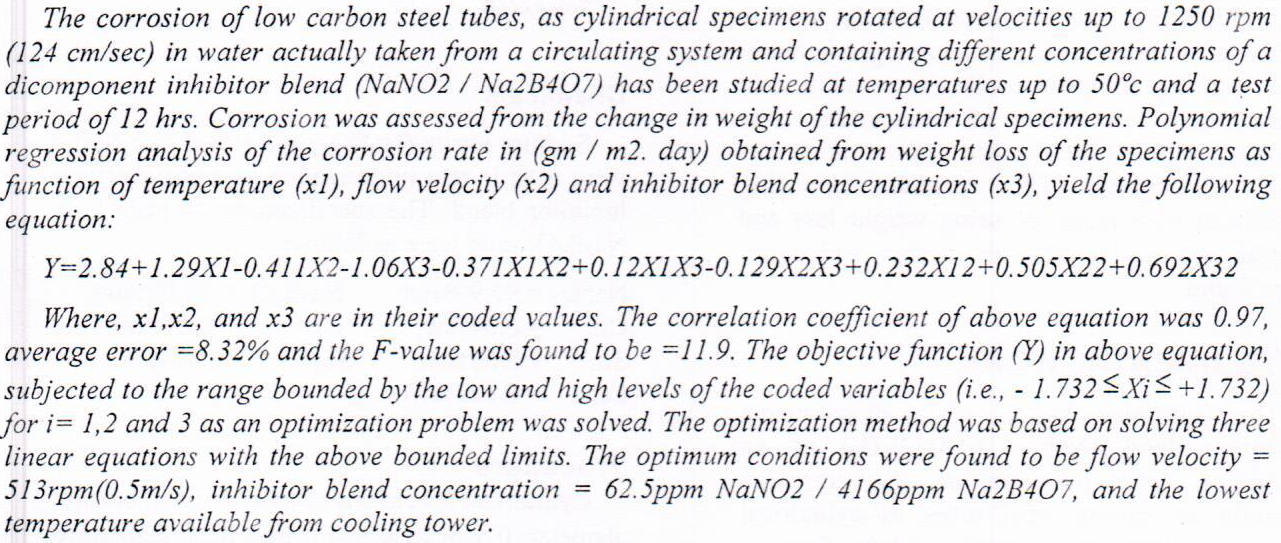
The Influence of Temperature and Flow Velocity on the Corrosion Inhibition of Low Carbon Tubes in Recirculating Water System by a Dicomponent Inhibitor Blend

 (145)
(145)
 (145)
(145)



The objective of the current research is to find an optimum design of hybrid laminated moderate thick composite plates with static constraint. The stacking sequence and ply angle is required for optimization to achieve minimum deflection for hybrid laminated composite plates consist of glass and carbon long fibers reinforcements that impeded in epoxy matrix with known plates dimension and loading. The analysis of plate is by adopting the first-order shear deformation theory and using Navier's solution with Genetic Algorithm to approach the current objective. A program written with MATLAB to find best stacking sequence and ply angles that give minimum deflection, and the results comparing with ANSYS.
The disposal of textile effluents to the surface water bodies represents the critical issue especially these effluents can have negative impacts on such bodies due to the presence of dyes in their composition. Biological remediation methods like constructed wetlands are more cost-effective and environmental friendly technique in comparison with traditional methods. The ability of vertical subsurface flow constructed wetlands units for treating of simulated wastewater polluted with Congo red dye has been studied in this work. The units were packed with waterworks sludge bed that either be unplanted or planted with Phragmites australis and Typha domingensis. The efficacy of present units was evaluated by monitoring of DO, Temperature, COD
... Show More
(7)
The dynamic development of computer and software technology in recent years was accompanied by the expansion and widespread implementation of artificial intelligence (AI) based methods in many aspects of human life. A prominent field where rapid progress was observed are high‐throughput methods in biology that generate big amounts of data that need to be processed and analyzed. Therefore, AI methods are more and more applied in the biomedical field, among others for RNA‐protein binding sites prediction, DNA sequence function prediction, protein‐protein interaction prediction, or biomedical image classification. Stem cells are widely used in biomedical research, e.g., leukemia or other disease studies. Our proposed approach of
... Show More
(4)
(3)
(215)
(193)
(6)
(5)
Background: preparation of root canals is an important step in root canal treatment. Mechanical instrumentation of root canals cause an irregular layer of debris, known as the smear layer. As a result, several studies reported that preferring the removal of the smear layer. Objective: To study the influence of the energy (100 mJ) of Erbium, Chromium: Yttrium Scandium Gallium Garnet (Er,Cr:YSGG) laser at short pulse duration (60 μs) on smear layer removal of apical third after using Photon induced photoacoustic streaming technique. Materials and methods: Eighteen straight single-rooted mandibular premolars were used. The roots length were uniform to 14mm from the anatomic apex and
... Show MoreThe simulation of passively Q-switching is four non – linear first order differential equations. The optimization of passively Q-switching simulation was carried out using the constrained Rosenbrock technique. The maximization option in this technique was utilized to the fourth equation as an objective function; the parameters, γa, γc and β as were dealt with as decision variables. A FORTRAN program was written to determine the optimum values of the decision variables through the simulation of the four coupled equations, for ruby laser Q–switched by Dy +2: CaF2.For different Dy +2:CaF2 molecules number, the values of decision variables was predicted using our written program. The relaxation time of Dy +2: CaF2, used with ruby was
... Show More
(2)
(4)
The temperature control process of electric heating furnace (EHF) systems is a quite difficult and changeable task owing to non-linearity, time delay, time-varying parameters, and the harsh environment of the furnace. In this paper, a robust temperature control scheme for an EHF system is developed using an adaptive active disturbance rejection control (AADRC) technique with a continuous sliding-mode based component. First, a comprehensive dynamic model is established by using convection laws, in which the EHF systems can be characterized as an uncertain second order system. Second, an adaptive extended state observer (AESO) is utilized to estimate the states of the EHF system and total disturbances, in which the observer gains are updated
... Show More
(38)
(36)