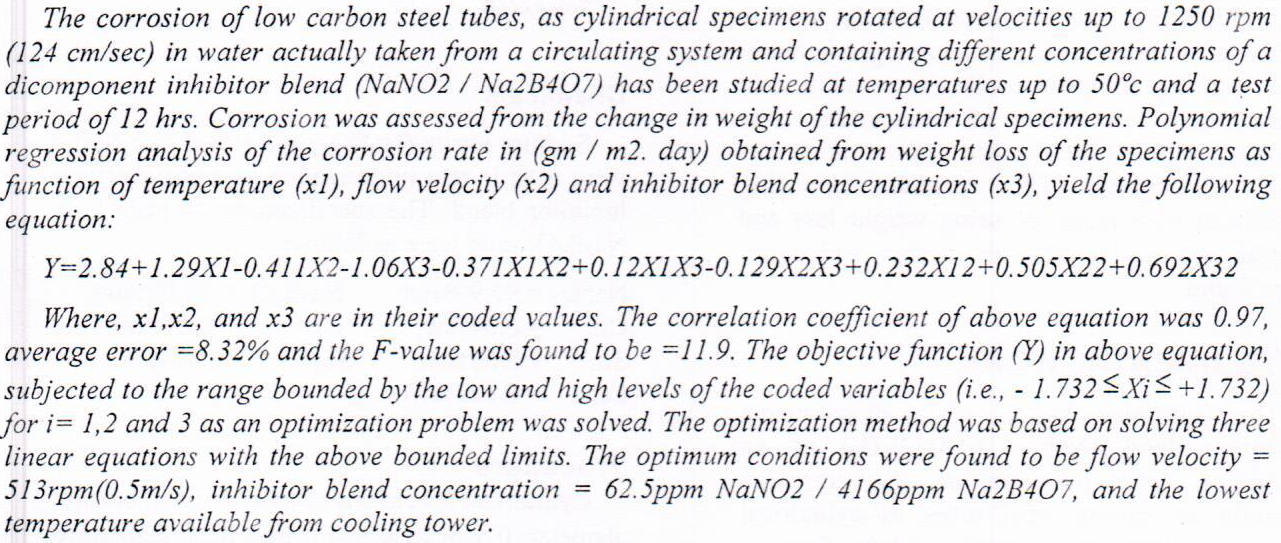
The Influence of Temperature and Flow Velocity on the Corrosion Inhibition of Low Carbon Tubes in Recirculating Water System by a Dicomponent Inhibitor Blend

By optimizing the efficiency of a modular simulation model of the PV module structure by genetic algorithm, under several weather conditions, as a portion of recognizing the ideal plan of a Near Zero Energy Household (NZEH), an ideal life cycle cost can be performed. The optimum design from combinations of NZEH-variable designs, are construction positioning, window-to-wall proportion, and glazing categories, which will help maximize the energy created by photovoltaic panels. Comprehensive simulation technique and modeling are utilized in the solar module I-V and for P-V output power. Both of them are constructed on the famous five-parameter model. In addition, the efficiency of the PV panel is established by the genetic algorithm
... Show More (36)
(36)
 (33)
(33)



Accurate calculation of transient overvoltages and dielectric stresses from fast-front excitations is required to obtain an optimal dielectric design of power components subjected to these conditions, which are commonly due to switching and lightning, as well as utilization of power-electronic devices. Toroidal transformers are generally used at the low voltage level. However, recent investigations and developments have explored their use at the medium voltage level. This paper analyzes the model-based improvement of the insulation design of medium voltage toroidal transformers. Lumped and distributed parameter models are used and compared to predict the transient response and dielectric stress along the transformer winding. The parameters
... Show More
(1)
(2)
(2)
(3)
This paper presents a vibration suppression control design of cantilever beam using two piezoelectric patches. One patch was used as an actuator element, while the other was used as a sensor. The controller design was designed via the balance realization reduction method to elect the reduced order model that is most controllable and observable. the sliding mode observer was designed to estimate six states from the reduced order model but three states are only used in the control law. Estimating a number of states larger than that used is in order to increase the estimation accuracy. Moreover, the state estimation error is proved bounded. An optimal LQR controller is designed then using the estimated states with the slid
... Show More
(1)
The taxonomy of Ficus L., 1753 species is confusing because of the intense morphological variability and the ambiguity of the taxa. This study handled 36 macro-morphological characteristics to clarify the taxonomic identity of the taxa. The study revealed that Ficus is represented in the Egyptian gardens with forty-one taxa; 33 species, 4 subspecies and 4 varieties, and classified into five subgenera: Ficus Corner, 1960; Terega Raf., 1838; Sycomorus Raf., 1838; Synoecia (Miq.) Miq., 1867, and Spherosuke Raf.,1838; out of them seven were misidentified. Amongst, four new Ficus taxa were recently introduced to Egypt namely: F. lingua subsp. lingua Warb. ex De Wild. & T. Durand, 1901; F. pumila L., 1753; F. rumphii Blume, 1825, and F. su
... Show More
(3)
(1)
In current study, the dye from flowers petals of Strelitzia reginae used for the first time to prepare natural photosensitizer for DSSC fabrication. Among five different solvents used to extract the natural dye from S. reginae flowers, the ethanol extract of anthocyanin dye revealed higher absorption spectrum of 0.757a.u. at wavelength of 454nm. A major effect of temperature was studied to increase the extraction yield. The results show that the optimal temperature was 70 °C and there was a sharp decrease of dye concentration from 0.827 at temperature of 70 °C to 0.521 at temperature of 90°C. The extract solution of flowers of S. reginae showed higher concentration in acidic media, especially at pH 4 (0.902). The
... Show More
Protection of the oil pipelineswhich extracted from the wells was found to shut the well and prevent the leakage of oil when broken using safety valve. This valve is automatically activated by loss of pressure between the well and pipelines, which take the pressure, signal from hydraulic pressure sensor through pressure control valve which has constant or variable value but it is regulated manually. The manual regulatory process requires the presence of monitoring workers continuously near the wells which are always found in remote areas. In this paper, a smart system has been proposed that work with proportional pressure control valve and also electronic pressure sensor through Arduino controller, which is programmed in a way that satisfie
... Show MoreAn experimental study was carried out to improve the surface roughness quality of the stainless steel 420 using magnetic abrasive finishing method (MAF). Four independent operation parameters were studied (working gap, coil current, feed rate, and table stroke), and their effects on the MAF process were introduced. A rotating coil electromagnet was designed and implemented to use with plane surfaces. The magnetic abrasive powder used was formed from 33%Fe and 67% Quartz of (250µm mesh size). The lubricant type SAE 20W was used as a binder for the powder contents. Taguchi method was used for designing the experiments and the optimal values of the selected parameters were found. An empirical equation representing the r
... Show MoreEco-friendly concrete is produced using the waste of many industries. It reduces the fears concerning energy utilization, raw materials, and mass-produced cost of common concrete. Several stress-strain models documented in the literature can be utilized to estimate the ultimate strength of concrete components reinforced with fibers. Unfortunately, there is a lack of data on how non-metallic fibers, such as polypropylene (PP), affect the properties of concrete, especially eco-friendly concrete. This study presents a novel approach to modeling the stress-strain behavior of eco-friendly polypropylene fiber-reinforced concrete (PFRC) using meta-heuristic particle swarm optimization (PSO) employing 26 PFRC various mixtures. The cement was partia
... Show More
(1)
Pultruded materials made of Fiber-Reinforced Polymer (FRP) come in a broad range of shapes, such as bars, I-sections, C-sections, etc. FRP materials are starting to compete with steel as structural materials owing to their great resistance, low self-weight, and cheap maintenance costs, especially in corrosive conditions. This study aims to evaluate the effectiveness of a novel concrete Composite Column (CC) using Encased I-Section (EIS) as a reinforcement in contrast to traditional steel bars by using Glass Fiber-Reinforced Polymer (GFRP) as I-section (CC-EIS) to evaluate the effectiveness of the hybrid columns which have been built by combining GFRP profiles with concrete columns. To achieve the aims of this study, nine circular co
... Show More
(6)
(8)