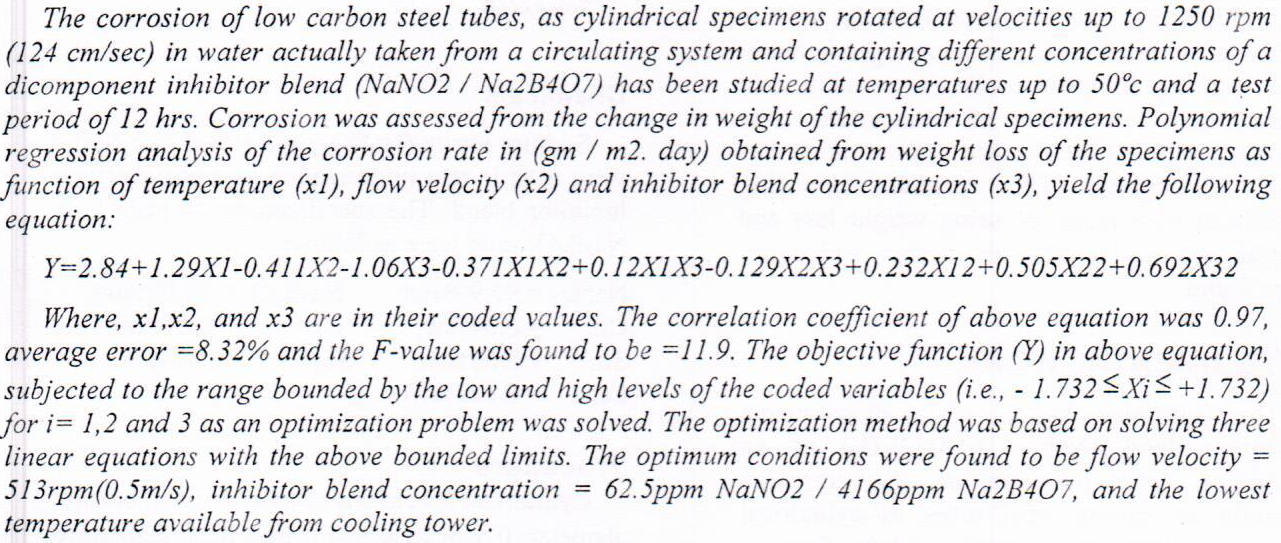
The Influence of Temperature and Flow Velocity on the Corrosion Inhibition of Low Carbon Tubes in Recirculating Water System by a Dicomponent Inhibitor Blend

 (3)
(3)
 (3)
(3)



The removal of COD from wastewater generated by petroleum refinery has been investigated by adopting electrocoagulation (EC) combined with adsorption using activated carbon (AC) derived from avocado seeds. The process variables influencing COD removal were studied: current density (2–10 mA/cm2), pH (4–9), and AC dosage (0.2–1 g/L). Response surface methodology (RSM) based on Box–Behnken design (BBD) was used to construct a mathematical model of the EC/AC process. Results showed that current density has the major effect on the COD removal with a percent of contribution 32.78% followed by pH while AC dosage has not a remarkable effect due to the good characteristics of AC derived from avocado seeds. Increasing current density gives be
... Show More
(3)
(3)
The work of this paper is an investigation to improve the condenser performance of the automobile air conditioning system by enhancing the air-side heat transfer from the condenser through the use of an air guide net installed in front of the condenser face which is basically an aluminum plate having a circular entrance shape for the air passage. The A/C system was examined under two types of test. The first test was conducted the air guide net, while the second was done with the air guide net. The performances of the A/C system under these tests were compared. For the second type of test, the experiment was carried out with three different size of air guide net, three different circular diameters (2, 3 and 3.5 cm) a
... Show More
This project sought to fabricate a flexible gas sensor based on a short functionalized multi-walled carbon nanotubes (f-MWCNTs) network for nitrogen dioxide gas detection. The network was prepared by filtration from the suspension (FFS) method and modified by coating with a layer of polypyrrole conductive polymer (PPy) prepared by the oxidative chemical polymerization to improve the properties of the network. The structural, optical, and morphological properties of the f-MWCNTs and f-MWCNTs/PPy network were studied using X-ray diffraction (XRD), Fourie-transform infrared (FTIR), with an AFM (atomic force microscopy). XRD proved that the structure of f-MWCNTs is unaffected by the synthesis procedure. The FTIR spectra verified the existence o
... Show More
(1)
(1)
(6)
(5)
(4)
The Video Assistant Referee (VAR) is a technology designed to review on- eld decisions through video footage in order to correct clear and critical refereeing errors. It enables the replay of key moments in slow motion to determine the correct naldecision,withcommunicationbetweenthevideoof cialsandtherefereeconductedviaheadset.Thesystem operates under the principle of "minimal interference, maximum bene t," intervening only in essential situations. This study aimedtoassessthecurrent implementationofVARintheIraqStarsFootballLeagueduringthe2023–2024season. To achieve this objective, the researchers employed a descriptive survey method involving a sample of 220 participants, including referees, coaches, players, assessors, academics, a
... Show More
(13)
(5)
(14)
(5)