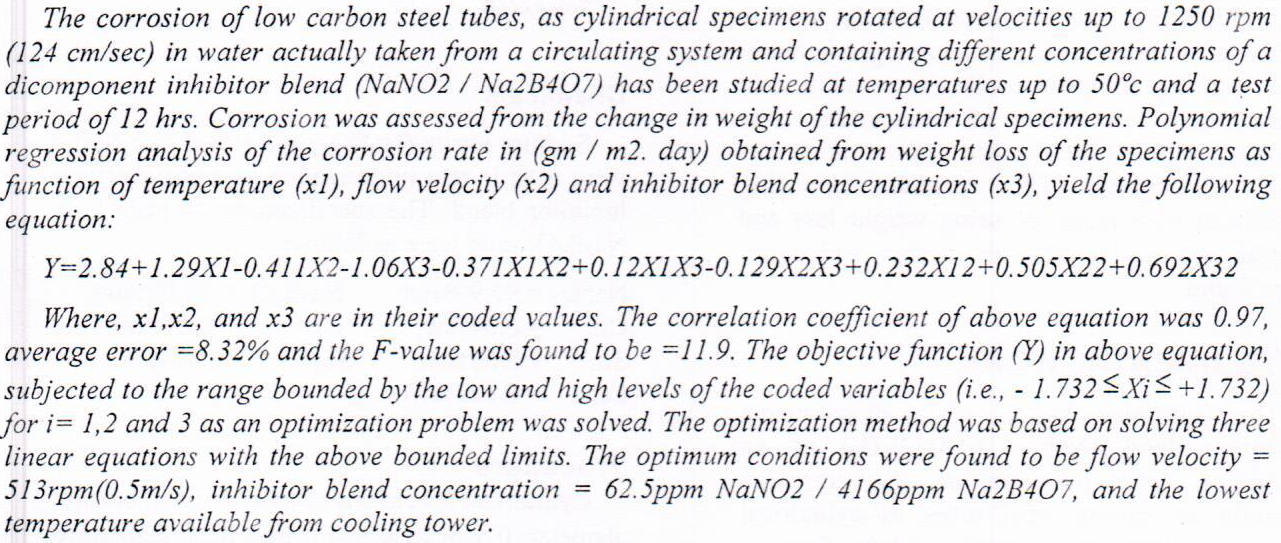
The Influence of Temperature and Flow Velocity on the Corrosion Inhibition of Low Carbon Tubes in Recirculating Water System by a Dicomponent Inhibitor Blend

Abstract. Shock chlorination is a well-known practice in swimming pools and domestic wells. One of the limitations for using this technique in drinking water purification facilities is the difficulty of quickly removing high chlorine concentrations in water distribution systems or production facilities. In order to use this method in the drinking water industry a shock de-chlorination method should be introduced for producing microorganism and biocide free water. De-chlorination using natural stagnant aeration (leaving the water to lose the chlorine naturally) is the safest known method if compared with chemical and charcoaling methods. Unfortunately, stagnant aeration is a slow process. Therefore, developing a process for accelerat
... Show More (4)
(4)

To produce Zinc Oxide NanoParticles, ZnO-NPs, different methods can be used. However, the utilization of Liquid-Phase Pulsed Laser Ablation, LP-PLA, methodology of three distinct environment of aqueous using pure zinc plate will be one of the approaches for this job. Thus, in this work, concentrates on the influence of the results after employing some changes on the environment in other words, the influence of the NPs size and/or the NPs availability/appearance. Cetyltrimethylammonium Bromide, CTAB, is one of the three surfactants that have been used in the water-based solution. That is, the Sodium Dodecyl Sulfate, SDS, besides the Distilled Water, DW, the three surfactants will be ready when the molarity of the DW is around 10− 3 M. Th
... Show More (2)
(2)
(2)
(2)


This research aims to create lightweight concrete mixtures containing waste from local sources, such as expanded polystyrene (EPS) beads and waste plastic fibers (WPFs), all are cheap or free in the Republic of Iraq and without charge. The modern, rigid, and mechanical properties of LWC were investigated, and the results were evaluated. Three mixtures were made, each with different proportions of plastic fibers (0.4%, 0.8%, 1.2%), in addition to a lightweight concrete mixture containing steak fibers (0.4%, 0.8%, 1.2%), in addition to a lightweight concrete mixture. It contains 20% EPS. The study found that the LWC caused by the addition of WPFs reduced the density (lightweight) of the concrete mixtures because EPS tends
... Show More
(4)
Carbon dioxide (CO2) flooding is an EOR technique in which carbon dioxide is injected into the reservoir to improve the oil recovery. The reservoir oil and rock properties are altered when carbon dioxide interacts with the oil and rock present in the reservoir. Carbon dioxide injection alters the oil and rock properties by causing reduction in oil viscosity, oil swelling and wettability alteration of the rock. This paper will present a proposal to study the wettability alteration in carbonate formations during miscible carbon dioxide flooding. In miscible carbon dioxide flooding, the injection pressure of carbon dioxide would be kept above the minimum miscibility pressure. Thus carbon dioxide is miscible with the oil present in the reservoi
... Show MoreMaximum power point tracking (MPPT) is used in photovoltaic (PV) systems to enhance efficiency and maximize the output power of PV module, regardless the variation of temperature, irradiation, and the electrical characteristics of the load. A new MPPT system has been presented in this research, consisting of a synchronous DC-DC step-down Buck converter controlled by an Arduino microcontroller based unit. The MPPT process with Perturb and Observe method is performed with a DC-DC converter circuit to overcome the problem of voltage mismatch between the PV modules and the loads. The proposing system has high efficiency, lower cost and can be easily modified to handle more energy sources. The test results indicate that the u
... Show MoreLaser shock peening (LSP) is deemed as a deep-rooted technology for stimulating compressive residual stresses below the surface of metallic elements. As a result, fatigue lifespan is improved, and the substance properties become further resistant to wear and corrosion. The LSP provides more unfailing surface treatment and a potential decrease in microstructural damage. Laser shock peening is a well-organized method measured up to the mechanical shoot peening. This kind of surface handling can be fulfilled via an intense laser pulse focused on a substantial surface in extremely shorter intervals. In this work, Hydrofluoric Acid (HF) and pure water as a coating layer were utilized as a new technique to improve the properti
... Show MoreElection study included four sites for the waters in area of Youssifiyah south of Baghdad (river water, tank water, liquefactions water, and water filtrate and seethed and purifier by alum and chloride), the samples were collected during the month of June in 2007. Temperature, electrical conductivity and acidity are measured. Also , the concentration of chloride , sulphate , carbonate , nitrate , sodium , calcium , magnesium , hard total and total dissolved substances are determined , as well as heavy metals assess environmental risk (such as Cu, Pb, Zn, Fe). It was also a study of bacterial totals included both total Bacteria (TB) and Total Coliform Bacteria (TC) and Fecal Coliform (FC) and Fecal Streptococci (FS). The stu
... Show More
This article discusses how women have significant abilities to cope with the difficulties of war times. They are not the weak and vulnerable victims who are thought to be. On the contrary, they have the power to control over many-sided fronts, like participating in the battlefield as nurses or activists for peace, or even fighters, as well as through the tasks and responsibilities assigned to them to protect and support their families during wartime. The researcher will examine the impact of war upon women. Like men, women suffer during wartime. They are being injured, tortured and killed. Yet, they are able to give examples of love and courage even in the difficult times of war. Hana is one of those women who lived during wartimes,
... Show More
In this research, the mechanism of cracks propagation for epoxy/ chopped carbon fibers composites have been investigated .Carbon fibers (5%, 10%, 15%, and 20%) by weight were used to reinforce epoxy resin. Bending test was carried out to evaluate the flexural strength in order to explain the mechanism of cracks propagation. It was found that, the flexural strength will increase with increasing the percentage weight for carbon fibers. At low stresses, the cracks will state at the lower surface for the specimen. Increasing the stresses will accelerate the speed of cracks until fracture accorded .The path of cracks is changed according to the distributions of carbon fibers
